 Back
BackMagnetic Fields and Magnetic Forces: Study Notes
Study Guide - Smart Notes
 Tailored notes based on your materials, expanded with key definitions, examples, and context.
Magnetic Fields and Magnetic Forces
Magnetic Field Lines
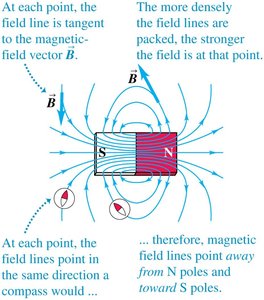
Magnetic fields are visualized using magnetic field lines, which indicate the direction and strength of the field. At each point, the tangent to a field line gives the direction of the magnetic field vector B. The density of lines represents the field's strength: the closer the lines, the stronger the field. Field lines never intersect, and they point away from the north pole and toward the south pole of a magnet.
Direction: At each point, the field lines point in the same direction a compass would.
Field Strength: The more densely packed the lines, the stronger the field at that location.
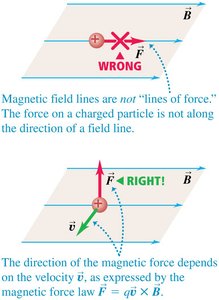
Field Lines and Force: The force on a charged particle is not along the direction of a field line, but depends on the velocity of the particle and the field direction.
Magnetic Field of a Straight Current-Carrying Wire
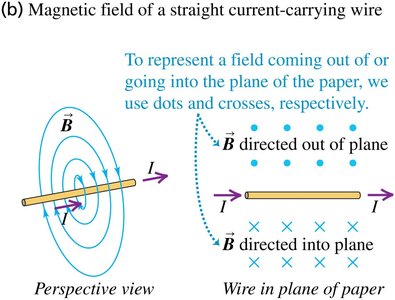
A current-carrying wire produces a magnetic field that forms concentric circles around the wire. The direction of the field is given by the right-hand rule: if the thumb points in the direction of the current, the fingers curl in the direction of the magnetic field.
Field Representation: Dots (•) indicate field out of the plane; crosses (×) indicate field into the plane.
Field Direction: Determined by the right-hand rule for straight conductors.
Visualizing Magnetic Fields with Iron Filings
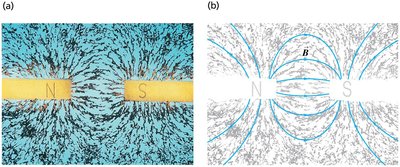
Iron filings align themselves along magnetic field lines, making the invisible field visible. This experiment demonstrates the pattern of field lines between two poles of a magnet.
Field Visualization: Iron filings act like tiny compass needles, aligning with the field.
Field Patterns: The observed pattern matches the theoretical drawing of field lines.
Magnetic Flux
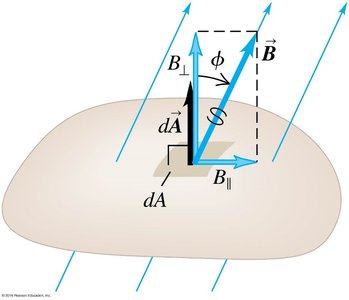
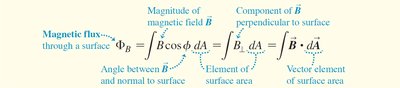
Magnetic flux (ΦB) quantifies the total magnetic field passing through a given area. It is analogous to electric flux in electrostatics. The SI unit of magnetic flux is the weber (Wb), where 1 Wb = 1 T·m2.
Definition: Magnetic flux through a surface is given by:
Angle: is the angle between the magnetic field and the normal to the surface.
Gauss's Law for Magnetism
Gauss's law for magnetism states that the net magnetic flux through any closed surface is zero. This reflects the fact that magnetic monopoles have not been observed in nature; magnetic field lines always form closed loops.
Mathematical Statement:

Motion of Charged Particles in a Magnetic Field
Force on a Moving Charge
A charged particle moving in a magnetic field experiences a force given by the Lorentz force law:
Direction: The force is always perpendicular to both the velocity and the magnetic field.
Effect: The force does not change the speed of the particle, only its direction.
Circular and Helical Motion
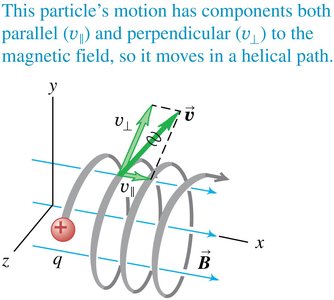
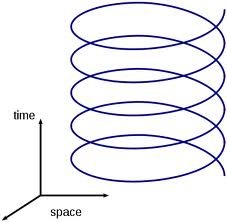
If the velocity of the particle is perpendicular to the magnetic field, the particle moves in a circle. If there is a component of velocity parallel to the field, the path becomes helical.
Radius of Circular Path:
Period of Revolution:
Cyclotron Frequency:
Helical Motion: The parallel component of velocity causes the particle to move along the field while circling around it.
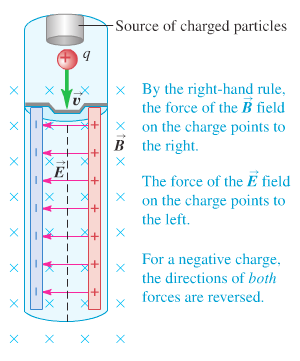
Motion in Combined Electric and Magnetic Fields
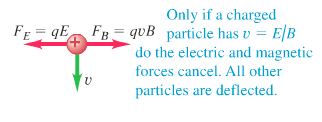
When both electric and magnetic fields are present, the total force on a charged particle is:
Velocity Selector: Only particles with velocity pass through undeflected, as the electric and magnetic forces cancel.
Magnetic Force on a Current-Carrying Conductor
Force on a Straight Conductor
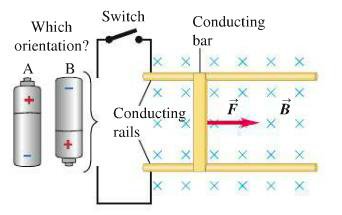
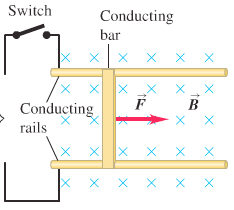
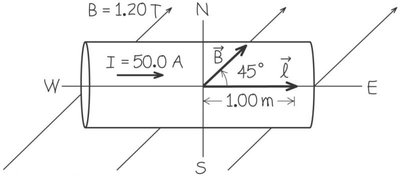
A current-carrying conductor in a magnetic field experiences a force given by:
Direction: Determined by the right-hand rule for the cross product.
Magnitude: , where is the angle between the conductor and the field.
Force on a Conductor at an Angle
When a conductor is placed at an angle to the magnetic field, the force is calculated using the vector cross product. The direction and magnitude depend on the orientation of the current and the field.
Force on a Shaped Conductor
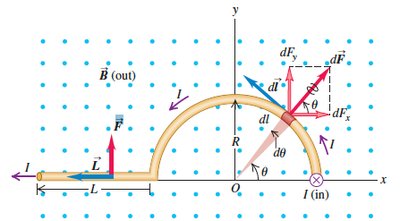
For conductors with bends or curves, the total force is the vector sum of the forces on each segment. For a semicircular segment, integration is used to find the net force.
Straight Segments: for each straight part.
Curved Segments: Integrate over the curve.
Total Force: Sum all components to find the net force.
Torque on a Current Loop and Applications
Torque on a Current Loop
A current loop in a magnetic field experiences a torque that tends to align the loop's magnetic moment with the field. The torque is given by:
Magnetic Moment: , where is the area of the loop.
Potential Energy:
Direct Current (DC) Motor
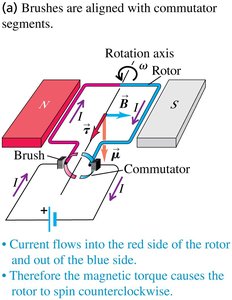
A DC motor uses the torque on a current-carrying loop in a magnetic field to produce rotational motion. The commutator ensures that the torque always acts in the same rotational direction, causing continuous rotation.
Example: Rectangular Coil in a Magnetic Field
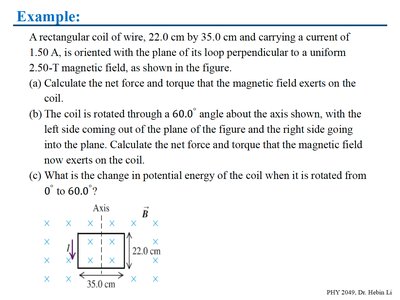
Consider a rectangular coil of wire carrying current in a uniform magnetic field. The net force, torque, and change in potential energy can be calculated as the coil is rotated in the field.
Net Force: Zero for a closed loop in a uniform field.
Torque:
Potential Energy Change:
Summary Table: Key Equations and Concepts
Concept | Equation | Description |
|---|---|---|
Magnetic Flux | Total field through a surface | |
Gauss's Law for Magnetism | No magnetic monopoles | |
Lorentz Force | Force on moving charge | |
Force on Conductor | Force on current-carrying wire | |
Radius of Circular Motion | Charged particle in uniform field | |
Torque on Loop | Current loop in field | |
Magnetic Moment | Loop's magnetic strength | |
Potential Energy | Energy of loop in field |
