 Back
BackMagnetic Fields and Their Effects on Charges and Currents
Study Guide - Smart Notes
 Tailored notes based on your materials, expanded with key definitions, examples, and context.
Magnetic Fields and Magnetism
Introduction to Magnetism
Magnetism is a fundamental interaction that arises from the motion of electric charges. It is closely related to electricity and is described in terms of magnetic fields, which exert forces on moving charges and magnetic materials.
Magnetic Field (\(\vec{B}\)): A region of space where a moving charge experiences a force due to magnetism.
Magnetic Poles: All magnets have two poles—north and south. Magnetic monopoles (isolated poles) do not exist; all magnets are dipoles.
Source of Magnetic Fields: Magnetic fields are produced by moving charges, such as electric currents.
Magnetic Materials: Materials like iron exhibit magnetism due to the intrinsic magnetic dipole moment of electrons, known as electron spin.
Important Magnetic Field Models
Three main models are used to describe magnetic fields in physics:
Uniform Magnetic Field: The field strength and direction are constant throughout a region.
Field of a Straight Current-Carrying Wire: The magnetic field forms concentric circles around the wire.
Field of a Current Loop or Solenoid: The field inside is strong and uniform, while outside it is weaker and resembles a bar magnet.
Additional info: These models help in understanding the behavior of magnetic fields in practical applications such as electromagnets and electric motors.
Forces on Charges and Currents in Magnetic Fields
Force on a Moving Charge
A charged particle moving in a magnetic field experiences a force that is always perpendicular to both its velocity and the magnetic field direction. This is described by the Lorentz force law:
Lorentz Force:
Direction: Determined by the right-hand rule for positive charges.
Circular Motion: In a uniform magnetic field, the force causes the particle to move in a circular path, known as cyclotron motion.
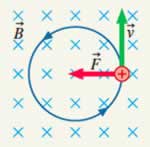
Radius of Circular Path:
Frequency of Revolution (Cyclotron Frequency):
Applications: Cyclotron motion is fundamental in devices like cyclotrons (particle accelerators) and in understanding the behavior of charged particles in Earth's magnetosphere.
Force on a Current-Carrying Wire
Since electric current is a flow of charges, a current-carrying wire in a magnetic field also experiences a force:
Force on a Straight Wire: , where is current and is the length vector in the direction of current.
Interaction Between Wires: Two parallel current-carrying wires exert attractive or repulsive forces on each other, depending on the direction of currents.
Torque on a Current Loop: A current loop in a magnetic field experiences a torque, which is the principle behind electric motors.
Applications and Importance of Magnetism
Technological and Natural Significance
Magnetism is essential in both technology and nature:
Motors and Generators: Operate based on magnetic forces and electromagnetic induction.
Data Storage: Hard disks and magnetic stripes use magnetic domains to store information.
Medical Imaging: Magnetic Resonance Imaging (MRI) relies on strong magnetic fields to visualize internal body structures.
Magnetic Levitation: Used in high-speed trains for frictionless movement.
Earth's Magnetic Field: Protects the planet from solar wind and cosmic radiation, making life possible.
