 Back
BackMagnetic Fields and Their Sources: Study Notes Ch 29
Study Guide - Smart Notes
 Tailored notes based on your materials, expanded with key definitions, examples, and context.
Magnetic Fields: Sources and Properties
Introduction to Magnetic Fields
Magnetic fields are fundamental to understanding the behavior of moving charges and currents in physics. They are produced by moving electric charges and exert forces on other moving charges, leading to a variety of important physical phenomena.
All charges create electric fields, but only moving charges create magnetic fields.
Stationary charges are unaffected by magnetic fields; only moving charges experience magnetic forces.
Electric vs. Magnetic Field Lines
Field lines are a visual tool to represent the direction and strength of electric and magnetic fields.
Electric field lines start at positive charges and end at negative charges, indicating the direction of force on a positive test charge.
Magnetic field lines emerge from the north pole of a magnet and enter the south pole. Unlike electric field lines, magnetic field lines never terminate; they form closed loops.
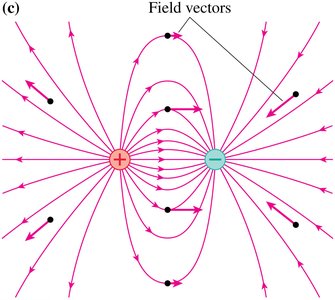
Magnetic Field Lines Around Magnets and Currents
Magnetic field lines can be visualized around bar magnets, current-carrying wires, and loops.
Field lines outside a bar magnet run from north to south; inside, they run from south to north, forming closed loops.
For a current-carrying loop, the field lines pass through the center and loop around the outside.
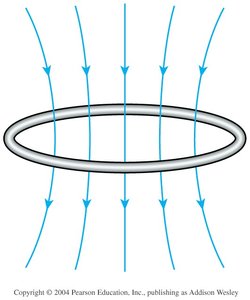
Magnetic Field Due to Moving Charges and Currents
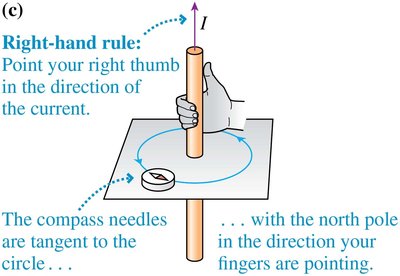
Right-Hand Rule for Currents
The right-hand rule is a mnemonic for determining the direction of the magnetic field around a current-carrying wire.
Point your right thumb in the direction of the current; your fingers curl in the direction of the magnetic field lines.
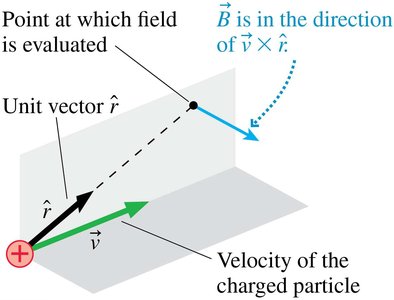
Magnetic Field of a Moving Point Charge
A moving point charge generates a magnetic field described by the Biot-Savart Law:
The direction of the field is given by the cross product of the velocity vector and the unit vector pointing from the charge to the field point.
q: charge
\vec{v}: velocity of the charge
r: distance from the charge to the field point
\hat{r}: unit vector from the charge to the field point
\mu_0: permeability of free space ( T·m/A)
Magnetic Field Due to a Current-Carrying Wire
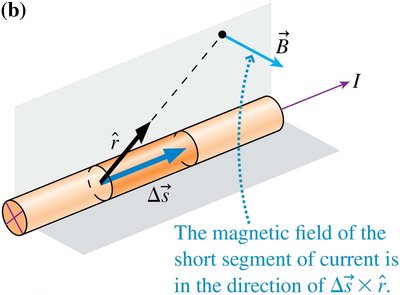
The Biot-Savart Law also applies to current elements:
I: current
\Delta \vec{s}: vector length of the wire segment
\hat{r}: unit vector from the segment to the field point
Magnetic Field of a Long Straight Wire
For a long, straight wire, the magnetic field at a distance r from the wire is:
The field forms concentric circles around the wire, with direction given by the right-hand rule.
Magnetic Field of a Circular Current Loop
The magnetic field at the center of a circular loop of radius R carrying current I is:
On the axis of the loop, the field decreases with distance from the center.
Magnetic Field of a Solenoid
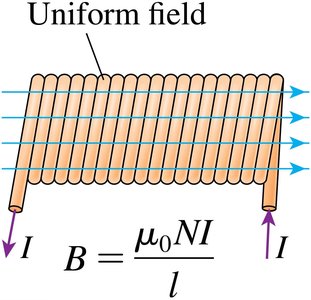
A solenoid is a coil of wire with many turns. The field inside a long solenoid is uniform and given by:
N: number of turns
l: length of the solenoid
Magnetic Forces and Motion
Lorentz Force Law
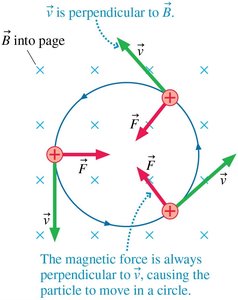
The force on a moving charge in a magnetic field is given by the Lorentz force law:
The force is perpendicular to both the velocity and the magnetic field.
This causes charged particles to move in circular or helical paths in uniform magnetic fields.
Cyclotron Motion
When a charged particle moves perpendicular to a uniform magnetic field, it undergoes circular motion with:
Radius:
Frequency:
Magnetic Dipoles and Materials
Magnetic Dipole Moment
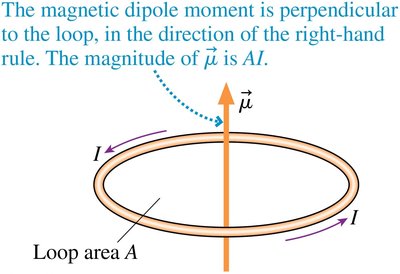
A current loop acts as a magnetic dipole with a magnetic moment:
I: current
\vec{A}: area vector perpendicular to the loop
Magnetic Properties of Materials
Materials respond differently to magnetic fields based on their atomic structure:
Ferromagnetic materials (e.g., iron) have domains where atomic magnetic moments align, resulting in strong magnetization.
In the absence of an external field, domains are randomly oriented, so the net magnetization is zero.
Applying a magnetic field aligns domains, increasing the material's net magnetic moment.
Summary Table: Key Magnetic Field Models
Source | Field Equation | Field Direction |
|---|---|---|
Long straight wire | Circular, right-hand rule | |
Circular loop | (center) | Along axis of loop |
Solenoid | Uniform inside, parallel to axis |
Applications and Examples
Magnetic force on a wire:
Torque on a current loop:
Hall Effect: Used to measure the sign and density of charge carriers in a conductor.
Example: The force on a rectangular current loop in a uniform magnetic field can produce a torque but not a net force, depending on the orientation of the loop relative to the field.
Additional info: The atomic origin of magnetism is due to both the orbital motion and intrinsic spin of electrons, leading to the observed macroscopic magnetic properties of materials.
