 Back
BackMagnetic Fields, Forces, and Electromagnetic Induction: Study Notes
Study Guide - Smart Notes
 Tailored notes based on your materials, expanded with key definitions, examples, and context.
Magnetic Fields and Their Sources
Magnetic Field from Current-Carrying Wires
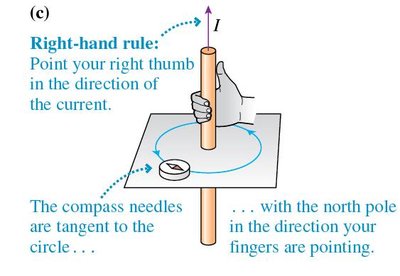
The magnetic field generated by a current-carrying wire is fundamental to electromagnetism. The direction of the field can be determined using the right-hand rule, and the field forms concentric circles around the wire.
Right-Hand Rule: Point your thumb in the direction of the current; your fingers curl in the direction of the magnetic field lines.
Compass Response: A compass placed near a current-carrying wire aligns tangentially to the magnetic field lines.
Equation for a Long Straight Wire:
Superposition Principle: The net magnetic field from multiple sources is the vector sum of individual fields.

Magnetic Field from Moving Charges
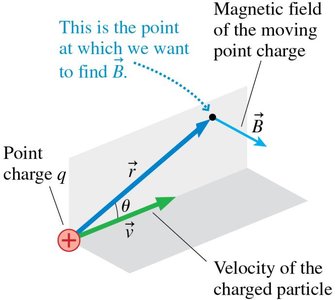
A moving charge produces a magnetic field, whose magnitude and direction depend on the charge's velocity and position relative to the observation point.
Biot-Savart Law for Point Charge:
Vector Form:
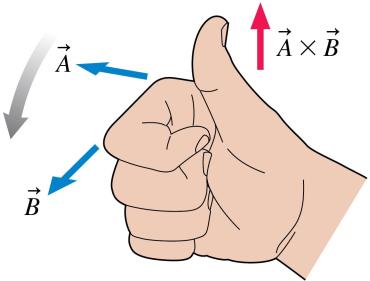
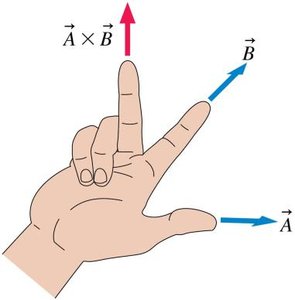
Direction: Determined by the right-hand rule for cross products.
Magnetic Fields from Current Loops and Dipoles
Current Loops and Magnetic Dipoles
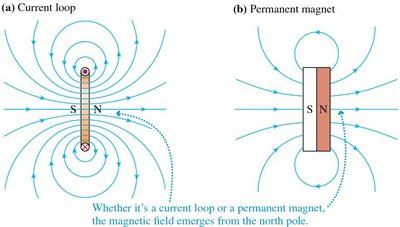
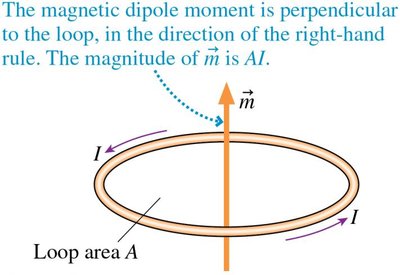
Current loops generate magnetic fields similar to those of permanent magnets. The magnetic dipole moment is a vector quantity associated with the loop.
Magnetic Dipole Moment: (where is area, is current)
Field on Axis:
Direction: From south to north pole of the dipole.
Ampère’s Law and Solenoids
Ampère’s Law
Ampère’s law relates the magnetic field around a closed loop to the current passing through the loop.
Ampère’s Law:
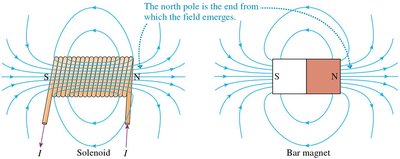
Solenoid Magnetic Field: (where is windings per unit length)
Magnetic Forces
Force on Moving Charges
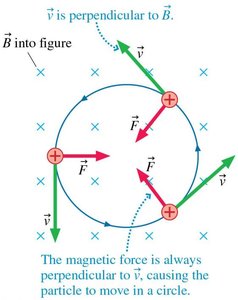
A charged particle moving in a magnetic field experiences a force perpendicular to both its velocity and the field.
Magnetic Force:
Vector Form:
Circular Motion: If velocity is perpendicular to , the particle moves in a circle of radius
Force on Current-Carrying Wires
Wires carrying current in a magnetic field experience a force, which can be calculated using the cross product.
Force on Wire:
Vector Form:
Electromagnetic Induction
Faraday’s Law and Lenz’s Law
Changing magnetic flux induces an emf in a loop, and the direction of induced current opposes the change in flux (Lenz’s law).
Faraday’s Law:
Lenz’s Law: Induced current creates a magnetic field opposing the change in flux.
Magnetic Flux:
Motional emf
Motional emf:
Maxwell’s Equations
Summary of Maxwell’s Equations
Maxwell’s equations unify electricity and magnetism, describing how electric and magnetic fields are generated and altered by charges and currents.
Gauss’s Law:
Gauss’s Law for Magnetism:
Faraday’s Law:
Ampère-Maxwell Law:
Fundamentals of Circuits
Circuit Elements and Diagrams
Basic circuit elements include batteries, wires, resistors, bulbs, junctions, capacitors, and switches. Circuit diagrams use standardized symbols to represent these elements.
Batteries: Provide emf by chemical reactions.
Resistors: Cause energy loss due to collisions.
Bulbs: Resistors that emit light.
Capacitors: Store charge separation.
Kirchoff’s Laws:
Junction Rule:
Loop Rule:
Table: Comparison of Magnetic Field Formulas
Source | Formula | Key Parameters |
|---|---|---|
Long Straight Wire | Current , distance | |
Current Loop (center) | Turns , current , radius | |
Solenoid | Windings per length , current | |
Point Charge | Charge , velocity , angle , distance |
