 Back
BackMagnetic Fields, Induction, and Electromagnetic Oscillations
Study Guide - Smart Notes
 Tailored notes based on your materials, expanded with key definitions, examples, and context.
Magnetic Fields Due to Currents
Biot-Savart Law
The Biot-Savart Law describes the magnetic field produced at a point by a small segment of current-carrying wire. The law is fundamental for calculating the magnetic field generated by arbitrary current distributions.
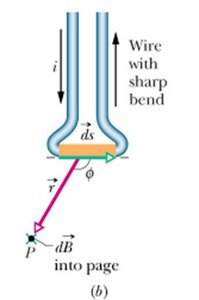
Formula: The infinitesimal magnetic field d\vec{B} at a point due to a current element i d\vec{s} is given by: where \( \vec{r} \) is the vector from the current element to the point of interest, and \( \mu_0 \) is the permeability of free space.
Direction: Determined by the right-hand rule for the cross product.
Applications: Used to find the field at the center of a loop, along the axis of a solenoid, or near a straight wire.
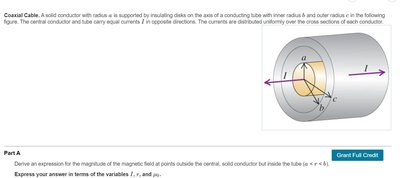
Magnetic Field of a Coaxial Cable
A coaxial cable consists of a central conductor and a surrounding conducting tube, each carrying equal but opposite currents. The magnetic field at a point between the conductors can be found using Ampère's Law.
Key Variables: a = radius of central conductor, b = inner radius of tube, c = outer radius of tube, I = current.
Field Calculation: For a < r < b (between the conductors): where r is the radial distance from the axis.
Physical Meaning: The field is azimuthal (circles the axis) and depends only on the enclosed current.
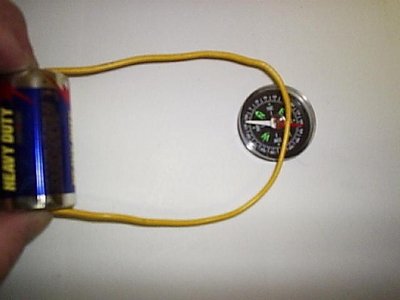
Magnetic Field Around a Straight Wire
A current-carrying wire produces a magnetic field that forms concentric circles around the wire. The direction is given by the right-hand rule.
Formula: where R is the distance from the wire.
Demonstration: A compass placed near a current-carrying wire will deflect, showing the presence of the magnetic field.
Ampère's Law
Statement and Application
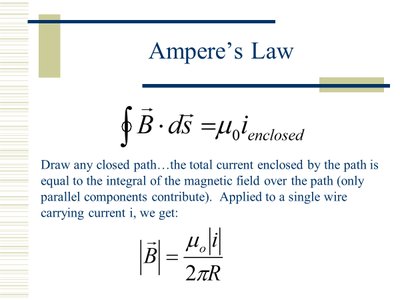
Ampère's Law relates the integrated magnetic field around a closed loop to the total current passing through the loop. It is especially useful for systems with high symmetry (e.g., straight wires, solenoids, toroids).
Mathematical Form:
Application: For a long straight wire, the field at distance R is:
Physical Interpretation: Only the current enclosed by the chosen path contributes to the integral.
Magnetic Forces and Induction
Force on Moving Charges
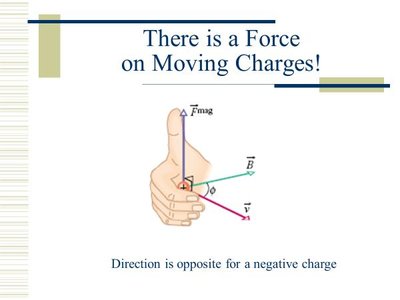
Charged particles moving in a magnetic field experience a force perpendicular to both their velocity and the magnetic field, described by the Lorentz force law.
Formula:
Direction: Right-hand rule for positive charges; opposite for negative charges.
Magnetic Force on a Current-Carrying Loop
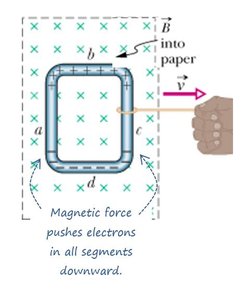
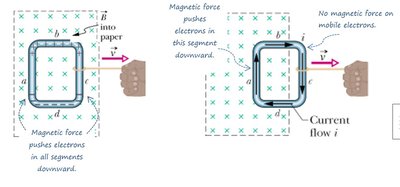
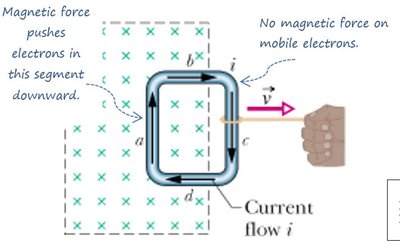
A current-carrying loop in a magnetic field experiences forces on its segments, which can result in a net torque or induced current depending on the configuration and motion.
Example: Moving a rectangular loop into a magnetic field induces a current due to the force on the charges.
Direction of Induced Current: Determined by Lenz's Law (opposes the change in magnetic flux).
Electromagnetic Induction
Faraday's Law and Lenz's Law
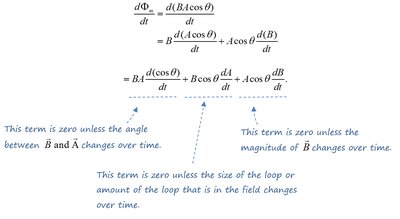
Faraday's Law states that a changing magnetic flux through a loop induces an electromotive force (emf) in the loop. Lenz's Law gives the direction of the induced emf: it always opposes the change in flux.
Faraday's Law: where is the magnetic flux.
Lenz's Law: The induced current creates a magnetic field that opposes the change in the original magnetic flux.
Ways to Change Flux:
Change the magnetic field strength (B)
Change the area of the loop (A)
Change the orientation (angle) between B and A
Induced Electric Fields
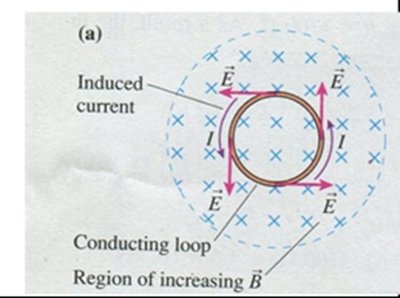
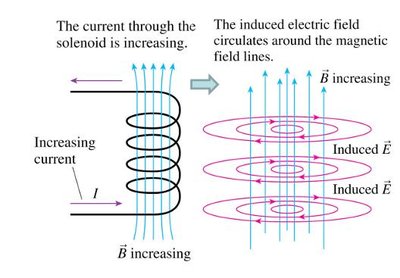
A changing magnetic field induces an electric field, even in the absence of a conductor. The induced electric field forms closed loops, unlike the field from static charges.
Maxwell-Faraday Equation:
Field Lines: Induced electric field lines are closed loops, not starting or ending on charges.
Maxwell's Equations and Electromagnetic Waves
Maxwell's Equations (Integral Form)
Maxwell's equations summarize the fundamental laws of electricity and magnetism, including the effects of changing fields and the existence of electromagnetic waves.
Gauss's Law for Electricity:
Gauss's Law for Magnetism:
Faraday's Law of Induction:
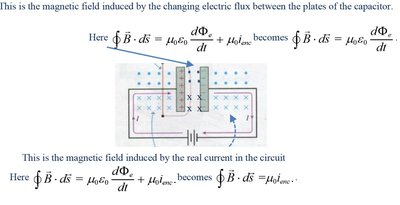
Ampère-Maxwell Law:
Electromagnetic Waves
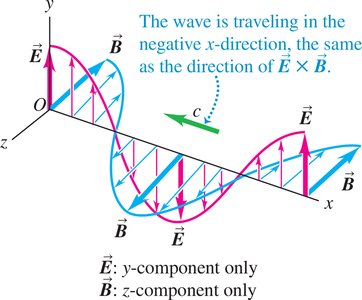
Maxwell's equations predict that changing electric and magnetic fields propagate as waves through space. These waves travel at the speed of light and form the basis of electromagnetic radiation.
Wave Properties: Electric and magnetic fields are perpendicular to each other and to the direction of propagation.
Speed of Light:
Electromagnetic Oscillations and Circuits
LC and LCR Circuits
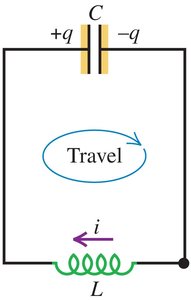
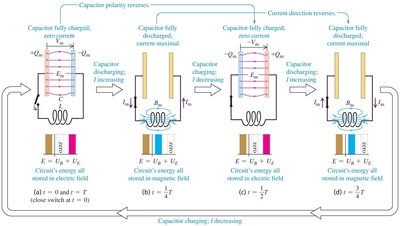
Circuits containing inductors (L) and capacitors (C) can exhibit oscillatory behavior, analogous to mass-spring systems in mechanics. Adding resistance (R) leads to damped oscillations.
LC Circuit: Energy oscillates between the electric field of the capacitor and the magnetic field of the inductor.
Frequency of Oscillation:
LCR Circuit: The presence of resistance causes the oscillations to decay over time (damping).
Inductors and Self-Inductance
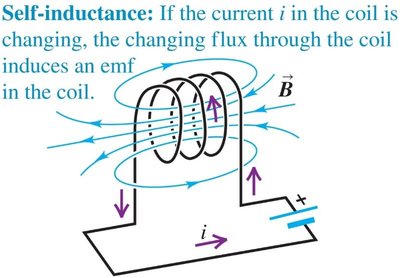
An inductor resists changes in current by inducing an emf that opposes the change. The property of self-inductance is quantified by the inductance L.
Induced emf:
Physical Meaning: The induced emf always acts to oppose the change in current (Lenz's Law).
RL Circuits: Current Growth and Decay
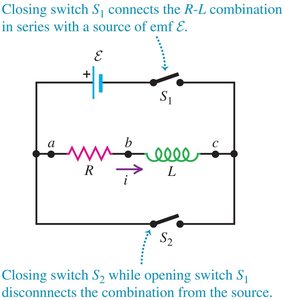
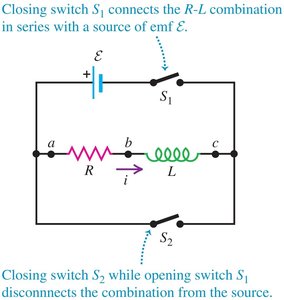
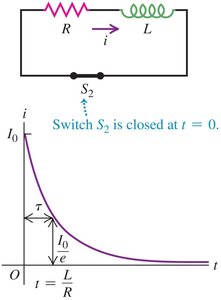
When a circuit containing a resistor (R) and inductor (L) is connected to a voltage source, the current does not immediately reach its maximum value but increases gradually. When disconnected, the current decays exponentially.
Current Growth: , where
Current Decay:
Inductors as Current Chokes
Inductors resist rapid changes in current, acting as 'chokes' in circuits. This property is used in filtering and timing applications.
Key Point: The greater the inductance, the slower the current changes.
Summary Table: Mass-Spring vs. LC Circuit
The mathematical analogy between mechanical oscillators (mass-spring) and electrical oscillators (LC circuit) is summarized below:
Quantity | Mass-Spring System | LC Circuit |
|---|---|---|
Kinetic Energy | ||
Potential Energy | ||
Angular Frequency | ||
General Solution |
*Additional info: Table structure inferred from standard physics analogies.*
