 Back
Magnetic Fields of Charged Particles in Motion: Sources, Laws, and Applications
Study Guide - Smart Notes
 Tailored notes based on your materials, expanded with key definitions, examples, and context.
Magnetic Fields of Charged Particles in Motion
Introduction to Magnetism and Its Sources
Magnetism arises fundamentally from the motion of charged particles. All magnetic phenomena, whether in materials or in free space, can be traced to moving charges, including electric currents and spinning charged particles.
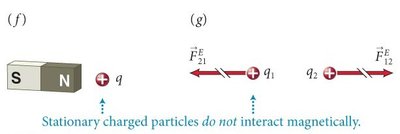
Key Point 1: Magnetic fields are produced by moving electric charges, not by stationary charges.
Key Point 2: Magnetic interactions depend on the state of motion of the charged particles.
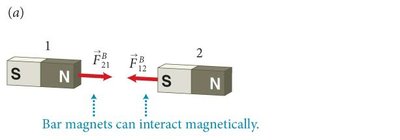
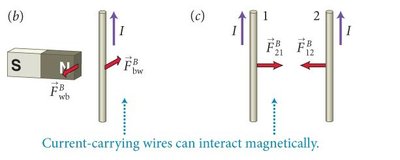
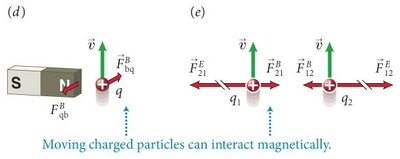
Example: Bar magnets, current-carrying wires, and moving charged particles all exhibit magnetic interactions, while stationary charges do not.
Magnetic Field Patterns: Wires and Moving Charges
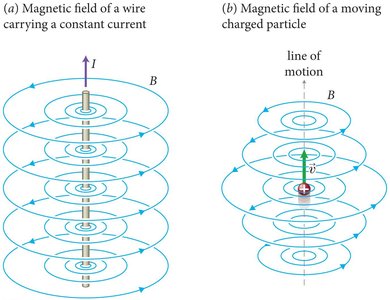
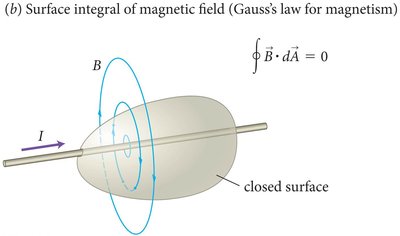
The magnetic field produced by a straight wire carrying a constant current exhibits cylindrical symmetry, forming concentric circles around the wire. In contrast, the field produced by a moving charged particle lacks this symmetry.
Key Point 1: The direction of the magnetic field around a wire is given by the right-hand rule: curl your fingers in the direction of current, and your thumb points in the direction of the field.
Key Point 2: The field lines for a moving charged particle are also circular but are centered on the line of motion.
Example: The field around a wire and a moving charge are illustrated below.
Current Loops and Spin Magnetism
Magnetic Fields from Current Loops
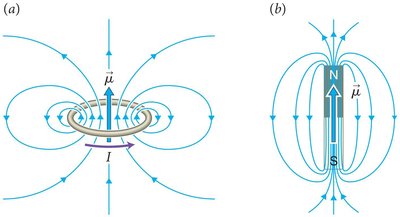
A wire bent into a loop carrying a constant current produces a magnetic field whose lines reinforce each other inside the loop, pointing in the same direction. The field pattern resembles that of a magnetic dipole.
Key Point 1: The magnetic field inside a current loop is strongest and most uniform at the center.
Key Point 2: The field pattern of a current loop is similar to that of a dipole.
Example: The right-hand rule for loops: curl your fingers in the direction of current, and your thumb points in the direction of the magnetic dipole moment.
Spin Magnetism
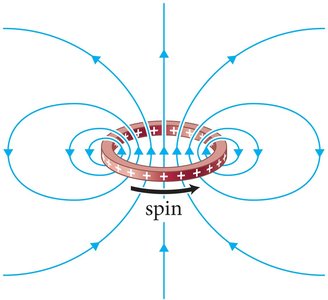
A spinning charged particle produces a magnetic field identical to that of an infinitesimally small magnetic dipole. This is the basis for atomic and subatomic magnetism.
Key Point 1: The magnetic field of a spinning charged particle is a dipole field.
Example: The field lines for a spinning ring of charge are shown below.
Magnetic Dipole Moment and Torque
Definition and Orientation of Magnetic Dipole Moment
The magnetic dipole moment (\vec{\mu}) is a vector that specifies the orientation and magnitude of a magnetic dipole. For a current loop, \vec{\mu} points in the direction of the magnetic field at the center of the loop.
Key Point 1: The direction of \vec{\mu} is determined by the right-hand rule.
Key Point 2: The dipole moment aligns with the external magnetic field when placed in it.
Example: For a bar magnet, \vec{\mu} points from the south pole to the north pole.
Torque on a Current Loop in a Magnetic Field
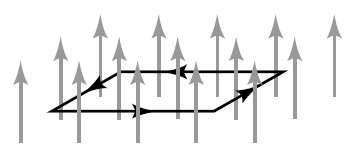
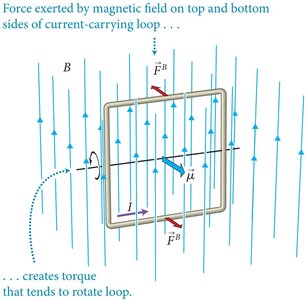
A current loop placed in a magnetic field experiences a torque that tends to align its magnetic dipole moment with the field. The torque is given by:
Key Point 1: The torque \vec{\tau} is given by .
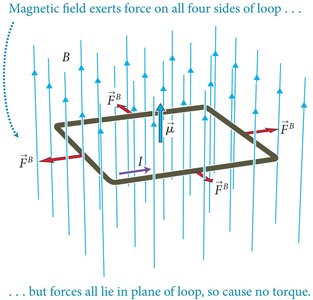
Key Point 2: When \vec{\mu} is perpendicular to \vec{B}, the torque is maximized; when parallel, there is no torque.
Example: The forces on the sides of a rectangular loop in a uniform magnetic field create a torque.
Ampère’s Law and Ampèrian Paths
Line Integrals and Ampère’s Law
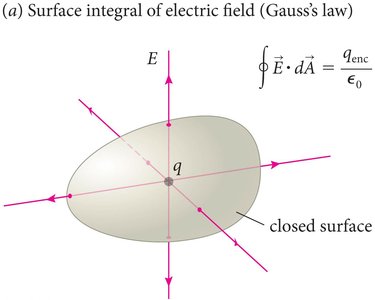
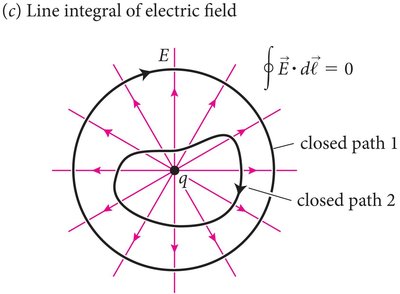
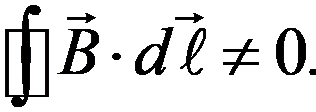
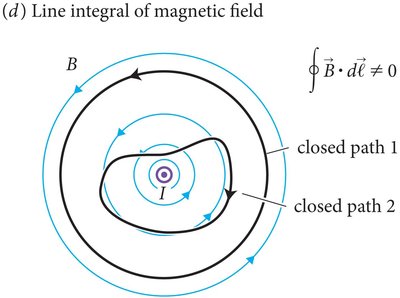
Ampère’s law relates the line integral of the magnetic field around a closed path (Ampèrian path) to the current enclosed by the path:
Key Point 1: The line integral of the magnetic field around a closed path is proportional to the enclosed current.
Key Point 2: The value of the integral is independent of the shape of the path, as long as it encloses the current.
Formula:
Example: For a straight wire, the integral around any concentric circular path is the same.
Calculating Magnetic Fields Using Ampère’s Law
Ampère’s law is a powerful tool for calculating magnetic fields in cases with high symmetry, such as straight wires, solenoids, and toroids.
Key Point 1: For a long straight wire, , where r is the radial distance from the wire.
Key Point 2: For a large current-carrying sheet, , where K is the current per unit width.
Example: The field inside a solenoid is uniform and given by , where n is the number of windings per unit length.
Solenoids and Toroids
Magnetic Field in Solenoids
A solenoid is a long, tightly wound coil of wire. The magnetic field inside an infinitely long solenoid is uniform and parallel to the axis, while outside the field approaches zero.
Key Point 1: The field inside is given by .
Key Point 2: The field outside is negligible for an infinitely long solenoid.
Example: The field lines inside a solenoid are parallel to its axis.
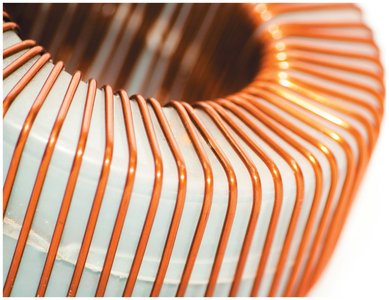
Magnetic Field in Toroids
A toroid is a solenoid bent into a circle. The magnetic field is contained within the windings and forms circles around the center of the toroid.
Key Point 1: The field inside a toroid at radius r is , where N is the total number of windings.
Example: The field at the center of a square toroid is calculated using the same principles as for a circular toroid.
Biot-Savart Law: Magnetic Fields from Current Distributions
Biot-Savart Law for Wires and Moving Charges
The Biot-Savart law provides a general method for calculating the magnetic field produced by any current distribution:
Key Point 1: The law states , where is a segment of the wire, is the unit vector from the segment to the observation point, and r is the distance.
Key Point 2: For a moving charged particle, .
Example: The field at the center of a circular arc of wire is , where is the angle subtended and R is the radius.
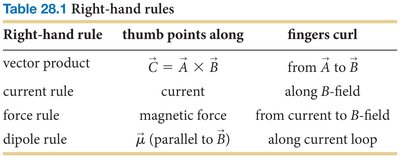
Summary Table: Right-Hand Rules in Magnetism
Right-hand rule | Thumb points along | Fingers curl |
|---|---|---|
Vector product | from to | |
Current rule | current | along B-field |
Force rule | magnetic force | from current to B-field |
Dipole rule | (parallel to ) | along current loop |
Summary of Key Equations
Ampère’s Law:
Magnetic Field of a Straight Wire:
Magnetic Field of a Solenoid:
Magnetic Field of a Toroid:
Biot-Savart Law:
Magnetic Field of a Moving Charge:
Applications and Examples
Electric Motors: The alignment of the magnetic dipole moment in current loops is the operating principle behind electric motors.
Magnetic Force Between Wires: Parallel wires carrying currents exert magnetic forces on each other, which can be attractive or repulsive depending on the direction of currents.
Magnetic Field Detection: Compass needles placed near current-carrying wires or loops deflect according to the strength and direction of the magnetic field.
Additional info: The notes above expand on the original slides by providing full academic context, definitions, and formulas, ensuring completeness and clarity for exam preparation.
