 Back
BackMagnetic Fields: Physics Study Notes (A-Level/College)
Study Guide - Smart Notes
 Tailored notes based on your materials, expanded with key definitions, examples, and context.
Magnetic Fields
Concept of a Magnetic Field
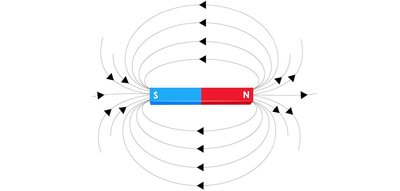
Magnetic fields are regions where magnetic forces can be observed, arising from the motion of electric charges or from permanent magnets. The direction of magnetic field lines is conventionally drawn from the north pole to the south pole of a magnet. These field lines visually represent the strength and direction of the magnetic field.
Magnetic field lines: Indicate the direction and strength of the field; denser lines mean stronger fields.
Permanent magnets: Materials that produce their own persistent magnetic field.
Direction convention: Field lines go from north to south outside the magnet.
Example: Bar magnets and Earth's magnetic field.
Force on a Current-Carrying Conductor
When a conductor carrying current is placed in a magnetic field, it experiences a force due to the interaction between the moving charges and the field. The magnitude of this force depends on the current, the length of the conductor, the magnetic flux density, and the angle between the current and the field.
Formula:
Magnetic flux density (B): Measured in teslas (T), it quantifies the strength of the magnetic field.
Fleming’s Left Hand Rule: Used to determine the direction of force, current, and field.
Maximum force: Occurs when current and field are perpendicular ().
Force on a Moving Charge
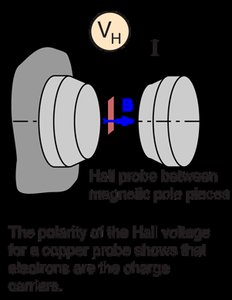
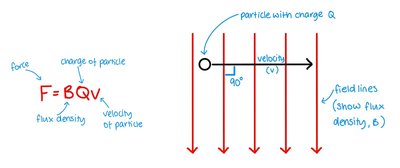
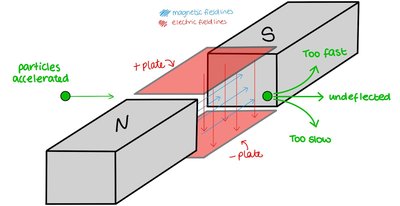
A charged particle moving through a magnetic field experiences a force perpendicular to both its velocity and the field. This force is responsible for phenomena such as the Hall Effect and the operation of velocity selectors.
Formula:
Hall Effect: The creation of a voltage across a conductor when it moves through a magnetic field, due to the separation of charge carriers.
Hall Voltage Formula:
Velocity selector: Uses perpendicular electric and magnetic fields to select particles of a specific velocity.
Magnetic Fields due to Currents
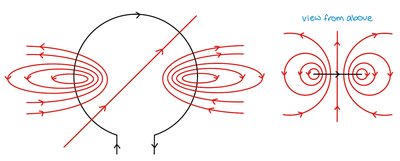
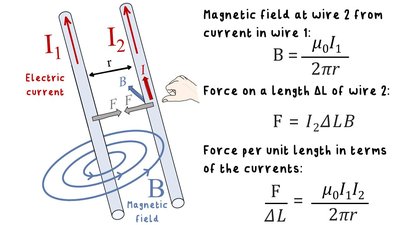
Electric currents generate magnetic fields. The direction and shape of these fields depend on the configuration of the current-carrying conductor. The strength of the field around a straight wire is given by Ampere’s Law, and the direction can be determined using Fleming’s Right Hand Rule.
Ampere’s Law:
Fleming’s Right Hand Rule: Used to determine the direction of the magnetic field around a wire.
Field shapes: Loops and solenoids create distinct field patterns, useful in particle acceleration and electromagnets.
Iron core: Increases the strength of the magnetic field in a solenoid.
Force between wires: Parallel wires carrying current exert forces on each other, attractive if currents are in the same direction, repulsive otherwise.
Electromagnetic Induction
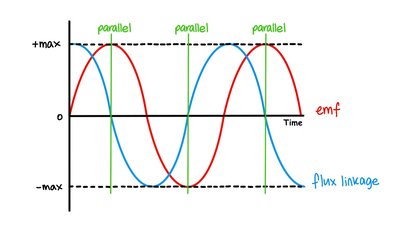
Electromagnetic induction is the process by which a changing magnetic flux induces an electromotive force (emf) in a circuit. This principle is fundamental to the operation of generators and transformers.
Magnetic flux (): (where is the area perpendicular to the field)
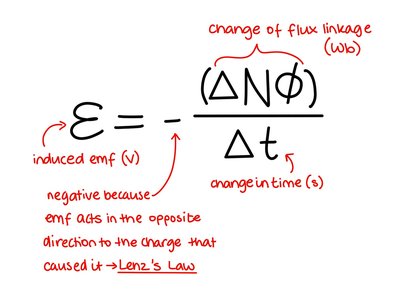
Flux linkage (): (for a coil with turns)
Faraday’s Law:
Lenz’s Law: The induced emf opposes the change in flux that caused it (negative sign in Faraday’s Law).
Example: Moving a magnet through a solenoid induces a current.
Summary Table: Key Magnetic Field Concepts
Concept | Formula | Key Points |
|---|---|---|
Force on wire | Max when perpendicular | |
Force on charge | Direction by Left Hand Rule | |
Magnetic field (wire) | Right Hand Rule for direction | |
Hall Voltage | Used to measure B | |
Induced emf | Lenz's Law: Opposes change | |
Velocity selector | Filters particles by speed |
Additional info: Academic context and explanations have been expanded for clarity and completeness. Only images directly relevant to the explanation have been included.
