 Back
BackWeek 6 Lec. 2
Study Guide - Smart Notes
 Tailored notes based on your materials, expanded with key definitions, examples, and context.
Magnetic Force on Moving Charges
Force on a Charged Particle in a Magnetic Field
The magnetic force on a charged particle moving in a magnetic field is a fundamental concept in electromagnetism. The force is always perpendicular to both the velocity of the particle and the direction of the magnetic field.
Formula: The force is given by , where q is the charge, v is the velocity vector, and B is the magnetic field vector.
Direction: Determined by the right-hand rule for positive charges and left-hand rule for negative charges.
Magnitude: , where is the angle between v and B.
Example: A particle with charge moving in the positive z-direction at in a magnetic field experiences a force calculated using the cross product.
Application: The path of a charged particle in a magnetic field is curved, as shown in the example below.
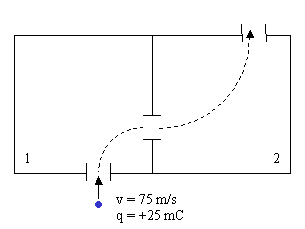
Path of a Charge in a Magnetic Field
Direction and Magnitude of Magnetic Fields
When a charged particle enters a region with a magnetic field, its trajectory is influenced by the field's direction and strength. The curvature of the path provides information about the field.
Direction: The direction of the magnetic field can be deduced from the curvature of the particle's path using the right-hand rule.
Magnitude: The radius of curvature is inversely proportional to the magnetic field strength; a tighter curve indicates a stronger field.
Example: Comparing two chambers, if the path curves more in chamber 1 than in chamber 2, then .
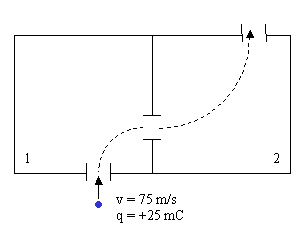
Electric Current and Magnetic Fields
Historical Discovery and Empirical Evidence
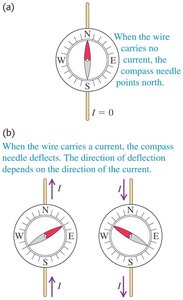
Electric currents produce magnetic fields, a phenomenon first observed by Hans Oersted in 1820. The orientation and direction of current flow affect the magnetic field produced.
Oersted's Experiment: A compass needle placed near a current-carrying wire deflects, indicating the presence of a magnetic field.
Direction of Deflection: Depends on the direction of current flow.
Key Concept: There is a direct relationship between electric current and magnetic field generation.
Magnetic Force on a Current-Carrying Conductor
Force on a Straight Wire
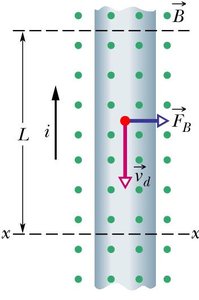
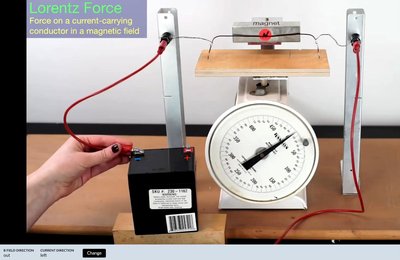
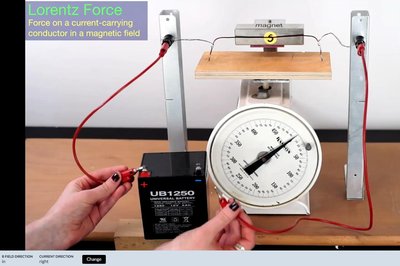
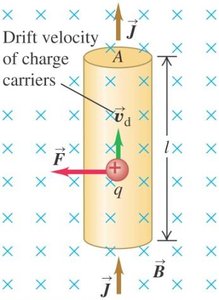
A current-carrying wire placed in a magnetic field experiences a force. This force is the result of the collective action of the magnetic force on each moving charge within the wire.
Formula: , where I is the current, L is the length vector of the wire, and B is the magnetic field.
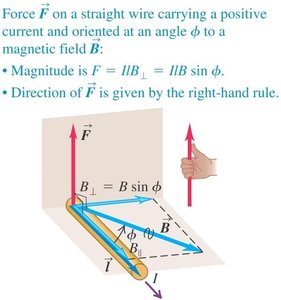
Direction: Perpendicular to both the wire and the magnetic field, given by the right-hand rule.
Magnitude: .
Example: The force on a wire segment in a uniform magnetic field can be measured experimentally.
Force on a Non-Straight Conductor
For conductors that are not straight, the force is calculated by integrating over the length of the conductor:
Formula: , where is an infinitesimal segment of the wire.
Application: Used for loops, arcs, and other shapes.
Direction of Magnetic Force
Right-Hand Rule
The direction of the magnetic force on a current-carrying conductor is always perpendicular to both the current and the magnetic field. The right-hand rule is used to determine this direction.
Right-Hand Rule: Point your thumb in the direction of current, fingers in the direction of the magnetic field, and your palm points in the direction of the force.
Example: For a wire at an angle to the field, .
Magnetic Force and Torque on a Current Loop
Force and Torque on a Current Loop
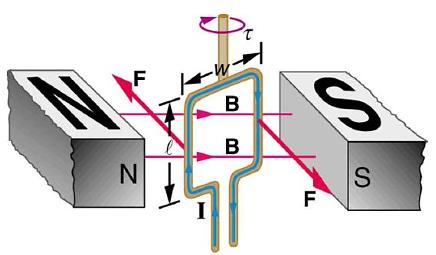
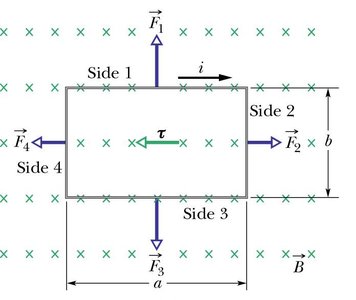
A current loop in a uniform magnetic field experiences no net force, but it does experience a torque. This torque is responsible for the operation of electric motors.
Net Force: The translational forces on opposite sides of the loop cancel out.
Torque Formula: , where A is the area of the loop and is the angle between the normal to the loop and the magnetic field.
Application: The torque causes the loop to rotate, converting electrical energy into mechanical energy.
Summary Table: Magnetic Force on Conductors
Situation | Formula | Direction |
|---|---|---|
Moving charge in B | Perpendicular to v and B | |
Straight wire in B | Perpendicular to I and B | |
Current loop in B | Causes rotation (torque) |
Additional info: The notes also reference the Hall effect, mass spectrometer, and magnetic flux, which are related topics in the study of magnetic fields and forces on charges and currents.
