 Back
BackMagnetic Force and Motion of Charged Particles in Magnetic Fields
Study Guide - Smart Notes
 Tailored notes based on your materials, expanded with key definitions, examples, and context.
Q1. Find the direction of the magnetic force for each case. Particles move with velocity m/s in an tesla magnetic field.
Background
Topic: Magnetic Force on Moving Charges
This question tests your understanding of the Lorentz force, which describes the force experienced by a charged particle moving through a magnetic field. It also asks you to apply the right-hand rule to determine the direction of the force for different particles (proton, electron, neutron).
Key Terms and Formulas:
Magnetic Force ():
Right-Hand Rule: Used to determine the direction of the force for positive charges; for negative charges, the direction is opposite.
Acceleration ():
Where:
= charge of the particle
= velocity vector
= magnetic field vector
= mass of the particle
Step-by-Step Guidance
Identify the charge and mass of the particle for each case (proton, electron, neutron).
Use the right-hand rule to determine the direction of the magnetic force for a proton (thumb = velocity, fingers = magnetic field, palm = force direction).
For an electron, remember the force direction is opposite to the right-hand rule since it is negatively charged.
For a neutron, note that it has no charge, so the magnetic force will be zero.
Set up the formula for the magnitude of the force: (where is the angle between and ).
Try solving on your own before revealing the answer!
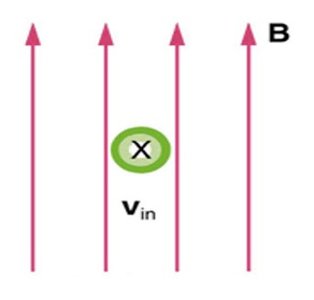
Final Answer:
For a proton, use the right-hand rule to find the force direction. For an electron, reverse the direction. For a neutron, the force is zero. The magnitude of the force is and acceleration is .
Example: For a proton, .
Q2. What is the direction of the magnetic force on a wire carrying current A in a T magnetic field? Calculate the force on a 0.25 m length wire.
Background
Topic: Magnetic Force on a Current-Carrying Wire
This question tests your ability to apply the formula for the force on a wire in a magnetic field and use the right-hand rule to determine the direction.
Key Terms and Formulas:
Magnetic Force on a Wire:
Right-Hand Rule: Thumb = current direction, fingers = magnetic field, palm = force direction.
Where:
= current
= length vector of the wire
= magnetic field vector
Step-by-Step Guidance
Identify the direction of current and magnetic field from the diagram.
Apply the right-hand rule to determine the direction of the force on the wire.
Set up the formula for the force: (where is the angle between and ).
Plug in the values: A, m, T.
Try solving on your own before revealing the answer!
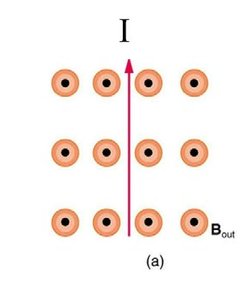
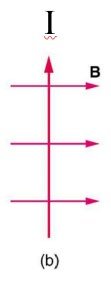
Final Answer:
The direction of the force is perpendicular to both the current and the magnetic field, as determined by the right-hand rule. The magnitude is .
Q3. Draw the paths of three particles (positive, negative, and neutral) entering in the +X direction into a region where the magnetic field is out of the page. Explain.
Background
Topic: Motion of Charged Particles in Magnetic Fields
This question tests your understanding of how charged and neutral particles move in a magnetic field, specifically the curvature of their paths due to the Lorentz force.
Key Terms and Formulas:
Lorentz Force:
Right-Hand Rule: Determines the direction of force for positive charges; negative charges move in the opposite direction.
Neutral particles: No force, so path remains straight.
Step-by-Step Guidance
For a positive particle, use the right-hand rule to determine the direction of the force and the resulting curved path.
For a negative particle, reverse the direction of the force; the path curves in the opposite direction.
For a neutral particle, note that it continues in a straight line since there is no force.
Draw or visualize the paths based on these force directions.
Try solving on your own before revealing the answer!
Final Answer:
The positive particle curves in one direction, the negative in the opposite, and the neutral particle moves straight. The curvature is due to the Lorentz force acting perpendicular to the velocity and magnetic field.
