 Back
BackMagnetic Force on Moving Charges and Currents – Step-by-Step Study Guidance
Study Guide - Smart Notes
 Tailored notes based on your materials, expanded with key definitions, examples, and context.
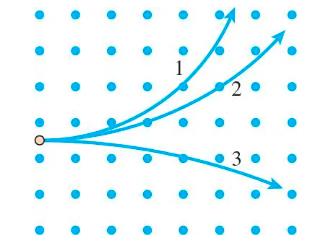
Q24.21. Three charged particles move in a magnetic field as shown in Figure Q24.21. All the particles have the same mass and the same magnitude of charge. Which particle is moving the fastest? Which particles have positive charges, and which have negative charges?
Background
Topic: Motion of charged particles in a magnetic field
This question tests your understanding of how charged particles move in a uniform magnetic field, specifically how their speed and charge affect the curvature of their paths and the direction of the magnetic force.
Key Terms and Formulas
Radius of curvature:
Right-hand rule: Used to determine the direction of the force on a positive charge moving in a magnetic field.
Magnetic force: (for perpendicular velocity and field)
Step-by-Step Guidance
Recall that the radius of curvature for a charged particle moving in a magnetic field depends on its mass , speed , charge , and the magnetic field .
Since all particles have the same and , and are in the same , the only variable affecting is . The particle with the largest radius is moving the fastest.
Use the right-hand rule to determine the direction of the force for each particle. For a positive charge, point your thumb in the direction of velocity and fingers in the direction of the magnetic field (out of the page), your palm points in the direction of the force. For a negative charge, the force is in the opposite direction.
Compare the curvature and direction of each particle's path to deduce which are positive and which are negative.
Try solving on your own before revealing the answer!
Q24.22. An electron and a proton are moving in circular orbits in the earth’s magnetic field, high above the earth’s atmosphere. The two particles move at the same speed. Which particle takes more time to complete one orbit? Explain.
Background
Topic: Cyclotron motion and period of revolution in a magnetic field
This question examines your understanding of how the mass and charge of a particle affect the period of its circular motion in a magnetic field.
Key Terms and Formulas
Period of revolution:
Radius of orbit:
Step-by-Step Guidance
Write the formula for the period of a charged particle in a magnetic field: .
Note that both particles (electron and proton) have the same speed and are in the same magnetic field, so and are the same for both (magnitude of charge is equal).
Compare the masses: the proton has a much larger mass than the electron.
Use the formula to reason which particle will have a longer period (take more time to complete one orbit).
Try solving on your own before revealing the answer!
P24.22. A proton moves with a speed of m/s in the directions shown in Figure P24.22. A 0.50 T magnetic field points in the positive x-direction. For each, what is the magnetic force on the proton? Give your answers as a magnitude and a direction.
Background
Topic: Magnetic force on a moving charge
This question tests your ability to calculate the magnitude and direction of the magnetic force on a moving charge using the cross product and the right-hand rule.
Key Terms and Formulas
Magnetic force:
Right-hand rule: Used to determine the direction of the force.
is the angle between the velocity and the magnetic field.
Step-by-Step Guidance
Identify the given values: C (proton), m/s, T.
For each direction, determine the angle between the velocity and the magnetic field.
Calculate the magnitude of the force using for each case.
Use the right-hand rule to determine the direction of the force for each scenario.
Try solving on your own before revealing the answer!
P24.25. The aurora is caused when electrons and protons, moving in the earth’s magnetic field of T, collide with molecules of the atmosphere and cause them to glow. What is the radius of the circular orbit for (a) an electron with speed m/s? (b) a proton with speed m/s?
Background
Topic: Circular motion of charged particles in a magnetic field
This question tests your ability to calculate the radius of the circular path of a charged particle moving perpendicular to a uniform magnetic field.
Key Terms and Formulas
Radius of orbit:
Electron mass: kg
Proton mass: kg
Elementary charge: C
Step-by-Step Guidance
Write the formula for the radius: .
For part (a), substitute the values for the electron: , m/s, , and .
For part (b), substitute the values for the proton: , m/s, , and .
Set up the calculations for each particle, but stop before plugging in the numbers for the final result.
Try solving on your own before revealing the answer!
P24.26. Problem 24.25 describes two particles that orbit the earth’s magnetic field lines. What is the frequency of the circular orbit for (a) an electron with speed m/s? (b) a proton with speed m/s?
Background
Topic: Frequency of circular motion in a magnetic field (cyclotron frequency)
This question tests your ability to relate the frequency of revolution to the charge, mass, and magnetic field for a charged particle in circular motion.
Key Terms and Formulas
Frequency:
Electron mass: kg
Proton mass: kg
Elementary charge: C
Step-by-Step Guidance
Write the formula for the frequency: .
For part (a), substitute the values for the electron: , , .
For part (b), substitute the values for the proton: , , .
Set up the calculations for each particle, but stop before plugging in the numbers for the final result.
Try solving on your own before revealing the answer!
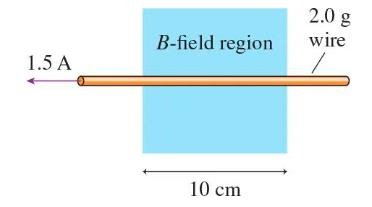
P24.33. What magnetic field strength and direction will levitate the 2.0 g wire in Figure P24.33?
Background
Topic: Magnetic force on a current-carrying wire balancing gravity (magnetic levitation)
This question tests your ability to set up the condition for equilibrium where the upward magnetic force balances the downward gravitational force on a wire.
Key Terms and Formulas
Magnetic force on a wire:
Gravitational force:
For levitation,
Step-by-Step Guidance
Set the magnetic force equal to the gravitational force: (since the angle is , ).
Solve for the magnetic field : .
Substitute the given values: kg, m/s, A, m.
Use the right-hand rule to determine the direction of the magnetic field needed for the force to be upward.
Try solving on your own before revealing the answer!
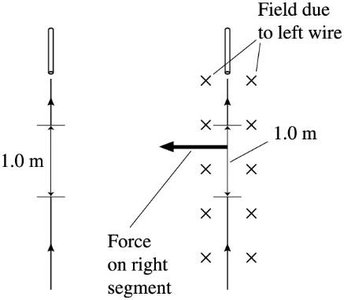
P24.35. If two 1.0-meter-long sections of very long wires a distance 1.0 m apart each carry a current of 1.0 A, what is the force between them?
Background
Topic: Force between parallel current-carrying wires (definition of the ampere)
This question tests your understanding of how the force between two parallel wires is used to define the ampere, the SI unit of current.
Key Terms and Formulas
Magnetic field due to a long straight wire:
Force on a wire in a magnetic field:
Force per unit length between two parallel wires:
Permeability of free space: T·m/A
Step-by-Step Guidance
Write the formula for the force per unit length between two parallel wires: .
Substitute the given values: A, m, m, T·m/A.
Set up the calculation for using , but stop before the final computation.
Try solving on your own before revealing the answer!
P24.36. A uniform 2.5 T magnetic field points to the right. A 3.0-m-long wire, carrying 15 A, is placed at an angle of 30° to the field, as shown in Figure P24.36. What is the force (magnitude and direction) on the wire?
Background
Topic: Force on a current-carrying wire in a magnetic field
This question tests your ability to calculate the magnitude and direction of the force on a wire carrying current at an angle to a uniform magnetic field.
Key Terms and Formulas
Magnetic force on a wire:
is the angle between the wire and the magnetic field.
Right-hand rule for direction of force.
Step-by-Step Guidance
Identify the given values: A, m, T, .
Write the formula for the force: .
Set up the calculation for the magnitude of the force, but stop before plugging in the numbers for the final result.
Use the right-hand rule to determine the direction of the force (relative to the page).
Try solving on your own before revealing the answer!
