 Back
BackMagnetic Forces and Fields: Step-by-Step Physics Guidance
Study Guide - Smart Notes
 Tailored notes based on your materials, expanded with key definitions, examples, and context.
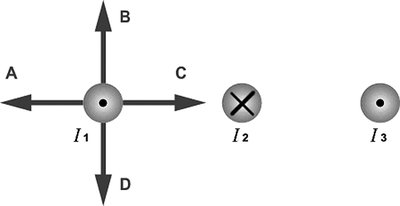
Q1. The figure shows three long, parallel current-carrying wires. The magnitudes of the currents are equal and their directions are indicated in the figure. Which of the arrows drawn near the wire carrying current 1 correctly indicates the direction of the magnetic force acting on that wire?
Background
Topic: Magnetic Force Between Parallel Currents
This question tests your understanding of the direction and nature of the magnetic force between parallel current-carrying wires. It requires you to apply the right-hand rule and analyze the interaction between the wires.
Key Terms and Formulas
Right-Hand Rule: Used to determine the direction of the magnetic field and force between wires.
Magnetic Force Between Wires: The force per unit length between two parallel wires carrying currents and separated by distance is given by:
= permeability of free space
= currents in the wires
= distance between wires
Step-by-Step Guidance
Identify the directions of the currents in all three wires. Use the diagram to see which way each current is flowing (out of the page, into the page, etc.).
Recall that parallel currents attract and anti-parallel currents repel. Determine which wires are parallel and which are anti-parallel to wire 1.
Apply the right-hand rule to find the direction of the magnetic field created by each wire at the location of wire 1. For a current out of the page, the magnetic field circles counterclockwise; for into the page, it circles clockwise.
Combine the effects of the magnetic fields from wires 2 and 3 to determine the net force direction on wire 1. Consider both magnitude and direction.
Try solving on your own before revealing the answer!
Final Answer: B
The net magnetic force on wire 1 is upward, as indicated by arrow B. This is due to the combined attractive and repulsive forces from the other wires, based on their current directions and the right-hand rule.
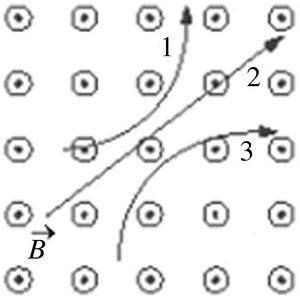
Q2. Three particles travel through a region of space where the magnetic field is out of the page, as shown in the figure. The electric charge of each of the three particles is, respectively:
Background
Topic: Motion of Charged Particles in a Magnetic Field
This question tests your ability to determine the sign of the charge of a particle based on its trajectory in a magnetic field using the right-hand rule.
Key Terms and Formulas
Right-Hand Rule: For positive charges, fingers point in the direction of velocity, curl toward the magnetic field, and thumb points in the direction of force.
Force on a Charged Particle:
= charge
= velocity vector
= magnetic field vector
Step-by-Step Guidance
Observe the direction of the magnetic field (out of the page) and the paths of the particles.
For each particle, use the right-hand rule to determine whether the curvature of the path corresponds to a positive, negative, or neutral charge.
Remember: Neutral particles are unaffected by the magnetic field and travel in a straight line.
Compare the paths of particles 1, 2, and 3 to deduce their charges.
Try solving on your own before revealing the answer!
Final Answer: A
Particle 1 is positive, particle 2 is neutral, and particle 3 is negative. The positive charge curves according to the right-hand rule, the neutral charge moves straight, and the negative charge curves opposite to the right-hand rule.
