 Back
BackLec 10
Study Guide - Smart Notes
 Tailored notes based on your materials, expanded with key definitions, examples, and context.
Magnetic Fields and Magnetic Forces
Introduction to Magnetism
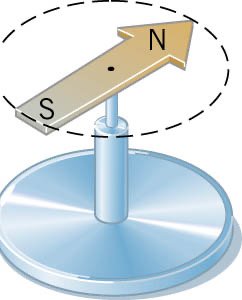
Magnetism is a fundamental force of nature, closely related to electricity. Magnets possess two distinct poles: North (N) and South (S). When suspended freely, the North pole of a magnet points toward the Earth's geographic North, which is why these poles are named as such.
Permanent magnets have fixed North and South poles.
The compass needle is a practical example of a permanent magnet, used to indicate direction.
Magnetic poles always occur in pairs; isolated North or South poles do not exist in nature.
Behavior of Magnetic Poles
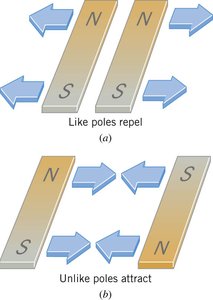
The interaction between magnetic poles is analogous to the interaction between electric charges. Like poles repel each other, while unlike poles attract.
Like poles (N-N or S-S) repel.
Unlike poles (N-S) attract.
Magnetic Field Concept
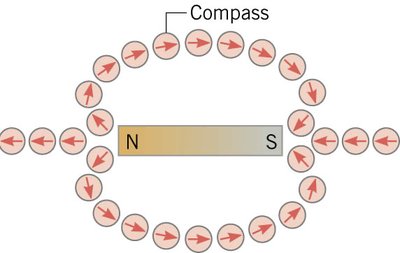
Magnets exert forces at a distance, similar to electric charges. This effect is described by the magnetic field, a vector field denoted by B. The direction of the magnetic field at any point is the direction indicated by the North pole of a small compass placed at that location.
The compass acts as a test device to map the direction of the magnetic field.
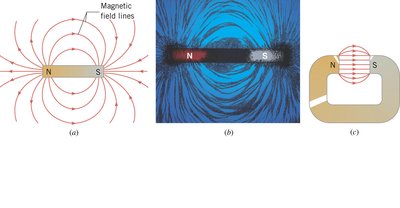
Magnetic field lines are visual representations of the field's direction and strength.
Magnetic Field Lines
Magnetic field lines provide a visual representation of the magnetic field. They have several important properties:
Field lines emerge from the North pole and enter the South pole.
The direction of the magnetic field vector is tangent to the field lines at any point.
The density of field lines (number per area) indicates the strength of the magnetic field.
Magnetic field lines form closed loops; they do not begin or end at a single pole.
Earth's Magnetic Field
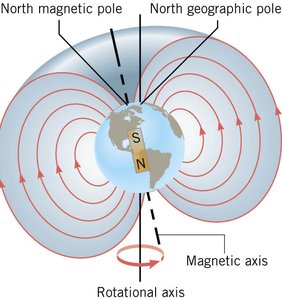
The Earth acts as a giant magnet, with its own magnetic field. The magnetic axis is tilted relative to the rotational axis by about 11.5 degrees. The North magnetic pole is not the same as the geographic North pole.
Earth's magnetic field lines are not parallel to the surface everywhere; near the poles, they are nearly perpendicular.
The angle between the compass direction and true North is called the angle of declination.
Earth's surface magnetic field is about 0.5 gauss.
The Force That a Magnetic Field Exerts on a Charge
Conditions for Magnetic Force
A magnetic field exerts a force on a charged particle only if:
The charge is moving.
The velocity of the charge has a component perpendicular to the magnetic field direction.
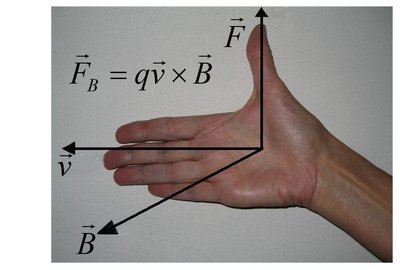
The force is always perpendicular to both the velocity (v) and the magnetic field (B).
Mathematical Expression for Magnetic Force
The vector equation for the force (F) on a charge (q) moving with velocity (v) in a magnetic field (B) is:
The magnitude is , where is the angle between v and B.
The direction is given by the Right Hand Rule for positive charges; for negative charges, the force is in the opposite direction.
Definition and Units of Magnetic Field
The magnitude of the magnetic field at any point is defined as:
SI unit: tesla (T) ()
Non-SI unit: gauss ()
Earth's magnetic field at the surface is approximately 0.5 gauss.
Example: Magnetic Forces on Charged Particles
Consider a proton moving at in a magnetic field of at an angle of to its velocity:
Force:
Acceleration:
For an electron, the magnitude of force is the same, but the direction is opposite.
The Motion of a Charged Particle in a Magnetic Field
Comparison: Electric vs. Magnetic Field Effects
The motion of a charged particle in an electric field differs from its motion in a magnetic field:
In an electric field, the force is parallel to the field and changes the particle's speed.
In a magnetic field, the force is perpendicular to the velocity, causing the particle to move in a curved path without changing its speed.
Velocity Selector
A velocity selector uses both electric and magnetic fields to allow only particles with a specific velocity to pass through undeflected. The forces balance when:
This allows measurement of particle velocity independent of charge.
Work Done by Electric and Magnetic Forces
The electric force can do work on a charged particle, changing its kinetic energy. The magnetic force, however, does no work because it is always perpendicular to the velocity, so the speed and kinetic energy remain constant.
Work by electric force:
Magnetic force: No work,
Circular Motion in a Magnetic Field
If a charged particle moves perpendicular to a uniform magnetic field, it follows a circular path. The magnetic force acts as the centripetal force:
Radius of curvature:
Example: For an electron with in Earth's field (), ; in , .
Particle Tracks in a Bubble Chamber
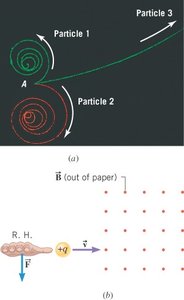
Charged particles moving in a magnetic field produce spiral tracks in a bubble chamber. The direction and curvature of the tracks reveal the sign and speed of the particles.
Particles with opposite charges curve in opposite directions.
The particle with the largest radius moves most rapidly.
The Mass Spectrometer
Principle and Application
A mass spectrometer measures the masses and relative abundances of isotopes. Ions are accelerated and deflected by a magnetic field; their radius of curvature depends on mass, charge, and velocity:
For ions accelerated by a potential :
Combining equations allows determination of mass.
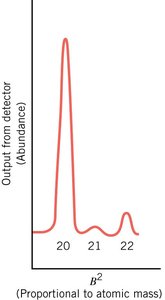
Isotopes are distinguished by their mass and abundance.
Mass Spectrum Example: Neon Isotopes
The mass spectrum of neon shows three isotopes with atomic mass numbers 20, 21, and 22. The most abundant isotope is mass 20.
Additional info: The notes above expand on brief points and provide academic context, including definitions, formulas, and examples, to ensure completeness and clarity for exam preparation.
