 Back
BackLecture 11
Study Guide - Smart Notes
 Tailored notes based on your materials, expanded with key definitions, examples, and context.
Magnetic Forces and Magnetic Fields
The Mass Spectrometer
The mass spectrometer is an instrument used to measure the masses and relative abundances of isotopes. Isotopes are atoms with the same number of protons but different numbers of neutrons. In a mass spectrometer, atoms are ionized (typically losing one electron, so q = +e), accelerated by a voltage, and then deflected by a magnetic field. The radius of curvature of their path depends on their mass-to-charge ratio, allowing for separation and detection of different isotopes.
Key Equations:
Radius of path:
Kinetic energy from acceleration:
Combining:
Application: The mass spectrum of neon shows three peaks, corresponding to isotopes with mass numbers 20, 21, and 22. The height of each peak indicates the relative abundance of each isotope.
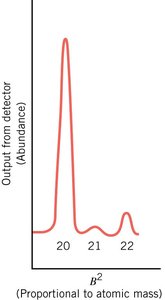
Additional info: The x-axis is proportional to , which is related to atomic mass, and the y-axis shows the abundance detected.
The Force on a Current in a Magnetic Field
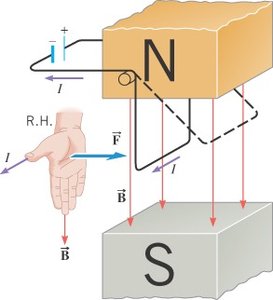
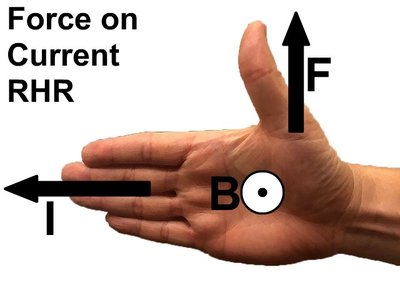
A magnetic force acts on a charged particle moving in a magnetic field, and also on a current-carrying wire. The direction of the force is given by the right-hand rule (RHR): point your thumb in the direction of current (or velocity for a positive charge), your fingers in the direction of the magnetic field, and your palm points in the direction of the force.
Force on a moving charge:
Force on a current-carrying wire:
Example: A 2.0 m wire carrying 20 A eastward in Earth's 0.5 Gauss (5.0×10⁻⁵ T) field (northward) experiences an upward force of N.
Applications: Magnetohydrodynamic (MHD) Propulsion
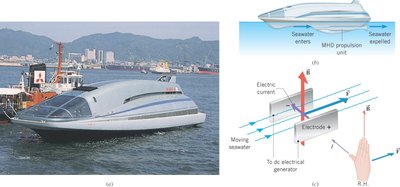
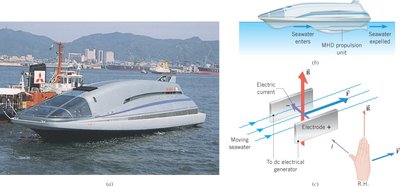
MHD propulsion uses the force on a current in a magnetic field to move conductive fluids, such as seawater, for ship propulsion. Water is expelled by the magnetic force, and by Newton's third law, the ship moves forward.
Force:
Electric power required:
Example: For a 1000 kg boat, T, A, V, m, the force is 200 N, power is 2 kW, and time to accelerate to 10 m/s is 50 s (ignoring friction).
Magnetic Fields Produced by Currents
Electric currents produce magnetic fields. The direction of the field around a straight wire is given by the right-hand rule: thumb in the direction of current, fingers curl in the direction of the magnetic field lines.
Magnetic field from a long straight wire:
Permeability of free space: T·m/A
Why must the wire be long? To avoid fringe field effects and ensure the formula applies.
Force Between Parallel Currents
Current-carrying wires exert forces on each other. Parallel currents in the same direction attract; opposite directions repel. The force per unit length between two parallel wires is:
Example: Two 1.0 m rods, 0.07 m apart, each of mass 0.5 kg, can be levitated with a current of 1300 A.
Magnetic Field of a Loop and a Solenoid
A current loop and a solenoid (a coil of many loops) produce magnetic fields:
Field at center of a loop:
Field inside a long solenoid: where is the number of turns per unit length.
Example: A 0.25 m solenoid with 5000 turns and 3.5 A current produces T.
The Force and Acceleration in a Loudspeaker
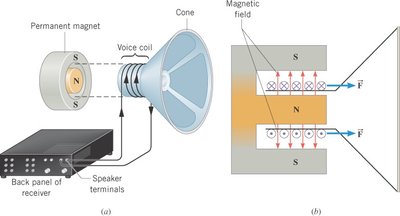
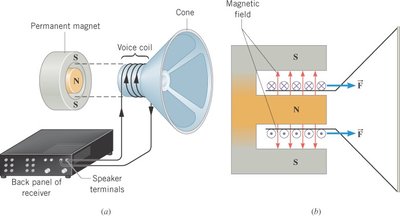
A loudspeaker uses the force on a current-carrying coil in a magnetic field to produce sound. The coil moves in response to the current, causing the attached cone to vibrate and create sound waves.
Force on the coil:
Example: For a coil with 55 turns, diameter 0.025 m, T, A, the force is 0.86 N. If the mass is 0.020 kg, acceleration is 43 m/s2.
The Torque on a Current-Carrying Coil
A current-carrying loop in a magnetic field experiences a torque that tends to align the loop's normal with the field. The net torque is:
where is the magnetic moment.
Application: This principle is used in galvanometers and electric motors.
The Galvanometer
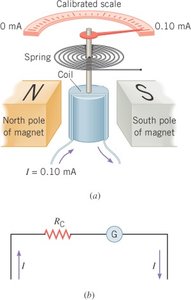
A galvanometer measures electric current by the torque on a coil in a magnetic field. The coil rotates, moving a pointer. The equilibrium position is set by the balance between magnetic torque and the restoring torque of a spring.
(magnetic torque)
(spring torque, Hooke's Law)
At equilibrium: so
DC Motor Principle
A DC motor uses the torque on a current-carrying coil in a magnetic field to produce rotation. The coil is connected to a split-ring commutator, which reverses the current direction every half-turn, maintaining continuous rotation.
When current flows, the coil experiences a torque and rotates.
Inertia keeps the coil moving even when the current is briefly zero during commutation.
