 Back
BackWeek 6 Lec. 1 (Week of 1st Exam)
Study Guide - Smart Notes
 Tailored notes based on your materials, expanded with key definitions, examples, and context.
Magnetic Forces on Moving Charges
Force on a Charged Particle in a Magnetic Field
The force experienced by a charged particle moving in a magnetic field is a fundamental concept in electromagnetism. The direction and magnitude of this force are determined by the charge, velocity, and the magnetic field.
Magnetic Force Formula: The force on a charge q moving with velocity v in a magnetic field B is given by the vector cross product:
Direction: Determined by the right-hand rule; the force is perpendicular to both v and B.
Magnitude: , where θ is the angle between v and B.
Uniform Circular Motion: If v is perpendicular to B, the particle moves in a circle with constant speed.
Radius of Circular Path
For a particle of mass m and charge q moving at speed v in a uniform magnetic field B:
Application: This relationship is used in devices like cyclotrons and mass spectrometers to determine particle properties.
Example: Proton in a Cyclotron
Consider a proton with kinetic energy 11 MeV in a 1.2 T magnetic field. The following steps show how to calculate its speed and the radius of its orbit:
Step 1: Convert kinetic energy to joules:

Step 2: Calculate speed using kinetic energy:

Step 3: Find the radius of the orbit:

Cyclotrons
Principle and Operation
A cyclotron is a type of particle accelerator that uses a constant magnetic field and a rapidly alternating electric field to accelerate charged particles in a spiral path.
Dees: The D-shaped electrodes where particles are accelerated.
Magnetic Field: Keeps particles in a circular path.
Alternating Voltage: Accelerates particles each time they cross the gap between the Dees.
Frequency: The frequency of the alternating voltage matches the orbital frequency of the particles:
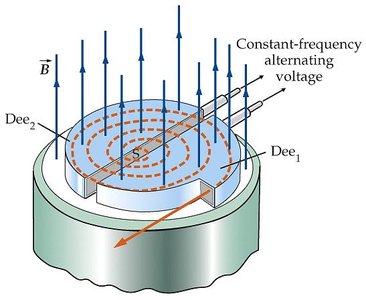
Energy Gain: Each crossing of the gap increases the particle's kinetic energy by .
Mass Spectrometers
Principle and Application
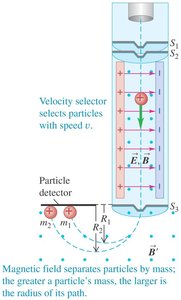
A mass spectrometer is a device that separates ions according to their mass-to-charge ratio (m/q) using electric and magnetic fields. It is widely used in physics, chemistry, and biology for identifying isotopes and molecules.
Velocity Selector: Uses perpendicular electric and magnetic fields to select particles of a specific velocity:
Magnetic Separation: After velocity selection, particles enter a region with only a magnetic field, causing them to follow circular paths. The radius depends on their mass:
Detection: Particles with different masses strike the detector at different positions, allowing for mass identification.
Summary Table: Key Equations and Concepts
Concept | Equation | Description |
|---|---|---|
Magnetic Force | Force on a moving charge in a magnetic field | |
Radius of Path | Radius of circular motion in a uniform B field | |
Kinetic Energy | Relates speed and energy of a particle | |
Velocity Selector | Only particles with this velocity pass through | |
Cyclotron Frequency | Frequency for resonance acceleration |
Additional info:
These concepts are foundational for understanding the behavior of charged particles in magnetic fields, which is essential in both experimental and applied physics.
Applications include particle accelerators, medical imaging (cyclotrons for PET scans), and analytical chemistry (mass spectrometry).
