 Back
BackChapter 27 Part III - Magnetic Forces, Magnetic Flux, and Gauss’s Law for Magnetism
Study Guide - Smart Notes
 Tailored notes based on your materials, expanded with key definitions, examples, and context.
Magnetic Forces on Moving Charges and Currents
Force on a Moving Charge in a Magnetic Field
The force experienced by a moving charge in a magnetic field is a fundamental concept in electromagnetism. The direction and magnitude of this force depend on the velocity of the charge, the strength and direction of the magnetic field, and the angle between them.
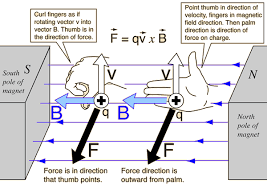
Magnetic Force Equation: The force F on a charge q moving with velocity v in a magnetic field B is given by the vector cross product:
Right-Hand Rule (RHR): The direction of the force is determined using the right-hand rule. Point your fingers in the direction of v, curl them toward B, and your thumb points in the direction of the force for a positive charge (reverse for negative charge).
Angular Motion: If the velocity is perpendicular to the magnetic field, the charge moves in a circular path due to the constant perpendicular force.
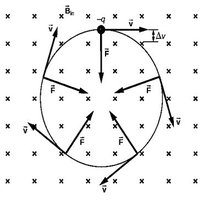
General Case: If the velocity is at an angle ϕ to the field, only the perpendicular component contributes to the force:
Force on a Current-Carrying Wire
When a current-carrying wire is placed in a magnetic field, each moving charge experiences a force, resulting in a net force on the wire.
Equation for a Straight Wire: where I is the current, L is the length vector of the wire, and B is the magnetic field.
Curved Wire: For a wire of arbitrary shape, use integration:
Application: This principle is used in electric motors, where forces on current-carrying wires produce rotational motion.
Measuring Magnetic Fields with Test Charges
Test Charge Method
Similar to measuring electric fields with test charges, magnetic fields can be measured by observing the force on a known, small test charge moving at a known velocity.
Conditions: The test charge should be small enough not to disturb the field.
Observations:
If B is absent, the charge moves in a straight line (Newton’s 1st Law).
If B is present, the charge is deflected unless its velocity is parallel to B.
If both E (electric field) and B are present, the total force is:
Magnetic Flux and Gauss’s Law for Magnetism
Magnetic Flux (ΦB)
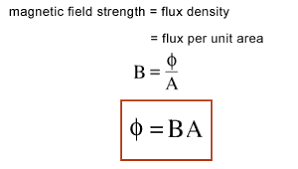
Magnetic flux quantifies the total magnetic field passing through a given surface. It is analogous to electric flux in electrostatics.
Definition: The magnetic flux through a surface is: or, for a uniform field:
Units: The SI unit is the weber (Wb).
Gauss’s Law for Magnetism
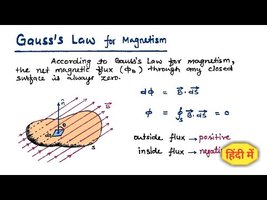
Gauss’s Law for Magnetism states that the net magnetic flux through any closed surface is always zero. This reflects the fact that magnetic monopoles do not exist; magnetic field lines always form closed loops.
Mathematical Statement:
Interpretation: The number of magnetic field lines entering a closed surface equals the number leaving it.
Summary Table: Key Magnetic Force and Flux Equations
Physical Situation | Equation | Description |
|---|---|---|
Force on moving charge | Force on charge q moving with velocity v in field B | |
Force on straight wire | Force on wire of length L carrying current I | |
Magnetic flux (general) | Flux through any surface | |
Magnetic flux (uniform field) | Flux through flat area A at angle φ to B | |
Gauss’s Law for Magnetism | No net flux through a closed surface |
Additional info:
When a wire is not straight, the force calculation requires integration over the wire’s path.
Magnetic fields are always produced by moving charges (currents) or changing electric fields.
