 Back
BackMagnetic Materials: Atomic Origins and Types of Magnetic Behavior
Study Guide - Smart Notes
 Tailored notes based on your materials, expanded with key definitions, examples, and context.
Magnetic Materials
Atomic Origins of Magnetism
Magnetic properties of materials arise from the motion of electrons within atoms. Electrons moving in orbits generate microscopic current loops, which in turn produce magnetic dipole moments. The net effect of these moments determines the magnetic behavior of the material.
Magnetic Dipole Moment (\(\vec{\mu}\)): Produced by a current loop, with magnitude \(\mu = I A\), where \(I\) is current and \(A\) is the area of the loop.
Angular Momentum (\(\vec{L}\)): For an electron of mass \(m\) and charge \(-e\) moving in a circular orbit of radius \(r\) and speed \(v\), \(L = m v r\).
The magnetic moment is related to angular momentum by \(\mu = \frac{e}{2m} L\).
Bohr Magneton (\(\mu_B\)): The fundamental unit of magnetic moment in atomic physics, \(\mu_B = \frac{e \hbar}{2m} = 9.274 \times 10^{-24} \ \mathrm{A \cdot m^2}\).
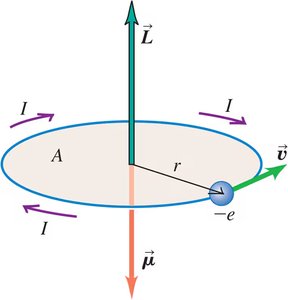
Additional info: The direction of the magnetic moment is opposite to the angular momentum for an electron due to its negative charge.
Types of Magnetic Behavior
Paramagnetism
Paramagnetic materials have atoms or ions with net magnetic moments. In the presence of an external magnetic field, these moments tend to align with the field, increasing the total magnetic field inside the material. However, thermal motion opposes this alignment, making the effect weak at room temperature.
Magnetization (\(\vec{M}\)): The magnetic moment per unit volume, \(\vec{M} = \frac{\vec{\mu}_{\text{total}}}{V}\).
The total magnetic field in a paramagnetic material:
Relative Permeability (\(K_m\)): The ratio of the material's permeability to that of free space, typically slightly greater than 1 for paramagnets.
Magnetic Susceptibility (\(\chi_m\)): Measures how much a material will become magnetized in an external field, \(\chi_m = K_m - 1\).
Curie's Law: Magnetization is inversely proportional to temperature, , where \(C\) is the Curie constant.
Material | \(\chi_m = K_m - 1\) (\(\times 10^{-5}\)) |
|---|---|
Paramagnetic | |
Iron ammonium alum | 66 |
Uranium | 40 |
Platinum | 26 |
Aluminum | 2.2 |
Sodium | 0.72 |
Oxygen gas | 0.19 |
Diamagnetic | |
Bismuth | -16.6 |
Mercury | -2.9 |
Silver | -2.6 |
Carbon (diamond) | -2.1 |
Lead | -1.8 |
Sodium chloride | -1.4 |
Copper | -1.0 |
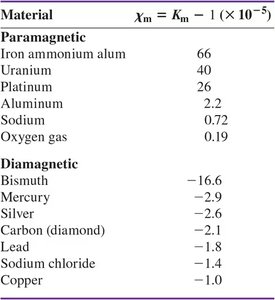
Additional info: Paramagnetic susceptibility decreases with increasing temperature due to thermal agitation.
Diamagnetism
Diamagnetic materials have no net atomic magnetic moment in the absence of an external field. When a field is applied, it induces a magnetic moment opposite to the field direction, resulting in a weak repulsion. Diamagnetic susceptibility is always negative and nearly temperature-independent.
Relative permeability \(K_m\) is slightly less than 1.
Examples: Bismuth, copper, silver, lead.
Ferromagnetism
Ferromagnetic materials, such as iron, cobalt, and nickel, exhibit strong interactions between atomic magnetic moments, causing them to align parallel in regions called domains. Even without an external field, these domains can result in a large net magnetization.
Domains are regions where atomic moments are aligned.
In the absence of a field, domains are randomly oriented, so the net magnetization is zero.
When an external field is applied, domains aligned with the field grow at the expense of others, increasing the net magnetization.
Relative permeability \(K_m\) can be much greater than 1 (up to 100,000).
Ferromagnetic materials can retain magnetization after the external field is removed (hysteresis).
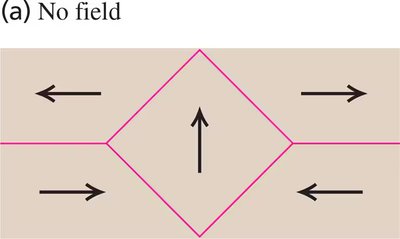
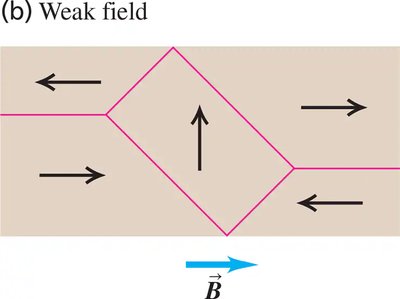
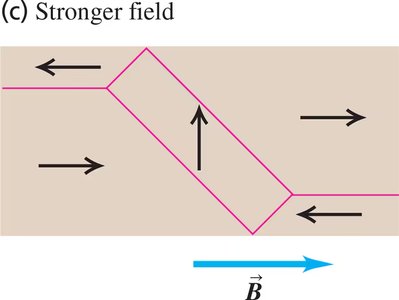
Additional info: The process of domain realignment under an external field explains the strong magnetization of ferromagnetic materials.
Saturation Magnetization
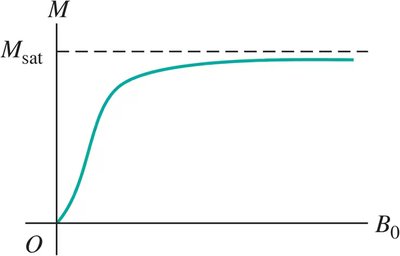
As the external field increases, a point is reached where nearly all domains are aligned with the field. This is called saturation magnetization, beyond which further increases in the field do not increase magnetization.
Hysteresis in Ferromagnetic Materials
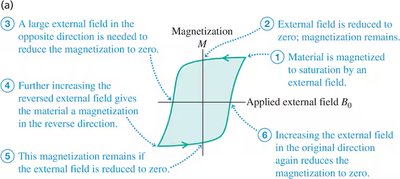
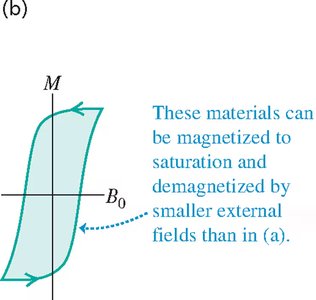
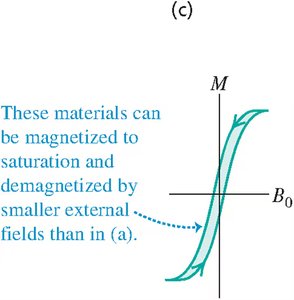
Ferromagnetic materials exhibit hysteresis: the magnetization depends on the history of the applied field. When the field is cycled, the magnetization traces out a loop (hysteresis loop), indicating energy loss during each cycle.
Materials with wide hysteresis loops are used for permanent magnets.
Materials with narrow loops are used in transformer cores and electromagnets to minimize energy loss.
Applications and Examples
Permanent Magnets: Made from materials with large, stable hysteresis loops (e.g., steel, Alnico).
Transformer Cores: Use soft iron with high permeability and low hysteresis loss.
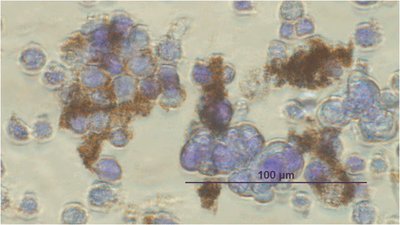
Medical Applications: Ferromagnetic nanoparticles can be used to target and remove cancer cells from the body.
Summary Table: Types of Magnetic Materials
Type | Magnetic Susceptibility (\(\chi_m\)) | Relative Permeability (\(K_m\)) | Behavior |
|---|---|---|---|
Paramagnetic | Small, positive | Slightly > 1 | Weakly attracted to magnets |
Diamagnetic | Small, negative | Slightly < 1 | Weakly repelled by magnets |
Ferromagnetic | Large, positive | \(\gg 1\) | Strongly attracted, can be permanently magnetized |
