 Back
BackMagnetism and Magnetic Fields: Foundations and Applications
Study Guide - Smart Notes
 Tailored notes based on your materials, expanded with key definitions, examples, and context.
Magnetism: Basic Concepts and Experiments
Magnetic Dipoles and Compasses
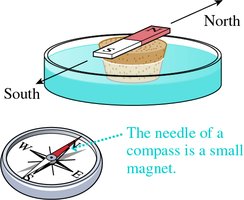
Magnetic dipoles, such as bar magnets, have two distinct poles: north and south. When allowed to rotate freely, a magnetic dipole will align itself so that one end consistently points toward the Earth's geographic north. This property is the basis for the operation of a compass, where the needle itself is a small magnet that aligns with the Earth's magnetic field.
Compass: A device with a magnetized needle that aligns with the Earth's magnetic field, pointing north-south.
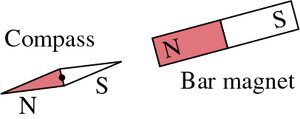
Magnetic Dipole: An object with a north and a south pole, such as a bar magnet.
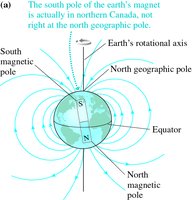
Identification of Poles: The north pole of a compass needle points toward the geographic north, which is actually near the Earth's magnetic south pole.
Magnetic Poles: Attraction and Repulsion
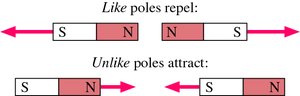
Magnets exhibit forces of attraction and repulsion depending on the orientation of their poles. Like poles repel each other, while unlike poles attract. This behavior is fundamental to understanding magnetic interactions.
Like Poles: North-north or south-south combinations repel each other.
Unlike Poles: North-south combinations attract each other.
Testing Poles: The pole that repels a known south pole and attracts a known north pole must itself be a south pole.
Magnetism as a Long-Range Force
Magnetism is a long-range force, meaning that magnets can exert forces on each other without direct contact. This property distinguishes magnetic forces from contact forces.
Magnetic Monopoles and Cutting Magnets
When a bar magnet is cut in half, each piece becomes a new, weaker magnet with both a north and a south pole. Magnetic monopoles (isolated north or south poles) have never been observed; all magnets are dipoles.
Magnetic Monopoles: Hypothetical particles with only one magnetic pole; not found in nature.
Dipole Nature: Cutting a magnet always results in two dipoles.

Magnetic Materials and Attraction
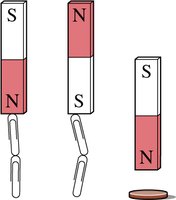
Magnets can attract certain materials, most notably iron, but not all substances are affected by magnetic fields. Materials such as copper, aluminum, glass, and plastic experience no force from a magnet. If an object is attracted to one pole of a magnet, it will also be attracted to the other pole.
Ferromagnetic Materials: Iron is the most common example.
Non-magnetic Materials: Copper, aluminum, glass, and plastic are not attracted to magnets.
Stationary Charges and Magnetism
Stationary electric charges do not interact with magnets; only moving charges (currents) can produce or experience magnetic effects.
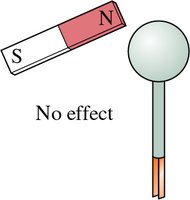
Distinction Between Magnetism and Electricity
Although magnetic poles and electric charges share some similar behaviors (such as attraction and repulsion), they are fundamentally different phenomena. Magnetism is not the same as electricity, though they are related through moving charges.
The Magnetic Field
Visualizing Magnetic Fields
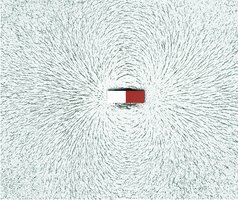
The magnetic field is a vector field that describes the influence a magnet or current exerts on its surroundings. Iron filings can be used to visualize magnetic field lines, as each filing acts like a tiny compass needle, aligning with the local magnetic field direction.
Field Lines: Indicate the direction and strength of the magnetic field; denser lines mean a stronger field.
Direction: Field lines emerge from the north pole and enter the south pole of a magnet.
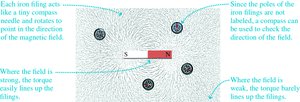
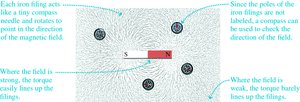
Magnetic Field Vectors and Field Lines
Magnetic fields can be represented by vectors at specific points or by continuous field lines. Field lines provide an overall picture of the field's structure, while vectors are useful for precise calculations at a point.
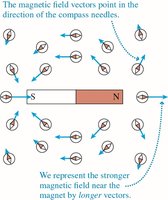
Field Lines for Single and Multiple Magnets
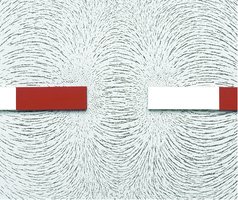
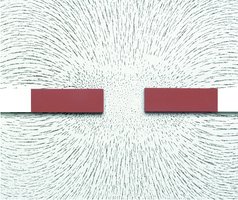
For a single bar magnet, field lines start at the north pole and end at the south pole. With multiple magnets, field lines can connect the north pole of one magnet to the south pole of another. Like poles placed near each other cause field lines to curve away, indicating repulsion.
Single Magnet: Field lines are denser near the poles, indicating stronger fields.
Two Magnets (Unlike Poles): Field lines connect from north to south across the gap.
Two Magnets (Like Poles): Field lines curve away from each other, showing repulsion.
Earth's Magnetic Field
The Earth itself acts as a giant magnet. The south magnetic pole of the Earth is located near the geographic north pole, which is why compass needles point north. However, the magnetic and geographic poles are not exactly coincident.
Electric Currents and Magnetic Fields
Oersted's Discovery
In 1819, Hans Christian Oersted discovered that an electric current in a wire causes a nearby compass needle to turn, demonstrating that electric currents produce magnetic fields. The direction of the field can be determined using the right-hand rule.
Right-Hand Rule: Point your thumb in the direction of the current; your fingers curl in the direction of the magnetic field lines.
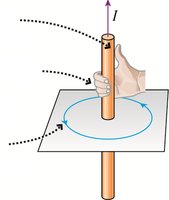
Magnetic Field of a Straight Wire
The magnetic field around a long, straight current-carrying wire forms concentric circles. The field strength decreases with distance from the wire.
Field Direction: Determined by the right-hand rule.
Field Strength: Inversely proportional to the distance from the wire.
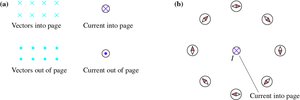
Source of the Magnetic Field: Moving Charges
Biot-Savart Law
All moving charges produce magnetic fields. The Biot-Savart law gives the magnetic field produced by a moving point charge:
μ₀ (Permeability Constant):
Direction: Given by the right-hand rule for the cross product of velocity and position vectors.
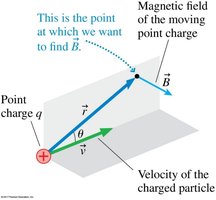

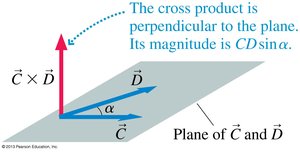
Magnetic Fields from Currents: Loops and Solenoids
Current Loops
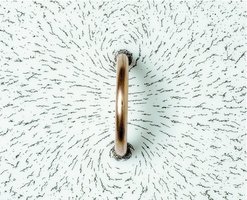
A current-carrying loop produces a magnetic field similar to that of a bar magnet, with a north and south pole. The field is strongest at the center of the loop and weaker farther away.
Field Lines: Form closed curves, emerging from the center and looping around.
Multiple Loops: The field at the center increases with the number of loops (N).
Solenoids
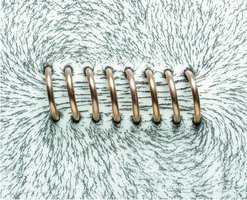
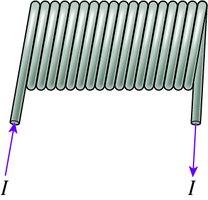
A solenoid is a coil of wire with many turns. When current flows through it, the magnetic field inside is strong and uniform, while the field outside is weak. The field strength inside a solenoid is proportional to the current and the number of turns per unit length.
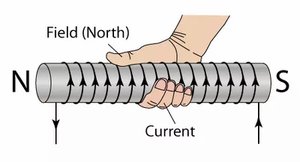
Right-Hand Rule for Loops (RHR-2): Curl your fingers in the direction of current; your thumb points toward the north pole of the solenoid.
Superposition of Magnetic Fields
When multiple sources of magnetic fields are present, the total magnetic field at any point is the vector sum of the individual fields. This principle is known as superposition and applies regardless of whether the sources are permanent magnets or currents.
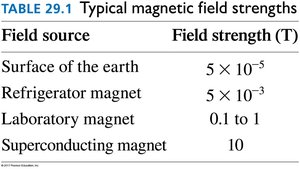
Summary Table: Typical Magnetic Field Strengths
Field Source | Field Strength (T) |
|---|---|
Surface of the earth | 5 × 10⁻⁵ |
Refrigerator magnet | 5 × 10⁻³ |
Laboratory magnet | 0.1 to 1 |
Superconducting magnet | 10 |
Additional info: This summary covers the foundational concepts of magnetism, including the behavior of magnetic dipoles, the nature of magnetic fields, the relationship between electricity and magnetism, and the properties of materials in magnetic fields. The right-hand rule is a recurring tool for determining the direction of magnetic fields and forces. The superposition principle is essential for analyzing complex magnetic field configurations.
