 Back
BackMagnetism and Magnetic Fields: Foundations and Applications
Study Guide - Smart Notes
 Tailored notes based on your materials, expanded with key definitions, examples, and context.
Magnetism: Basic Concepts
Introduction to Magnetism
Magnetism is a fundamental interaction between moving electric charges, resulting in attractive or repulsive forces. It is closely related to electricity and is described by the concept of the magnetic field, denoted as B. Magnetic fields are produced by moving charges (currents) and are responsible for the forces experienced by magnets and magnetic materials.
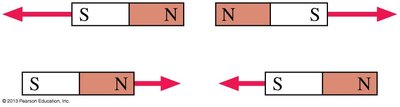
Magnetic Poles: Every magnet has two poles: a north pole and a south pole. Like poles repel, and unlike poles attract.
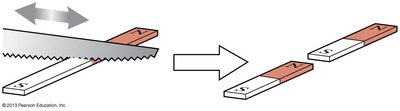
Magnetic Dipoles: Cutting a magnet in half results in two smaller magnets, each with a north and south pole. This property means that isolated magnetic monopoles do not exist in nature; all magnets are dipoles.
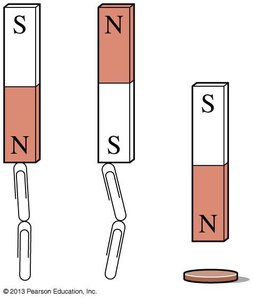
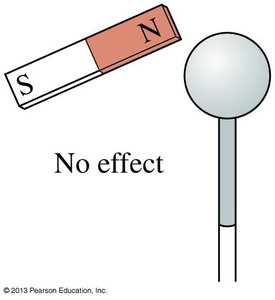
Magnetic Materials: Only certain materials (e.g., iron, nickel) are attracted to magnets and are called magnetic materials.
Magnetic Field and Field Lines
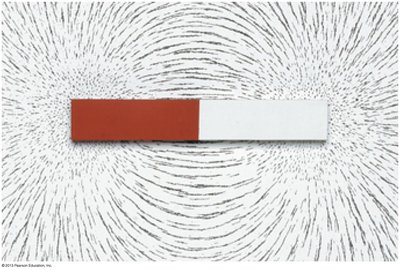
The magnetic field (B) is a vector field that describes the influence a magnet or current has on its surroundings. The direction of the field at any point is the direction a north pole would move if placed there. Magnetic field lines emerge from the north pole and enter the south pole, forming closed loops.
Visualizing Fields: Iron filings align along magnetic field lines, revealing the field's structure.
Field Strength: The density of field lines indicates the strength of the magnetic field; closer lines mean a stronger field.
Earth's Magnetic Field
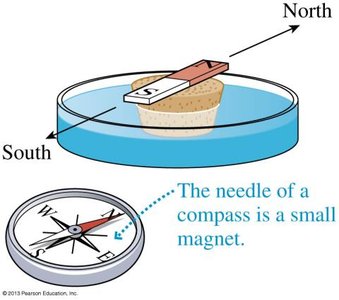
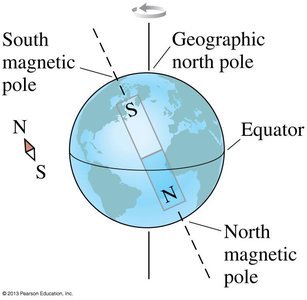
Earth itself acts as a giant magnet due to currents in its molten iron core. The geographic north pole is actually a magnetic south pole, which is why compass needles point north. The magnetic poles are not fixed and can reverse over geological time scales (geomagnetic reversal).
Magnetic Fields and Electric Currents
Currents Create Magnetic Fields
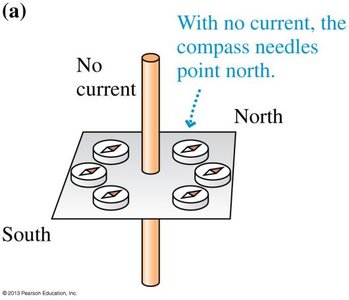
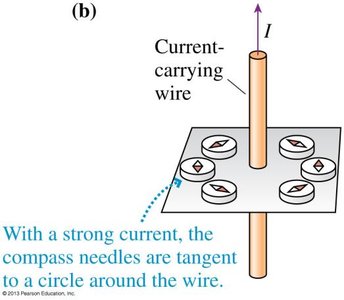
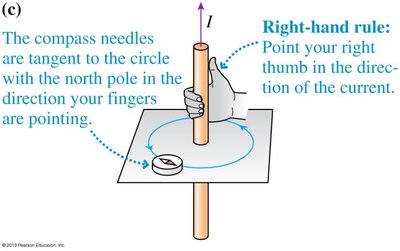
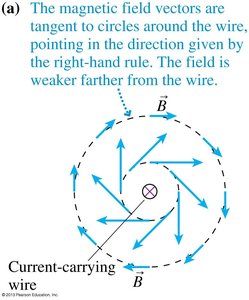
Electric currents generate magnetic fields. This was first observed when a compass needle deflected near a current-carrying wire. The field lines produced by a straight current-carrying wire are concentric circles around the wire, with direction given by the right-hand rule:
Point your right thumb in the direction of the current; your fingers curl in the direction of the magnetic field.
Notation for Field Directions
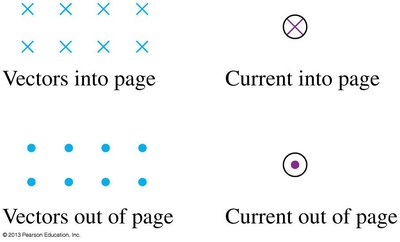
In diagrams, vectors into the page are shown as crosses (×), and vectors out of the page as dots (•). This notation is essential for representing three-dimensional fields in two dimensions.
Mathematical Tools: The Cross Product
Definition and Properties
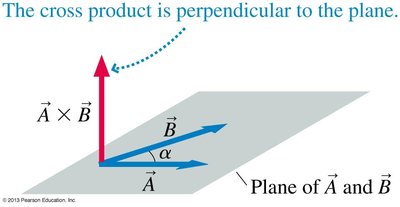
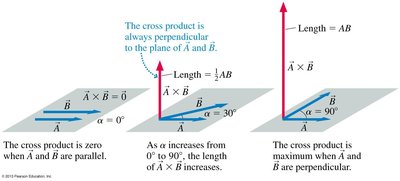
The cross product of two vectors A and B is a vector perpendicular to both, with magnitude:
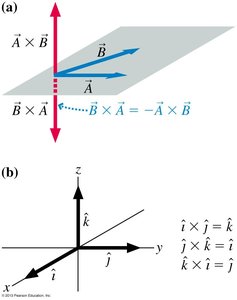
where is the angle between A and B. The direction is determined by the right-hand rule.
The cross product is zero if the vectors are parallel ( or ).
It is maximum when the vectors are perpendicular ().
The cross product is anti-commutative: .
Sources of Magnetic Fields
Biot-Savart Law
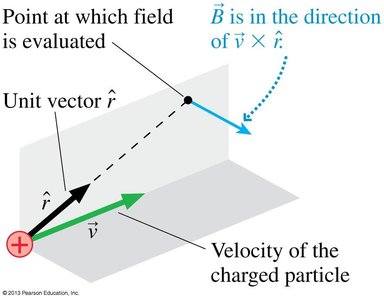
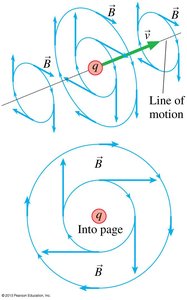
The Biot-Savart law gives the magnetic field produced by a moving point charge:
where is the permeability of free space, is the charge, is its velocity, is the unit vector from the charge to the field point, and is the distance.
The field is zero along the line of motion ().
For a negative charge, the field direction reverses.
Magnetic Field of a Current-Carrying Wire
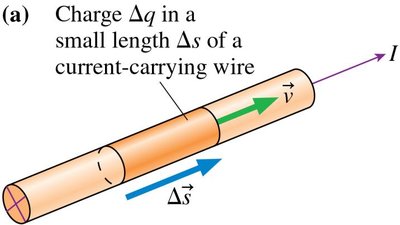
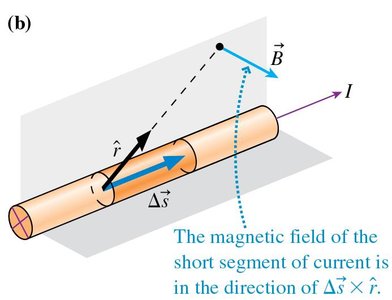
For a small segment of a current-carrying wire, the Biot-Savart law becomes:
For a long, straight wire, the field at distance is:
The field lines encircle the wire, and the direction is given by the right-hand rule.
Magnetic Field of a Current Loop
A current loop produces a magnetic field similar to a bar magnet. On the axis of a loop of radius carrying current :
For points far from the loop ():
, where is the magnetic dipole moment.
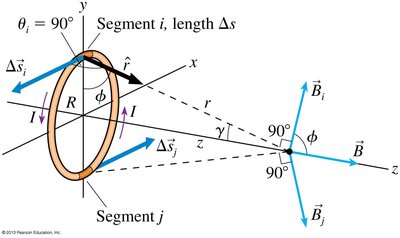
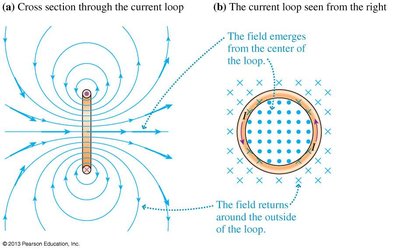
Magnetic Dipoles and Electromagnets
A current loop acts as a magnetic dipole, with a dipole moment (area times current). The field lines of a current loop and a bar magnet are similar, and the north pole is defined as the side from which the field emerges.
Solenoids and Uniform Magnetic Fields
A solenoid is a coil of wire with many turns, producing a nearly uniform magnetic field inside when current flows. For an ideal solenoid (long and tightly wound):
where is the number of turns per unit length. Solenoids are used in devices like MRI machines and electromagnets.
Magnetic Forces
Force on Moving Charges
The force on a charge moving with velocity in a magnetic field is:
The force is perpendicular to both and .
No force acts if the velocity is parallel or antiparallel to the field.
The force is maximum when is perpendicular to .
Circular Motion: Cyclotron Motion
A charged particle moving perpendicular to a uniform magnetic field undergoes circular motion (cyclotron motion). The radius of the path is:
The period of revolution is:
This principle is used in devices like mass spectrometers and cyclotrons.
Magnetic Properties of Matter
Atomic Origins of Magnetism
Magnetism in materials arises from the motion of electrons (orbital and spin). In most materials, these effects cancel out, resulting in weak or no magnetism. In ferromagnetic materials (e.g., iron, nickel), atomic magnetic moments align in regions called domains, producing strong magnetism.
Induced Magnetism: External fields can align domains, inducing a net magnetic dipole.
Permanent Magnets: If domains remain aligned after the external field is removed, the material becomes a permanent magnet.
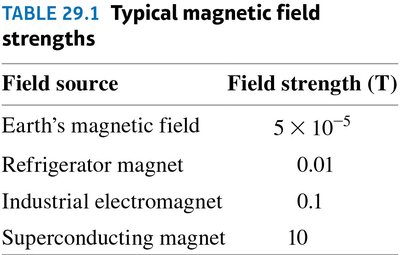
Representative Magnetic Field Strengths
Field source | Field strength (T) |
|---|---|
Earth’s magnetic field | 5 × 10⁻⁵ |
Refrigerator magnet | 0.01 |
Industrial electromagnet | 0.1 |
Superconducting magnet | 10 |
Summary
Magnetism is a result of moving charges and is described by the magnetic field B.
Magnetic fields are produced by currents and affect other currents and magnetic materials.
The cross product and right-hand rule are essential tools for understanding directions of fields and forces.
Applications include electric motors, MRI machines, and mass spectrometers.
