 Back
BackMagnetism and Magnetic Fields: Principles and Biomedical Applications
Study Guide - Smart Notes
 Tailored notes based on your materials, expanded with key definitions, examples, and context.
Magnetism and Magnetic Fields
Permanent Magnets and Magnetic Poles
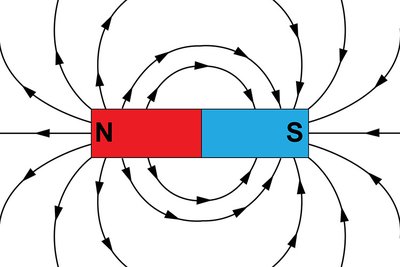
Permanent magnets are materials that naturally exhibit magnetic properties, possessing both a north and south pole. The origin of magnetism in these materials is linked to the coordinated movement of electrons, which generates electric currents. The Earth's magnetic field, produced by the motion of molten iron and nickel in its outer core, is essential for navigation and protection from solar wind.
Magnetic poles always exist as pairs; splitting a magnet results in new pairs of north and south poles.
Earth's magnetic field enables migration in organisms and shields the planet from solar wind.
Magnetic compass aligns with Earth's magnetic field and has been used for navigation since the 11th century.
Magnetic Materials
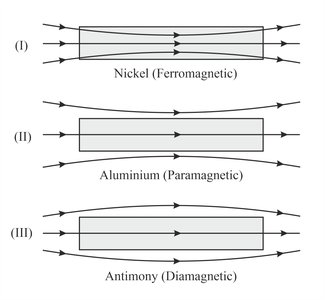
Magnetic materials are classified based on their response to external magnetic fields. The three main types are ferromagnetic, paramagnetic, and diamagnetic materials.
Ferromagnetic: Strongly attracted by magnetic fields; can become temporary magnets (e.g., iron, nickel).
Paramagnetic: Weakly attracted by magnetic fields (e.g., aluminium, platinum).
Diamagnetic: Repelled by magnetic fields (e.g., mercury, copper, water).
Magnetic Poles vs. Electric Charges
Magnetic poles always exist in pairs (north and south), whereas electric charges can exist as isolated monopoles (positive or negative). The interaction rules are similar: like poles or charges repel, opposite attract.
Electric charges: Monopoles; can exist alone as positive or negative.
Magnetic poles: Always paired; splitting a magnet creates new pairs.
Interaction: Like repels, opposite attracts.
Magnetism and Currents
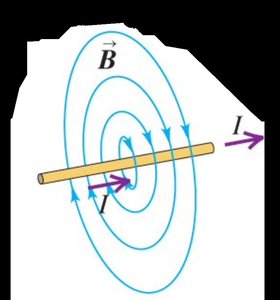
Magnetism is fundamentally related to moving electric charges. H.C. Oersted demonstrated in 1820 that a current-carrying wire affects a nearby compass needle, showing that moving charges create magnetic fields.
Moving charges generate magnetic fields.
Direction of magnetic field depends on the direction of current.
Origins and Properties of Magnetic Field
The magnetic field (B-field) is a vector quantity that mediates magnetic interactions. It is generated by moving charges or currents and is represented by the symbol \mathbf{B}. The direction of the field is indicated by the north pole of a compass needle.
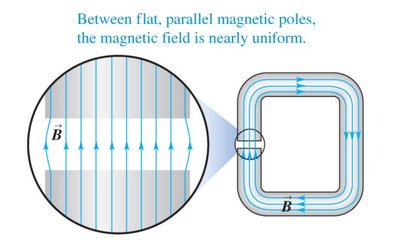
Magnetic field lines are directed from north to south and always form closed loops.
Field lines are tangent to the magnetic field at any point and do not cross.
Uniform magnetic field exists between flat, parallel magnetic poles.
Magnetic Field vs. Electric Field
Electric fields arise from charges at rest and exert forces on both moving and static charges. Magnetic fields arise from magnets or moving charges (currents) and exert forces only on moving charges.
Electric field (\mathbf{E}): Acts on static and moving charges.
Magnetic field (\mathbf{B}): Acts only on moving charges.
Magnetic Force on a Moving Particle
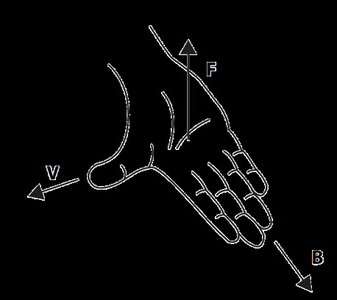
The magnetic force (\mathbf{F}) on a moving charge is always perpendicular to both the velocity (\mathbf{v}) and the magnetic field (\mathbf{B}). The magnitude and direction are given by:
Formula:
Magnitude:
Units: Tesla (T), where
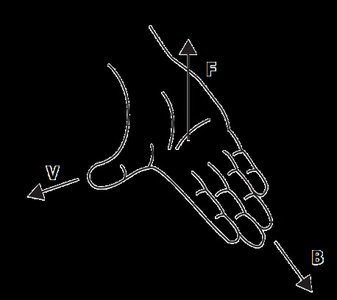
Right-hand rule: For a positive charge, fingers point in the direction of \mathbf{B}, thumb in the direction of \mathbf{v}, and the force comes out of the palm. For a negative charge, the force is opposite.
Magnetic Flux and Gauss's Law for Magnetism
Magnetic flux quantifies the total magnetic field passing through a surface. It is defined as:
Formula:
SI unit: Weber (Wb),
Gauss's Law for Magnetism: The net magnetic flux through any closed surface is zero, reflecting that magnetic field lines always form closed loops.
Formula:
Motion of Charged Particles in Magnetic Fields
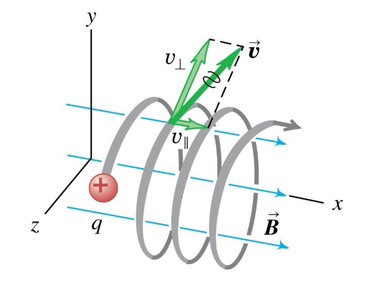
When a charged particle moves in a magnetic field, the force is perpendicular to its velocity, causing circular or helical motion depending on the angle between velocity and field.
Circular motion: If velocity is perpendicular to \mathbf{B}, the radius is
Helical motion: If velocity has a component parallel to \mathbf{B}, the path is a helix.
Velocity Selection Using Electric and Magnetic Fields
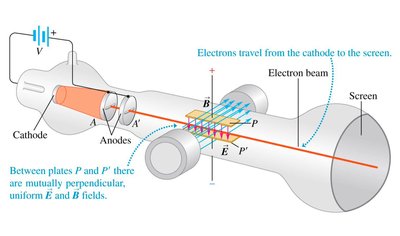
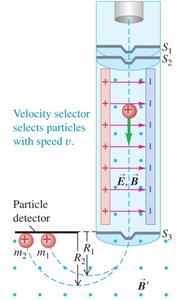
A velocity selector uses perpendicular electric and magnetic fields to select particles of a specific speed. The particle moves in a straight line only if the magnetic force cancels the electric force:
Condition:
Mass Spectrometry and Biomedical Applications
Mass spectrometry uses magnetic fields to separate ions based on their charge-to-mass ratio. Biomedical applications include protein characterization, drug monitoring, and cancer research.
Radius of path:
Applications: Protein sequencing, therapeutic drug monitoring, biomarker discovery.
Sources of Magnetic Field
Magnetic Field of a Moving Charge
A moving charge generates a magnetic field, which depends on the velocity, distance, and the charge itself. The permeability constant is .
Formula:
Biot-Savart Law
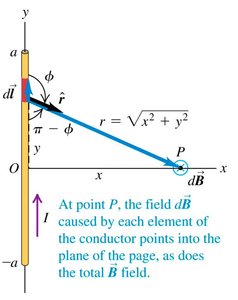
The Biot-Savart Law describes the magnetic field produced by a current-carrying conductor:
Formula:
Magnetic Field of a Straight Current-Carrying Conductor
The magnetic field produced by a straight current-carrying conductor is given by:
Formula:
Direction: Determined by the right-hand rule.
Force Between Parallel Conductors
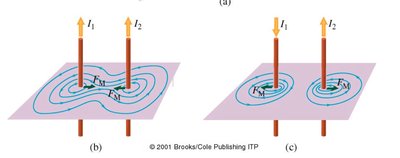
Parallel current-carrying conductors exert forces on each other. Parallel currents attract, anti-parallel currents repel.
Force per unit length:
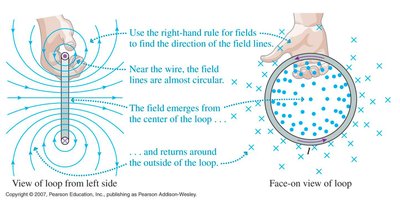
Magnetic Field of a Circular Current Loop
The magnetic field at the center of a current loop of radius is:
Formula:
For a coil with turns:
Ampere's Law
Ampere's Law relates the circulation of the magnetic field around a closed loop to the total current passing through the loop:
Formula:
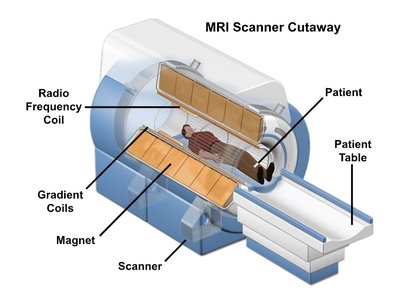
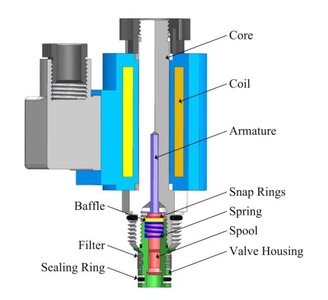
Solenoids and Applications
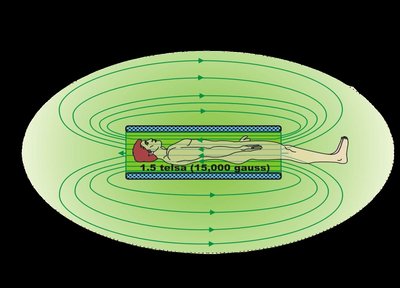
A solenoid is a coil of wire designed to produce a uniform magnetic field. The field inside a solenoid is given by:
Formula: where is the number of turns per unit length.
Applications: MRI scanners, solenoid pumps/valves, blood pressure monitoring.
Summary Table: Types of Magnetic Materials
Type | Response to Magnetic Field | Examples |
|---|---|---|
Ferromagnetic | Strong attraction, can become temporary magnets | Iron, Nickel |
Paramagnetic | Weak attraction | Aluminium, Platinum |
Diamagnetic | Repelled by magnetic field | Mercury, Copper, Water |
Additional info: Table summarizes the classification and properties of magnetic materials as discussed in the notes.
