 Back
BackMagnetism and Magnetic Fields: Step-by-Step Physics Guidance
Study Guide - Smart Notes
 Tailored notes based on your materials, expanded with key definitions, examples, and context.
Q1. Why does a compass needle sometimes dip downward instead of staying parallel to the Earth's surface?
Background
Topic: Earth's Magnetic Field and Magnetic Dip
This question tests your understanding of how Earth's magnetic field lines are oriented and how a compass needle aligns with them.
Key Terms:
Magnetic field lines: Invisible lines representing the direction and strength of Earth's magnetic field.
Dip angle: The angle between the magnetic field line and the horizontal ground.
Step-by-Step Guidance
Recall that a compass needle aligns itself with Earth's magnetic field lines.
Understand that Earth's magnetic field lines are not always horizontal; they can tilt downward or upward depending on your location.
Recognize that the dip angle measures how much the field lines tilt into the ground.
When the field lines tilt downward, one end of the compass needle will dip below the horizontal plane.
Try solving on your own before revealing the answer!
Final Answer:
The compass needle dips downward because Earth's magnetic field lines are not perfectly horizontal; they tilt into the ground, causing the needle to align with the dip angle.
Q2. What is the direction of the magnetic field lines around a straight wire carrying a current directly away from you?
Background
Topic: Magnetic Field Around a Current-Carrying Wire
This question tests your understanding of the right-hand rule and the direction of magnetic field lines produced by a current.
Key Terms and Formula:
Right-hand rule: A method to determine the direction of the magnetic field around a wire.
Magnetic field lines: Circles centered on the wire.
Step-by-Step Guidance
Point your right thumb in the direction of the current (away from you).
Curl your fingers around the wire; the direction your fingers curl is the direction of the magnetic field lines.
Observe that the field lines form circles around the wire.
For a current moving away from you, the field lines are clockwise when viewed from your perspective.
Try solving on your own before revealing the answer!
Final Answer:
The magnetic field lines form clockwise circles around the wire when the current is moving away from you.
Q3. In what direction is the force on a wire passing between the poles of a vertically held horseshoe magnet (north pole left, south pole right) carrying a current directly away from you?
Background
Topic: Magnetic Force on a Current-Carrying Wire
This question tests your ability to use the right-hand rule to determine the direction of the force on a wire in a magnetic field.
Key Terms and Formula:
Right-hand rule: Used to find the direction of force () on a current-carrying wire.
Magnetic field (): Points from north to south pole.
Current (): Direction of flow of positive charge.
Force formula:
Step-by-Step Guidance
Identify the direction of the magnetic field: from left (north) to right (south).
Point your fingers in the direction of the current (away from you).
Curl your fingers in the direction of the magnetic field (to the right).
Your thumb points in the direction of the force (downward).
Try solving on your own before revealing the answer!
Final Answer:
The force on the wire is downward, as determined by the right-hand rule.
Q4. Will a magnet attract any metallic object, such as those made of aluminum or copper? Why or why not?
Background
Topic: Magnetic Properties of Materials
This question tests your understanding of ferromagnetic, paramagnetic, and diamagnetic materials.
Key Terms:
Ferromagnetic materials: Materials strongly attracted to magnets (e.g., iron, cobalt, nickel).
Paramagnetic and diamagnetic materials: Weakly attracted or repelled by magnets (e.g., aluminum, copper).
Magnetic domains: Regions within ferromagnetic materials where magnetic moments are aligned.
Step-by-Step Guidance
Recall that magnets attract ferromagnetic materials due to domain alignment.
Understand that aluminum and copper are not ferromagnetic; their domains do not align strongly.
Recognize that only materials with magnetic domains that can align will be attracted to a magnet.
Consider examples: paper clips (iron) are attracted, coins (copper/aluminum) are not.
Try solving on your own before revealing the answer!
Final Answer:
A magnet will only attract ferromagnetic materials, not all metals like aluminum or copper.
Q5. Two iron bars attract each other no matter which ends are placed close together. Are both magnets? Explain.
Background
Topic: Magnetism and Induced Magnetism
This question tests your understanding of how magnets interact with non-magnetic materials.
Key Terms:
Magnet: An object with a north and south pole.
Induced magnetism: When a magnet causes a non-magnetic material to become temporarily magnetic.
Step-by-Step Guidance
Recall that two magnets will attract or repel depending on pole orientation.
If two bars always attract, consider that one may be a magnet and the other a non-magnet.
The magnet induces domain alignment in the non-magnetic bar, causing attraction.
If both were magnets, repulsion would occur with like poles facing each other.
Try solving on your own before revealing the answer!
Final Answer:
No, both are not magnets. One is a magnet and the other is a non-magnetic iron bar.
Q6. How does the magnetic field due to current in home wires affect a compass? Discuss the effect for AC and DC currents.
Background
Topic: Magnetic Fields from Electric Currents
This question tests your understanding of how alternating (AC) and direct (DC) currents produce magnetic fields and their effect on a compass.
Key Terms:
AC (Alternating Current): Current changes direction periodically.
DC (Direct Current): Current flows in one direction.
Magnetic field: Produced by moving charges (current).
Step-by-Step Guidance
Recall that a compass responds to steady magnetic fields.
AC current changes direction rapidly (60 times per second), so the magnetic field also changes rapidly.
The compass needle cannot respond quickly enough to follow the changing field.
DC current produces a steady magnetic field, which can affect the compass if close enough.
Most house wires have paired currents in opposite directions, causing their fields to mostly cancel out.
Try solving on your own before revealing the answer!
Final Answer:
AC currents do not noticeably affect a compass due to rapid changes; DC currents can affect a compass if the field is steady and strong enough.
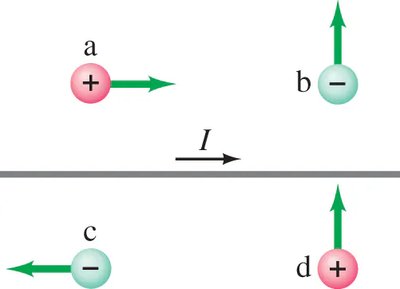
Q7. Use the right-hand rule to determine the direction of the force on each particle in the diagram. The magnetic field is coming out of the page above the wire and into the page below the wire.
Background
Topic: Magnetic Force on Moving Charges
This question tests your ability to use the right-hand rule to determine the direction of force on charged particles in a magnetic field.
Key Terms and Formula:
Right-hand rule: Used for positive charges; left-hand rule for negative charges.
Magnetic force formula:
Direction of : Out of the page (above wire), into the page (below wire).
Step-by-Step Guidance
For each particle, identify its charge and velocity direction.
Apply the right-hand rule for positive charges: fingers in direction of velocity, palm in direction of field, thumb points in direction of force.
For negative charges, reverse the direction found using the right-hand rule.
Determine the force direction for each particle based on its position relative to the wire and the field direction.
Try solving on your own before revealing the answer!
Final Answer:
a: Force down, toward the wire b: Force to the left, opposite of the direction of the current c: Force up, toward the wire d: Force to the left, opposite of the direction of the current
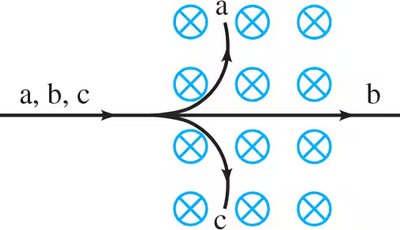
Q8. Three particles a, b, c enter a magnetic field and follow paths as shown. What can you say about the charge on each particle?
Background
Topic: Motion of Charged Particles in Magnetic Fields
This question tests your understanding of how the direction of force relates to the sign of the charge using the right-hand rule.
Key Terms and Formula:
Right-hand rule: Determines force direction for positive charges.
Magnetic force formula:
Field direction: Into the page (represented by x's).
Step-by-Step Guidance
Observe the initial direction of force for each particle as it enters the field.
Apply the right-hand rule for positive charges; for negative charges, reverse the direction.
Analyze the path: upward force means positive charge, downward force means negative charge, straight path means uncharged.
Match each particle's path to its charge based on the force direction.
Try solving on your own before revealing the answer!
Final Answer:
a: Positive charge b: Uncharged c: Negative charge
Q9. Why does a strong magnet held near a CRT television screen cause the picture to become distorted or go black?
Background
Topic: Magnetic Fields and Electron Beams in CRTs
This question tests your understanding of how magnetic fields affect moving charges (electrons) in a cathode ray tube.
Key Terms and Formula:
CRT (Cathode Ray Tube): Uses electron beams to create images.
Magnetic force formula:
Deflection: Magnetic field bends electron paths.
Step-by-Step Guidance
Recall that CRT screens use electron beams to light up specific spots.
Understand that a magnetic field exerts a force on moving electrons, changing their direction.
When electrons are deflected, they hit different spots, causing distortion.
If the field is strong enough, electrons may miss the screen entirely, causing black spots.
Try solving on your own before revealing the answer!
Final Answer:
The magnetic field bends electron paths, distorting the image or causing black spots where electrons are deflected away from their intended targets.
Q10. Suppose you have three iron rods, two of which are magnetized but the third is not. How would you determine which two are magnets without using any additional objects?
Background
Topic: Identifying Magnets
This question tests your understanding of how magnets interact with each other and with non-magnetic materials.
Key Terms:
Magnet: Has both attractive and repulsive interactions.
Non-magnet: Only attracted, never repelled.
Step-by-Step Guidance
Test each rod end against the others to see if they attract or repel.
Repulsion only occurs between two magnets with like poles facing each other.
Attraction can occur between a magnet and a non-magnet.
Identify the two rods that repel each other; these are the magnets.
Try solving on your own before revealing the answer!
Final Answer:
The two rods that repel each other are the magnets; the third is not magnetized.
Q11. Can you set a resting electron into motion with a magnetic field? With an electric field? Explain.
Background
Topic: Forces on Charged Particles
This question tests your understanding of how electric and magnetic fields interact with stationary and moving charges.
Key Terms and Formula:
Magnetic force:
Electric force:
Step-by-Step Guidance
Recall that the magnetic force depends on velocity; if , then .
Understand that the electric force acts on any charge, regardless of motion.
Conclude that a magnetic field cannot move a resting electron, but an electric field can.
Consider the equations: for stationary electron, for stationary electron.
Try solving on your own before revealing the answer!
Final Answer:
A magnetic field cannot move a resting electron, but an electric field can.
Q12. A charged particle moves in a straight line through a region of space. Could there be a nonzero magnetic field in this region? If so, give two possible situations.
Background
Topic: Motion of Charged Particles in Fields
This question tests your understanding of conditions under which a magnetic field does not affect a moving charge.
Key Terms and Formula:
Magnetic force:
Electric force:
Step-by-Step Guidance
Recall that the magnetic force is zero if is parallel or antiparallel to .
Consider the case where electric and magnetic forces cancel each other out, resulting in zero net force.
In both cases, the particle continues in a straight line despite the presence of a magnetic field.
Think about the equations: or .
Try solving on your own before revealing the answer!
Final Answer:
Yes, if the velocity is parallel to the field or if electric and magnetic forces cancel, the particle moves straight.
Q13. What would be the effect on the magnetic field inside a long solenoid if (a) the diameter of all the loops was doubled, (b) the spacing between loops was doubled, or (c) the solenoid’s length was doubled along with a doubling in the total number of loops?
Background
Topic: Magnetic Field in a Solenoid
This question tests your understanding of how the geometry of a solenoid affects the magnetic field inside it.
Key Terms and Formula:
Solenoid: A coil of wire producing a uniform magnetic field inside.
Magnetic field formula:
: Number of turns per unit length.
Step-by-Step Guidance
For (a), note that the formula for does not depend on the diameter of the loops.
For (b), doubling the spacing between loops halves the number of turns per unit length (), so decreases by half.
For (c), doubling both length and number of loops keeps constant, so is unchanged.
Use the formula to analyze each scenario.
Try solving on your own before revealing the answer!
Final Answer:
(a) No effect; (b) decreases by half; (c) No effect.
Q14. How does a relay work using a solenoid and an iron rod?
Background
Topic: Electromagnetic Devices
This question tests your understanding of how a solenoid can be used to control a circuit via a relay.
Key Terms:
Relay: An electromagnetic switch.
Solenoid: Coil of wire producing a magnetic field.
Iron rod: Becomes magnetized inside the solenoid.
Step-by-Step Guidance
Place the iron rod inside the solenoid; when current flows, the rod becomes magnetized.
The magnetic field attracts a piece of iron on a pivot, moving it toward a switch.
The switch closes, allowing current to flow in the main circuit.
The relay uses a small current to control a larger current.
Try solving on your own before revealing the answer!
Final Answer:
The solenoid magnetizes the iron rod, which attracts the pivoted iron piece, closing the switch and allowing current to flow.
Q15. Describe the path of magnetic field lines for a simple bar magnet.
Background
Topic: Magnetic Field Lines
This question tests your understanding of the direction and path of magnetic field lines around a bar magnet.
Key Terms:
Magnetic field lines: Path taken by the magnetic field from north to south pole.
Bar magnet: Has a north and south pole.
Step-by-Step Guidance
Field lines leave the north pole and travel through space to the south pole.
Field lines return through the magnet from south to north inside the magnet.
The full loop is: North → South (outside), South → North (inside).
Visualize the field lines as continuous loops.
Try solving on your own before revealing the answer!
Final Answer:
Magnetic field lines leave the north pole, travel through space to the south pole, and return inside the magnet from south to north.
