 Back
BackMagnetism, Electromagnetic Induction, and Transformers: Study Notes
Study Guide - Smart Notes
 Tailored notes based on your materials, expanded with key definitions, examples, and context.
Magnetism and Magnetic Forces
Force on a Moving Charge in a Magnetic Field
The force experienced by a charged particle moving through a magnetic field is given by the Lorentz force law. This force is always perpendicular to both the velocity of the particle and the direction of the magnetic field.
Formula: (for perpendicular velocity and field)
Right-Hand Rule: For a positive charge, point your fingers in the direction of velocity (v), curl them toward the magnetic field (B), and your thumb points in the direction of the force (F). For a negative charge, the force is in the opposite direction.
Circular Motion: If the velocity is perpendicular to the magnetic field, the particle moves in a circle. The magnetic force provides the centripetal force:
Example: An electron moving at right angles to a uniform magnetic field will follow a circular path due to the constant perpendicular force.
Force on a Current-Carrying Wire
A wire carrying current in a magnetic field experiences a force, which is the basis for electric motors.
Formula: (where I is current, L is length of wire in the field)
Right-Hand Rule for Wires: Point your thumb in the direction of current, fingers in the direction of the magnetic field, and your palm faces the direction of the force.
Example: The force on a straight wire segment in a uniform magnetic field is maximized when the wire is perpendicular to the field.
Magnetic Field of a Wire
A current-carrying wire generates a magnetic field that circles the wire. The direction is given by the right-hand grip rule: thumb in the direction of current, fingers curl in the direction of the magnetic field lines.
Formula: (for a long straight wire)
Example: The magnetic field strength decreases as you move farther from the wire.
Electromagnetic Induction
Faraday's Law and Induced EMF
When a conductor moves through a magnetic field, an electromotive force (EMF) is induced across it. This is the principle behind electric generators.
Formula: (for a straight conductor of length L moving at velocity v perpendicular to field B)
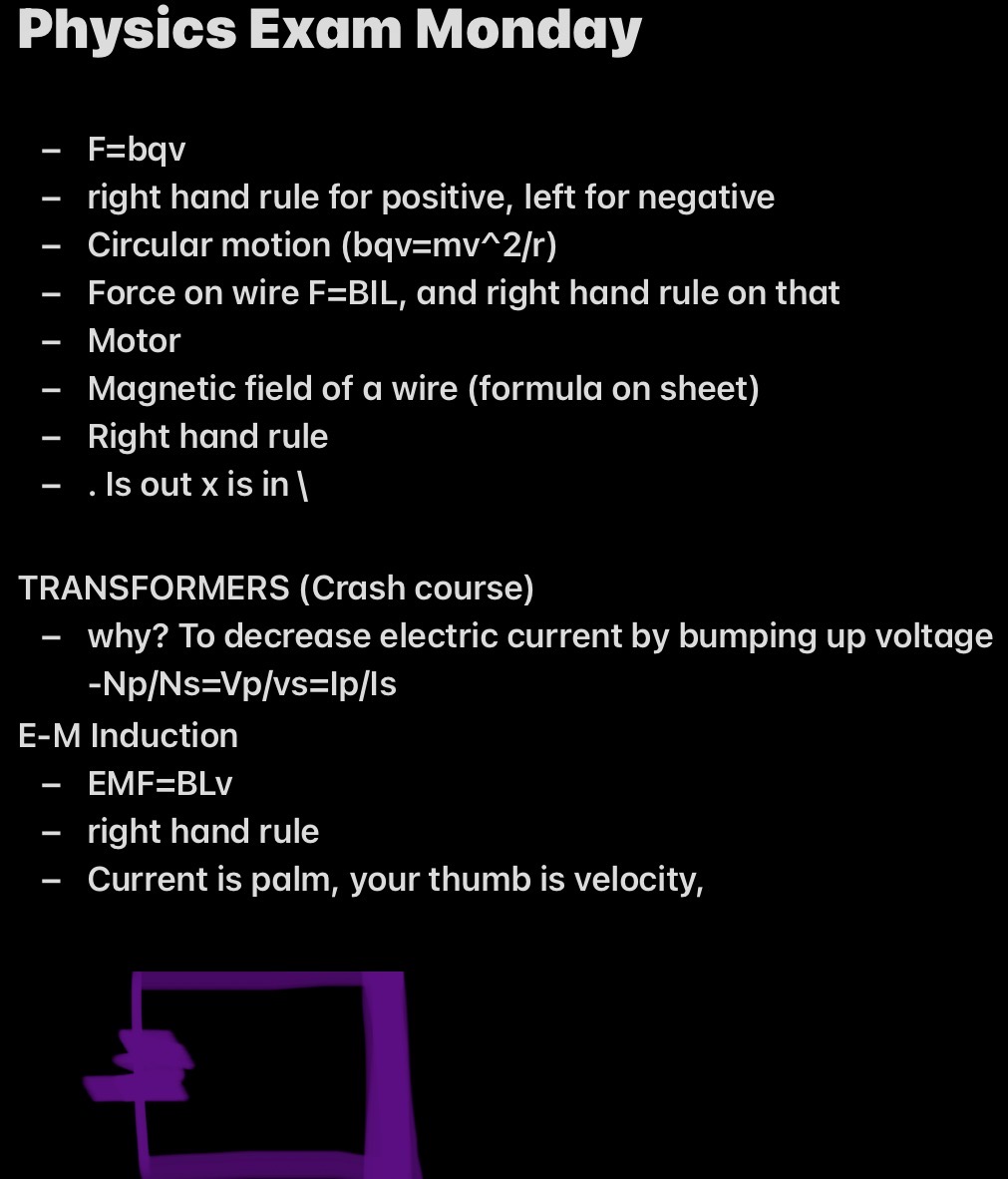
Right-Hand Rule for Induction: Point your fingers in the direction of the magnetic field, thumb in the direction of velocity, and your palm faces the direction of the induced current (for positive charges).
Example: Moving a metal rod through a magnetic field induces a voltage across its ends.
Transformers
Principle and Purpose
Transformers are devices used to change the voltage of alternating current (AC) electricity. They operate on the principle of electromagnetic induction and are essential for efficient power transmission.
Purpose: To decrease electric current by increasing voltage, reducing energy loss in transmission lines.
Transformer Equation: Where N = number of turns, V = voltage, I = current, p = primary, s = secondary.
Example: A step-up transformer increases voltage and decreases current for long-distance power transmission.
Summary Table: Key Formulas and Rules
Concept | Formula | Right-Hand Rule |
|---|---|---|
Force on charge | Fingers: v, Curl: B, Thumb: F | |
Force on wire | Thumb: I, Fingers: B, Palm: F | |
Induced EMF | Fingers: B, Thumb: v, Palm: I | |
Transformer | N/A |
Additional info: The notes reference the right-hand rule multiple times, which is a fundamental tool for determining directions of forces, fields, and currents in electromagnetism. The image provided visually reinforces the right-hand rule for electromagnetic induction.
