 Back
BackMagnetism: Magnetic Fields and Forces
Study Guide - Smart Notes
 Tailored notes based on your materials, expanded with key definitions, examples, and context.
Magnetism
Introduction to Magnetic Fields
Magnetism is a fundamental force of nature, closely related to electricity, and is described by the behavior of magnetic fields and their interactions with charges and currents. Magnetic fields are vector fields that exert forces on moving charges and magnetic materials.
Magnetic Field (\(\vec{B}\)): A region in space where a magnetic force can be detected, typically produced by moving electric charges (currents) or magnetic materials.
Magnetic Field Lines: Imaginary lines used to represent the direction and strength of a magnetic field. The density of lines indicates field strength; lines point from north to south outside a magnet.
SI Unit: The tesla (T), where 1 T = 1 N/(A·m).
Magnetic Forces
Magnetic fields exert forces on moving charges and on current-carrying wires. The direction and magnitude of these forces are determined by the right-hand rule and the cross product.
Force on a Moving Charge: A charge \(q\) moving with velocity \(\vec{v}\) in a magnetic field \(\vec{B}\) experiences a force given by:
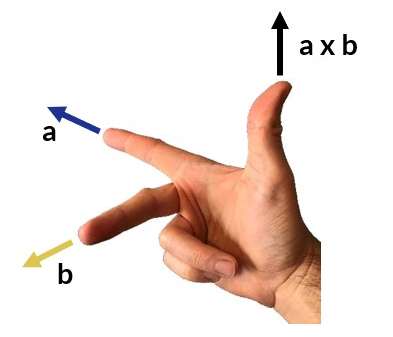
Direction: Determined by the right-hand rule (see image below).
Magnitude: , where \(\theta\) is the angle between \(\vec{v}\) and \(\vec{B}\).
Force on a Current-Carrying Wire: For a wire of length \(\vec{L}\) carrying current \(I\):
Cross Product and the Right-Hand Rule
The cross product is a mathematical operation used to determine the direction of the force in magnetic interactions. The right-hand rule is a mnemonic for finding the direction of the result of a cross product.
Right-Hand Rule: Point your fingers in the direction of the first vector (\(\vec{a}\)), curl them toward the second vector (\(\vec{b}\)), and your thumb points in the direction of the cross product (\(\vec{a} \times \vec{b}\)).
Application: Used to determine the direction of the magnetic force on a moving charge or current.
Magnetic Field Lines
Magnetic field lines provide a visual representation of the direction and strength of magnetic fields. They emerge from the north pole of a magnet and enter the south pole, forming closed loops.
Properties:
Field lines never cross.
The closer the lines, the stronger the field.
Inside a bar magnet, field lines run from south to north.
Earth's Magnetic Field: The Earth acts as a giant magnet with a magnetic field similar to that of a bar magnet.
Summary Table: Key Magnetic Quantities
Quantity | Symbol | SI Unit | Formula |
|---|---|---|---|
Magnetic Field | \(\vec{B}\) | Tesla (T) | — |
Magnetic Force (charge) | \(\vec{F}\) | Newton (N) | |
Magnetic Force (wire) | \(\vec{F}\) | Newton (N) |
Example: Force on a Moving Charge
A proton (\(q = +1.6 \times 10^{-19}\) C) moves at \(2 \times 10^6\) m/s perpendicular to a magnetic field of 0.5 T. The force is:
