 Back
BackMagnetism: Magnetic Fields, Forces, and Applications
Study Guide - Smart Notes
 Tailored notes based on your materials, expanded with key definitions, examples, and context.
Chapter 22: Magnetism
The Magnetic Field
Magnetic fields are fundamental to the study of magnetism and are produced by moving electric charges or magnetic materials. The magnetic field, denoted by B, is measured in Tesla (T) and can be visualized using magnetic field lines, which indicate the direction and strength of the field.
Definition: The magnetic field is a vector field that describes the influence of magnetic forces in a region of space.
Field Lines: Magnetic field lines exit from the north pole of a magnet and enter the south pole, forming closed loops.
Compass: The direction of the magnetic field at any point is the direction a compass needle points.
Earth's Magnetic Field: The Earth itself acts as a giant magnet, with a magnetic field similar to that of a bar magnet.
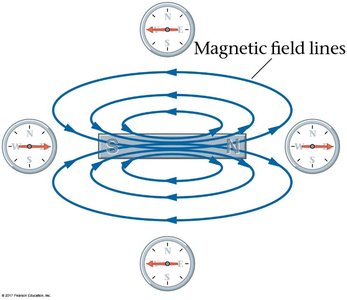
Magnets: Some Basics
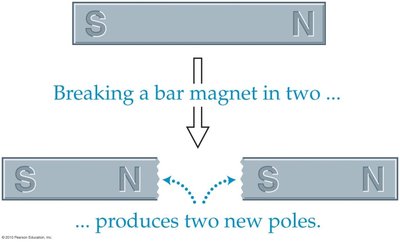
Magnets have two poles, north and south, and exhibit unique properties compared to electric charges. Unlike electric charges, isolated magnetic poles cannot be produced; breaking a magnet results in two new magnets, each with both poles.
Permanent Bar Magnets: Have opposite poles at each end.
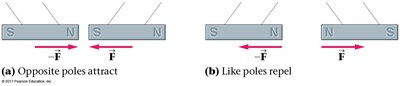
Poles: Opposite poles attract, like poles repel.
Indivisibility: Breaking a bar magnet creates two new magnets, each with a north and south pole.
The Magnetic Force on a Moving Charge
Charged particles moving in a magnetic field experience a force perpendicular to both their velocity and the magnetic field. The magnitude and direction of this force are determined by the charge, velocity, magnetic field strength, and the angle between velocity and field.
Formula: The force on a charge q moving with velocity v in a magnetic field B is given by:
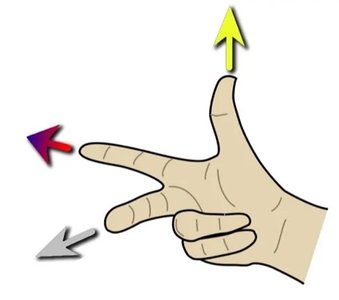
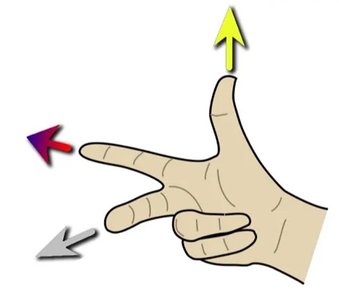
Direction: Determined by the Right-Hand Rule (RHR).
Right-Hand Rule: Point fingers in direction of velocity, curl toward magnetic field, thumb points in direction of force for positive charge; for negative charge, force is opposite.
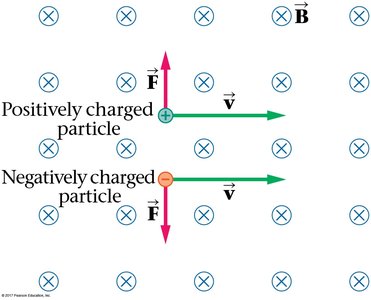
Motion of Charged Particles in a Magnetic Field
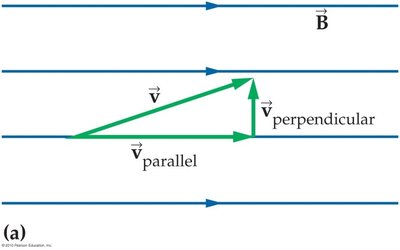
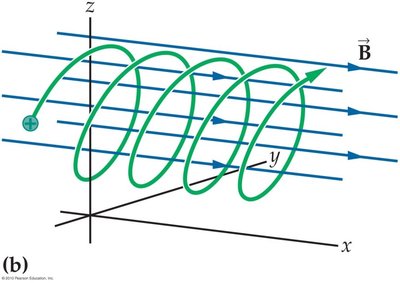
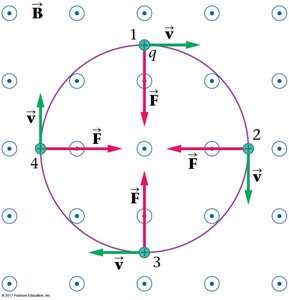
Charged particles moving perpendicular to a uniform magnetic field undergo circular or helical motion. The magnetic force acts as a centripetal force, causing the particle to move in a circle.
Circular Motion: For a particle of mass m and charge q moving with speed v in a field B:
Helical Motion: If the velocity has components both parallel and perpendicular to the field, the path is a helix.
Work: Magnetic force does no work on the particle; it only changes the direction of motion.
Magnetic Force on a Current-Carrying Wire
Electric currents, composed of moving charges, experience a force when placed in a magnetic field. The direction and magnitude of this force depend on the current, length of wire, magnetic field, and angle between wire and field.
Formula:
Direction: Determined by the Right-Hand Rule.
Torque on a Current Loop
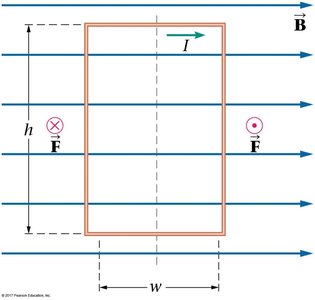
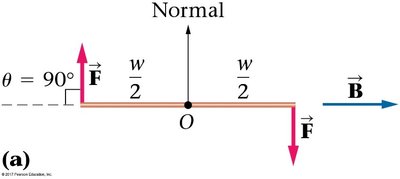
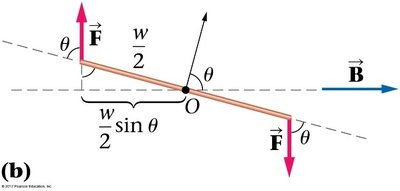
A current loop in a magnetic field experiences a torque that tends to align the loop's normal with the magnetic field. Only the vertical segments of the loop experience force, creating a net torque.
Formula: where N is the number of turns, I is current, A is area, B is field, and θ is angle.
Magnetic Moment:
Alignment: The loop rotates to align its normal with the field.
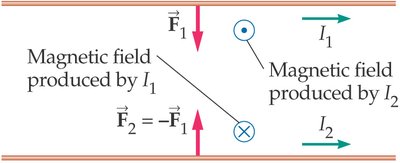
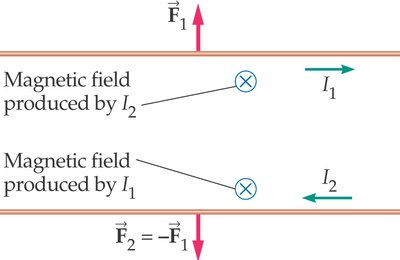
Magnetic Force Between Two Current-Carrying Wires
Parallel wires carrying currents exert forces on each other due to their magnetic fields. The direction of the force depends on whether the currents are in the same or opposite directions.
Same Direction: Wires attract each other.
Opposite Direction: Wires repel each other.
Formula: where μ₀ is the permeability of free space, I₁ and I₂ are currents, L is length, d is separation.


Magnetic Field Due to a Current-Carrying Wire
Electric currents generate magnetic fields that form concentric circles around the wire. The direction of the field is given by the Right-Hand Rule.
Formula:
Direction: Thumb points in direction of current, fingers curl in direction of field.
Current Loops and Solenoids
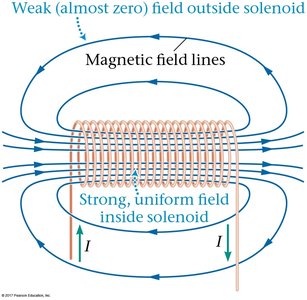
Current loops and solenoids are important in creating uniform magnetic fields. A solenoid is a series of loops forming a cylinder, producing a strong, uniform field inside and a weak field outside.
Solenoid: A long coil of wire; field inside is uniform and strong.
Formula: where n is turns per unit length, I is current.
Applications: Used in electromagnets, MRI machines, and scientific instruments.
Ampere’s Law
Ampere’s Law relates the magnetic field in a loop to the total current passing through the loop. It is fundamental in calculating fields in symmetric situations.
Formula:
Application: Used to find fields in solenoids, toroids, and around wires.
Summary Table: Key Magnetic Formulas
Quantity | Formula | Description |
|---|---|---|
Magnetic Force (charge) | Force on moving charge in field | |
Magnetic Force (wire) | Force on current-carrying wire | |
Radius of circular motion | Charged particle in field | |
Magnetic field (wire) | Field around straight wire | |
Magnetic field (solenoid) | Field inside solenoid | |
Ampere’s Law | Field-current relationship |
Example: A proton moving east at m/s experiences a force of N due south. The magnetic field causing this force can be found using .
Example: An electron moving at m/s at 50° to a 400 mT field experiences a force and acceleration .
Additional info: These notes expand on brief points with full academic explanations, formulas, and relevant images to provide a comprehensive study guide for college-level physics students.
