 Back
BackMagnetism: Torque, Applications, and Magnetic Fields from Currents
Study Guide - Smart Notes
 Tailored notes based on your materials, expanded with key definitions, examples, and context.
Magnetism
Torque on a Current-Carrying Coil/Loop
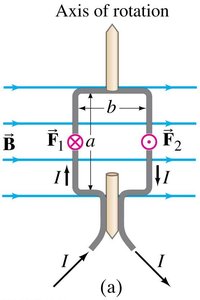
The torque experienced by a current-carrying loop in a magnetic field is a fundamental concept in electromagnetism. This torque arises due to the interaction between the magnetic field and the current flowing through the loop, causing rotational motion.
Force on a wire: The force on a segment of wire carrying current I in a magnetic field B is given by .
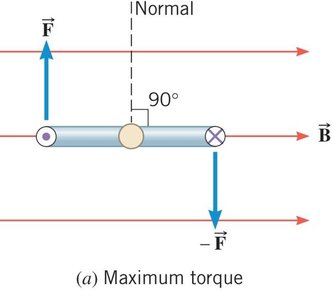
Torque formula: The torque τ is the product of force and the moment arm: .
Area relation: For a rectangular loop, , where A is the area of the loop and φ is the angle between the normal to the loop and the magnetic field.
Multiple loops: For N loops, .
Maximum torque: Occurs when the plane of the loop is perpendicular to the magnetic field ().
Example: A wire of length m forms a single-turn coil with current A in a T field. The maximum torque is .
Applications: Galvanometers, Motors, Loudspeakers
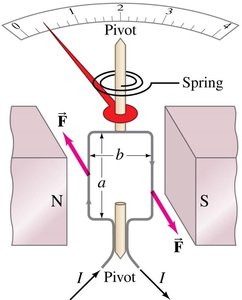
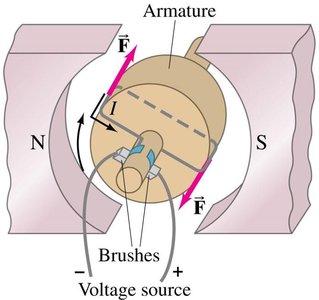
Devices such as galvanometers, electric motors, and loudspeakers utilize the torque on a current loop to perform useful work or measure electrical quantities.
Galvanometer: Measures electric current by detecting the torque on a coil in a magnetic field. The coil's rotation is proportional to the current.
Electric motor: Converts electrical energy to mechanical energy using the torque on a current-carrying loop.
Loudspeaker: Uses a coil in a magnetic field to convert electrical signals into mechanical vibrations (sound).
Magnetic Field Due to a Long Straight Wire
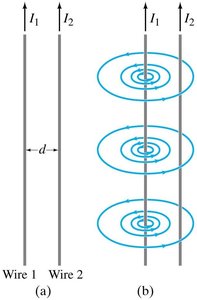
A current-carrying straight wire generates a magnetic field that circles the wire. The strength of the field depends on the current and the distance from the wire.
Magnetic field formula: , where T·m/A is the permeability of free space, I is the current, and r is the radial distance from the wire.
Field direction: Determined by the right-hand rule: thumb points in the direction of current, fingers curl in the direction of the magnetic field.
Force Between Two Parallel Wires
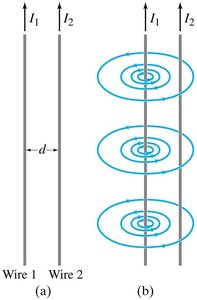
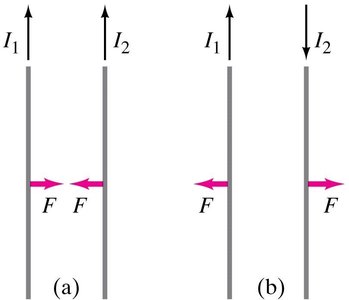
Two parallel wires carrying currents exert forces on each other due to their magnetic fields. The direction and magnitude of the force depend on the direction of the currents.
Magnetic field at wire 2 due to wire 1: , where d is the separation distance.
Force on wire 2: , where l_2 is the length of wire 2.
Direction: Parallel currents attract; antiparallel currents repel.
Example: Two wires separated by 0.120 m carry 8.0 A in opposite directions. Find the net magnetic field at points A and B.
Suspending a wire: The force between wires can counteract gravity, allowing a wire to be suspended by the magnetic force from another wire.
Magnetic Field Produced by Currents: Loop of Wire
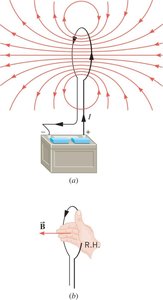
A loop of wire carrying current produces a magnetic field at its center, similar to the field of a bar magnet. The field strength depends on the current and the radius of the loop.
Field at center of loop: , where R is the radius of the loop.
Field lines: The pattern of field lines around a loop resembles that of a bar magnet, with a north and south pole.
Right-hand rule: Curl fingers in direction of current; thumb points in direction of magnetic field inside the loop.
Additional info:
All equations are presented in LaTeX format for clarity and academic rigor.
Images included are directly relevant to the explanation of each topic, reinforcing key concepts visually.
