 Back
BackMechanical Waves and Standing Waves on Strings
Study Guide - Smart Notes
 Tailored notes based on your materials, expanded with key definitions, examples, and context.
Mechanical Waves
Wave Functions and Parameters
Mechanical waves are disturbances that travel through a medium, transferring energy from one point to another without transporting matter. The mathematical description of a sinusoidal wave is essential for understanding its behavior.
Wave Function: The displacement of a point on a string as a function of position and time is given by the wave function. For a wave traveling in the +x direction: $y(x, t) = A \cos(kx - \omega t)$ where A is amplitude, k is the wave number, \omega is angular frequency, x is position, and t is time.
Wave Number: $k = \frac{2\pi}{\lambda}$, where \lambda is the wavelength.
Angular Frequency: $\omega = 2\pi f$, where f is the frequency.

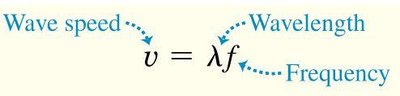
Wave Speed: The speed at which the wave propagates is given by $v = \lambda f$.
Wavelength (\lambda): The distance over which the wave's shape repeats.
Frequency (f): The number of oscillations per second.
Example: If a wave has a wavelength of 2 m and a frequency of 5 Hz, its speed is $v = 2 \times 5 = 10$ m/s.
Speed of a Mechanical Wave on a String
The speed of a transverse wave on a stretched string depends on the tension in the string and its mass per unit length:
Formula: $v = \sqrt{\frac{F}{\mu}}$ where F is the tension in the string and \mu is the mass per unit length.

Example: For a string with tension 100 N and mass per unit length 0.01 kg/m, $v = \sqrt{\frac{100}{0.01}} = 100$ m/s.
Boundary Conditions and Wave Reflection
Reflection at a Fixed End
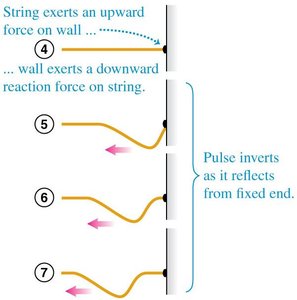
When a wave pulse reaches a fixed end, it reflects and inverts due to the reaction force exerted by the wall.
Pulse Inversion: The reflected pulse is inverted relative to the incident pulse.
Reflection at a Free End
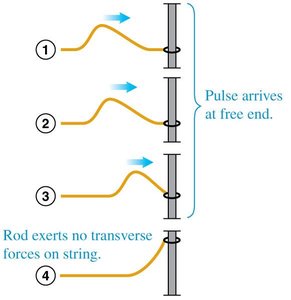
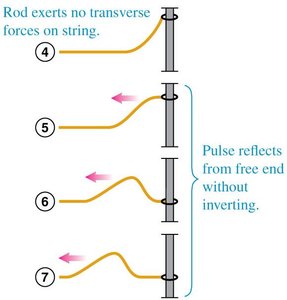
When a wave pulse reaches a free end, it reflects without inversion because the end can move freely.
No Inversion: The reflected pulse maintains the same orientation as the incident pulse.
Interference and Superposition
Principle of Superposition
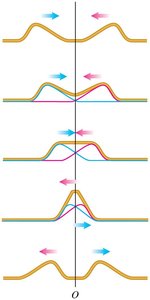
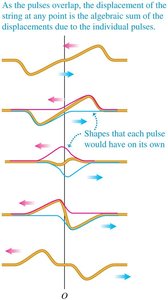
When two or more waves overlap in space, the resulting displacement is the algebraic sum of the individual displacements. This principle leads to interference patterns.
Constructive Interference: Occurs when waves add to produce a larger amplitude.
Destructive Interference: Occurs when waves add to produce a smaller (or zero) amplitude.
Standing Waves on a String
Formation of Standing Waves
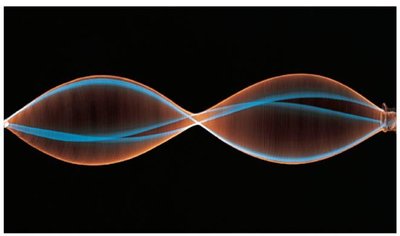
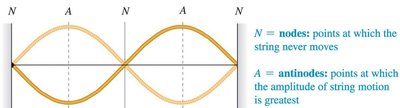
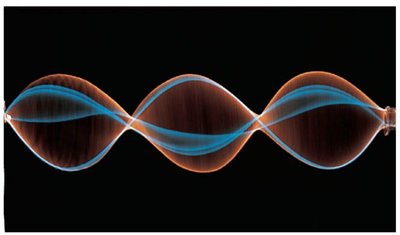
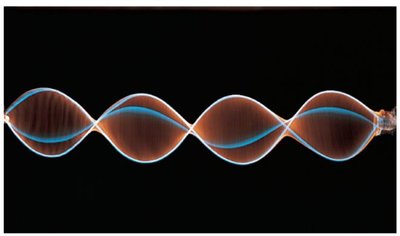
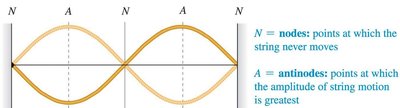
Standing waves are formed by the superposition of two waves of the same frequency and amplitude traveling in opposite directions. They are characterized by nodes (points of no motion) and antinodes (points of maximum motion).
Wave Function for Standing Wave (fixed end at x = 0): $y(x, t) = (A_{sw} \sin kx) \sin \omega t$
Nodes: Points where the string never moves ($y = 0$ at all times).
Antinodes: Points where the amplitude of motion is greatest.


Conditions for Nodes and Antinodes
Nodes: Occur at positions where $\sin kx = 0$, i.e., $kx = n\pi$ ($n = 0, 1, 2, ...$).
Antinodes: Occur at positions where $\sin kx = \pm 1$, i.e., $kx = (n + 1/2)\pi$.
Normal Modes of a String Fixed at Both Ends
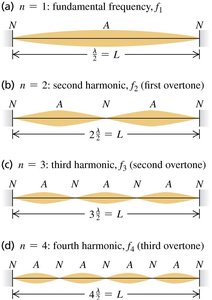
When both ends of a string of length L are fixed, only certain wavelengths and frequencies are allowed, corresponding to the string's normal modes.
Allowed Wavelengths: $\lambda_n = \frac{2L}{n}$, where $n = 1, 2, 3, ...$
Allowed Frequencies: $f_n = \frac{nv}{2L}$
Fundamental Frequency (First Harmonic): $f_1 = \frac{1}{2L} \sqrt{\frac{F}{\mu}}$

Example: For a string of length 0.66 m, vibrating at its fundamental frequency with a wave speed of 435 m/s, the wavelength is $\lambda_1 = 2L = 1.32$ m and the frequency is $f_1 = \frac{v}{\lambda_1} = \frac{435}{1.32} \approx 329$ Hz.
Applications: String Instruments
When a string on a musical instrument is plucked, bowed, or struck, a standing wave is produced. The frequency of the standing wave determines the pitch of the sound produced. Increasing the tension in the string increases the frequency and thus the pitch.
Fundamental Frequency: The lowest frequency at which the string vibrates.
Harmonics: Higher frequencies at which the string can also vibrate, corresponding to integer multiples of the fundamental frequency.
Example: The E string of a violin with a fundamental frequency of 659 Hz and a wavelength of 0.66 m has a wave speed $v = f \lambda = 659 \times 0.66 = 435$ m/s.
Additional info: The study of standing waves is crucial for understanding musical instruments, resonance, and many engineering applications involving vibrations.
