 Back
BackMechanical Waves: Fundamentals, Types, and Interference
Study Guide - Smart Notes
 Tailored notes based on your materials, expanded with key definitions, examples, and context.
Mechanical Waves
Introduction to Mechanical Waves
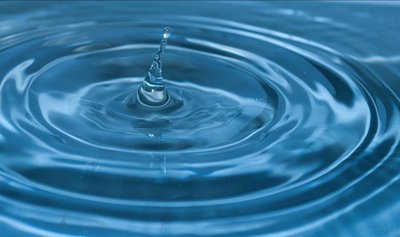
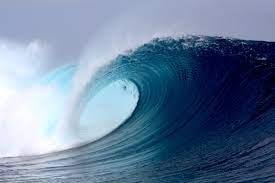
Mechanical waves are disturbances that propagate through a material medium, transporting energy from one location to another without the net movement of matter. The medium's particles oscillate around their equilibrium positions, requiring energy input to sustain the wave motion.
Definition: A mechanical wave is a disturbance that travels through a medium, transferring energy but not matter.
Key property: The medium is essential; mechanical waves cannot travel through a vacuum.
Examples: Waves on a string, sound waves in air, water waves.
Types of Mechanical Waves
Transverse Waves
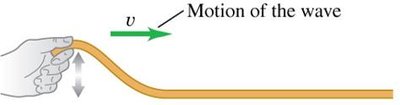
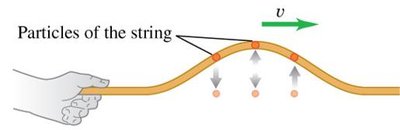
In transverse waves, the particles of the medium move perpendicular to the direction of wave propagation. A common example is a wave traveling along a stretched string.
Particle motion: Perpendicular to wave direction.
Examples: Waves on strings, electromagnetic waves (though not mechanical), surface water waves.
Longitudinal Waves
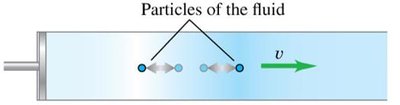
In longitudinal waves, the particles of the medium oscillate parallel to the direction of wave propagation. These waves consist of compressions and rarefactions.
Particle motion: Parallel to wave direction.
Examples: Sound waves in air, pressure waves in fluids.
Periodic Waves
Sinusoidal (Harmonic) Waves
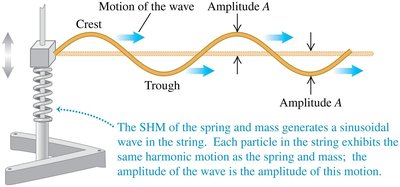
Periodic waves are generated by simple harmonic motion, resulting in sinusoidal waveforms. The motion of a single point in the medium can be described using the same parameters as simple harmonic motion (SHM): period, frequency, and angular frequency.
Period (T): Time for one complete cycle.
Frequency (f): Number of cycles per second ().
Angular frequency (\(\omega\)):
Wave Parameters
The main parameters describing a wave are:
Amplitude (A): Maximum displacement from equilibrium.
Wavelength (\(\lambda\)): Distance between two successive crests or troughs.
Frequency (f): Number of cycles per second.
Wave speed (v): Speed at which the wave propagates through the medium.
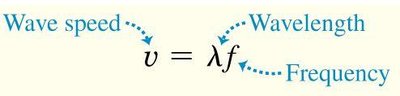
The relationship between these parameters is given by:
Periodic Longitudinal Waves
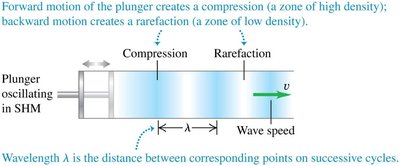
Longitudinal waves generated by SHM can be described using the same parameters as transverse waves. Instead of crests and troughs, these waves have compressions (high density) and rarefactions (low density).
Mathematical Description of Waves
Wave Functions
The displacement of a point on a wave can be described mathematically. For a sinusoidal wave traveling in the +x direction:
Amplitude (A): Maximum displacement
Wave number (k):
Angular frequency (\(\omega\)):

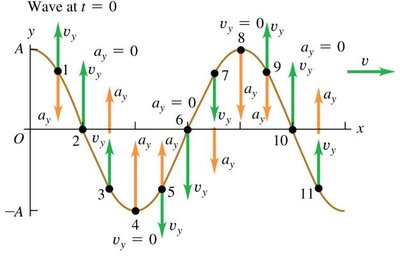
Particle Velocity and Acceleration
Each particle in the medium oscillates with a velocity and acceleration that can be derived from the wave function. The velocity and acceleration vary with position and time.
Wave Speed in Different Media
Speed of a Mechanical Wave
The speed of a mechanical wave depends on the properties of the medium. For a wave on a string:
F: Tension in the string (N)
\(\mu\): Mass per unit length (kg/m)

Boundary Conditions and Wave Reflection
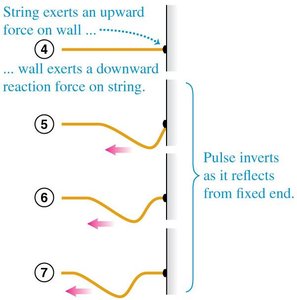
Reflection at a Fixed End
When a wave pulse reaches a fixed end, it is reflected and inverted. The fixed end cannot move, so the reflected pulse is upside down compared to the incident pulse.
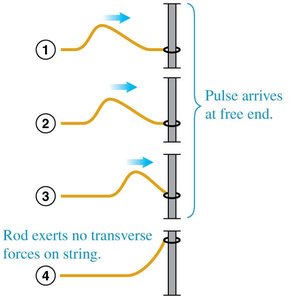
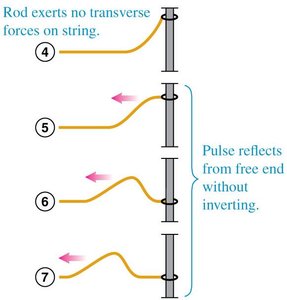
Reflection at a Free End
When a wave pulse reaches a free end, it is reflected without inversion. The free end is free to move, so the reflected pulse maintains its orientation.
Wave Interference and Superposition
Principle of Superposition
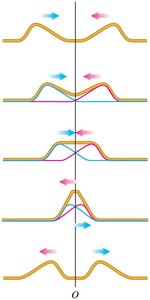
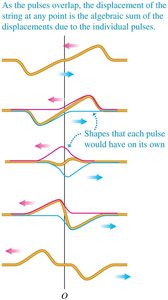
When two or more waves overlap in space, the resulting displacement is the algebraic sum of the individual displacements. This principle is called superposition and leads to interference effects.
Constructive interference: When displacements add to produce a larger amplitude.
Destructive interference: When displacements add to produce a smaller (or zero) amplitude.

Summary Table: Key Parameters of Mechanical Waves
Parameter | Symbol | Definition | Unit |
|---|---|---|---|
Amplitude | A | Maximum displacement from equilibrium | m |
Wavelength | \(\lambda\) | Distance between successive crests/troughs | m |
Frequency | f | Number of cycles per second | Hz |
Period | T | Time for one complete cycle | s |
Wave speed | v | Speed at which the wave propagates | m/s |
