 Back
Mechanics I: Force and Motion, Interacting Systems, and Applications in Life Sciences
Study Guide - Smart Notes
 Tailored notes based on your materials, expanded with key definitions, examples, and context.
Force and Motion
Newton's Laws and the Concept of Force
Understanding the connection between force and motion is fundamental in physics. Newton's laws describe how forces affect the motion of objects, and these principles are widely applicable in life sciences, from animal locomotion to cellular mechanics.
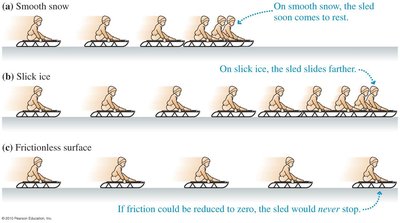
Newton's First Law (Law of Inertia): An object remains at rest or in uniform motion unless acted upon by a net external force. Inertia is the natural resistance to changes in motion.
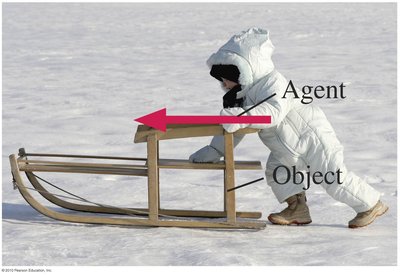
Force: A push or pull exerted by one object on another, with an identifiable agent. Forces act on objects and can be visualized using vectors.
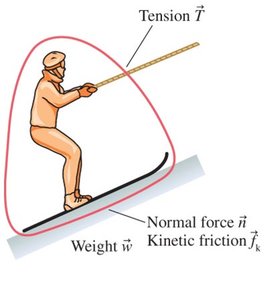
Free-Body Diagrams: Simplified representations used to analyze forces acting on an object. They help isolate relevant forces and clarify problem-solving.
Types of Forces
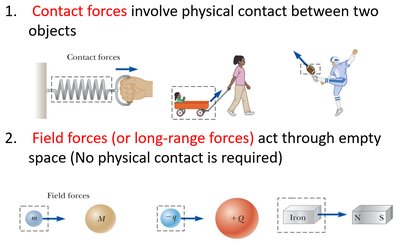
Forces can be classified as contact forces (requiring physical contact) or field forces (acting at a distance).
Contact Forces: Include normal force, friction, tension, and spring force.
Field Forces: Include gravitational, electric, and magnetic forces.
Force Notation
Common forces and their notation are summarized below:
Force | Notation |
|---|---|
General force | \vec{F} |
Weight | \vec{w} |
Spring force | \vec{F}_{sp} |
Tension | \vec{T} |
Normal force | \vec{n} |
Static friction | \vec{f}_s |
Kinetic friction | \vec{f}_k |
Drag | \vec{D} |
Thrust | \vec{F}_{thrust} |
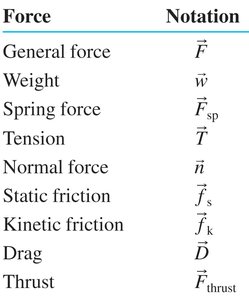
Catalog of Forces
Gravitational Force (Weight)
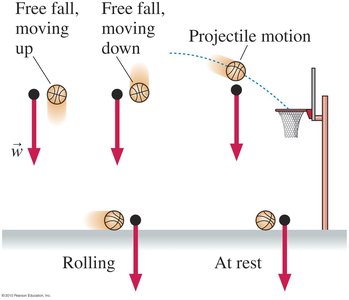
The gravitational force is always directed toward the center of the planet and is given by:
Formula:
Direction: Vertically downward
Application: Varies with location due to changes in
Tension Force
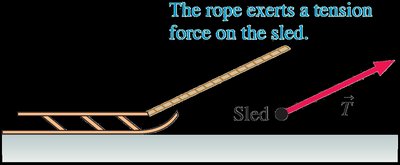
Tension exists only when an object is attached to a string or rope and is always parallel to the string, away from the object.
Normal Force
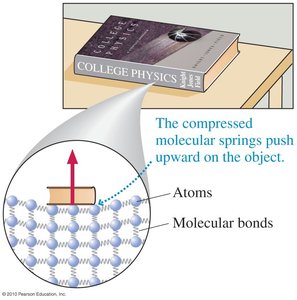
The normal force is a support force exerted by a surface, always perpendicular and away from the surface.
Frictional Forces
Friction opposes motion and is essential in animal locomotion and many biological processes.
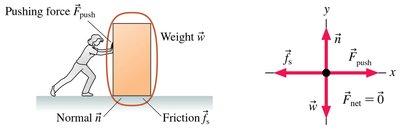
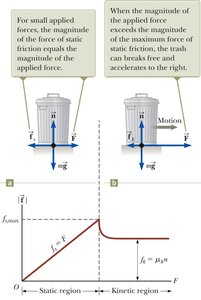
Static Friction: Prevents slipping, adjusts to match applied force up to a maximum
Kinetic Friction: Opposes motion when object is sliding,
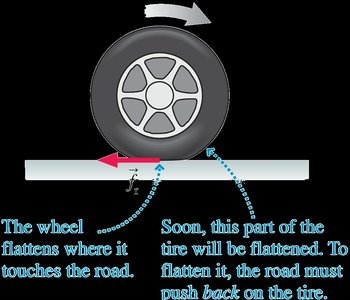
Rolling Friction: Opposes motion when object is rolling,
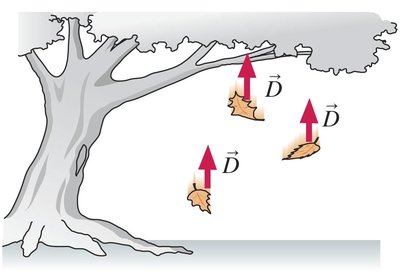
Drag Force
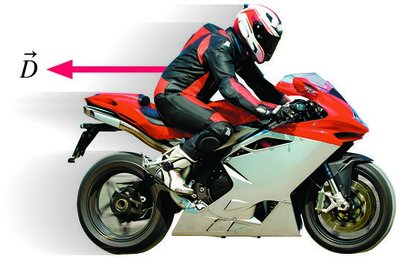
Drag opposes motion through a fluid and increases with speed. It is characterized by inertial or viscous drag, depending on the Reynolds number.
High Reynolds Number:
Low Reynolds Number:
Spring Force (Hooke's Law)
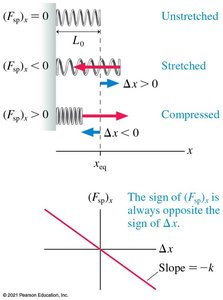
Spring force is a restoring force that returns a system to equilibrium. Hooke's law describes the linear relationship:
Formula:
Direction: Always toward equilibrium position
Thrust and Contact Forces
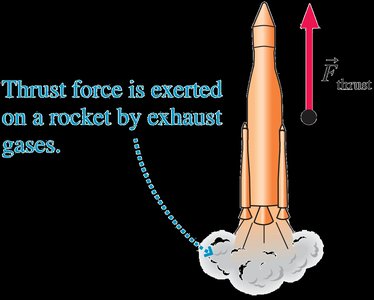
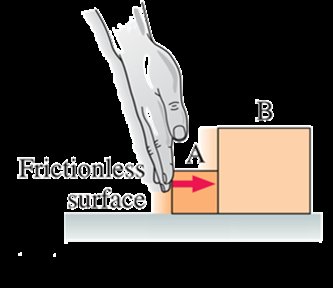
Thrust is generated by expelling mass (e.g., rocket exhaust), and contact forces arise when objects touch.
Newton's Second Law and Problem Solving
Newton's Second Law
Newton's second law relates force, mass, and acceleration:
Formula:
Component Form: , ,
Units: SI: N (kg m/s2), US: lb (slug ft/s2)
Vector Addition of Forces
Forces combine as vectors. The net force is the vector sum of all external forces:
Formula:
Methods: Parallelogram and triangle methods for vector addition
Mass and Weight
Mass is an intrinsic property describing inertia; weight is the gravitational force exerted by a planet:
Weight Formula:
Mass: Scalar, SI unit: kg
Weight: Vector, varies with location
Apparent Weight
Apparent weight is the contact force supporting you, which can differ from true weight in accelerating systems:
Formula:
Newton's Third Law and Interacting Systems
Newton's Third Law
For every action, there is an equal and opposite reaction. Forces always occur in pairs, acting on different objects:
Formula:
Action-Reaction Pair: Forces are equal in magnitude, opposite in direction
Newton's Law of Gravity
Universal Gravitation
Gravity is a universal force, directly proportional to the product of masses and inversely proportional to the square of the distance:
Formula:
Gravitational Constant:
Local Gravity:
Friction Coefficients Table
Comparison of Friction Types
Different materials exhibit different coefficients of static, kinetic, and rolling friction:
Material | Static (\mu_s) | Kinetic (\mu_k) | Rolling (\mu_r) |
|---|---|---|---|
Rubber on concrete | 1.00 | 0.80 | 0.02 |
Steel on steel (dry) | 0.80 | 0.60 | 0.002 |
Steel on steel (lubricated) | 0.10 | 0.05 | — |
Wood on wood | 0.50 | 0.20 | — |
Wood on snow | 0.12 | 0.06 | — |
Ice on ice | 0.10 | 0.03 | — |
Applications in Life Sciences
Biological Examples
Animal Locomotion: Friction and propulsion are essential for movement.
Seed Dispersal: Drag forces affect how seeds and spores travel through air.
Fish Buoyancy: Forces and equilibrium are crucial for aquatic life.
Problem-Solving Strategies
Steps for Analyzing Dynamics Problems
Draw a free-body diagram.
Determine acceleration direction and magnitude.
Apply Newton's second law in component form.
Check units and consistency.
Finalize by checking results against diagrams and extreme values.
Summary
This guide covers the fundamental concepts of force and motion, types of forces, Newton's laws, and their applications in life sciences. It provides a structured approach to problem-solving and highlights the importance of forces in biological systems.
