 Back
BackMechanisms of Heat Transfer: Conduction, Convection, and Radiation
Study Guide - Smart Notes
 Tailored notes based on your materials, expanded with key definitions, examples, and context.
Mechanisms of Heat Transfer
Introduction
Heat transfer is the process by which thermal energy moves from regions of higher temperature to regions of lower temperature. In physics, there are three primary mechanisms for heat transfer: conduction, convection, and radiation. Each mechanism operates under different physical principles and is relevant in various natural and engineered systems.
Conduction
Definition and Physical Basis
Conduction is the transfer of heat through a material without the movement of the material as a whole. It occurs due to direct contact between particles, where kinetic energy is transferred from high-energy (hotter) particles to low-energy (colder) particles. This process is significant in solids, especially metals, due to their high density of free electrons.
Occurs within a body or between bodies in direct thermal contact.
Microscopic mechanism: Energy is transferred via collisions and vibrations of atoms and molecules.
Thermal conductivity (k): A material property that quantifies how well a substance conducts heat. Higher values indicate better conductors.
Quantitative Description
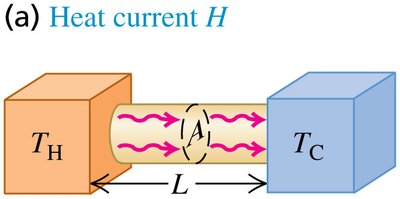
The rate of heat transfer by conduction through a uniform rod is given by:
H: Heat current (rate of heat flow, in watts)
k: Thermal conductivity of the material (W/m·K)
A: Cross-sectional area of the rod (m2)
T_H, T_C: Temperatures at the hot and cold ends (K or °C)
L: Length of the rod (m)

Thermal Conductivities of Common Substances
Substance | k (W/m·K) |
|---|---|
Silver | 406 |
Copper | 385 |
Aluminum | 205 |
Concrete | 0.8 |
Wood | 0.12–0.04 |
Fiberglass | 0.04 |
Styrofoam | 0.027 |
Metals are excellent thermal conductors, while insulators (such as wood, fiberglass, and Styrofoam) have much lower thermal conductivities due to trapped air bubbles.
Convection
Definition and Physical Basis
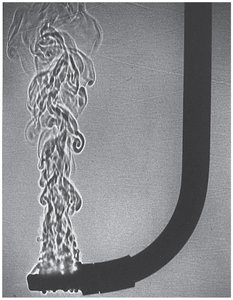
Convection is the transfer of heat by the bulk movement of a fluid (liquid or gas). It involves the physical transport of warmer fluid to cooler regions and vice versa, resulting in the redistribution of thermal energy.
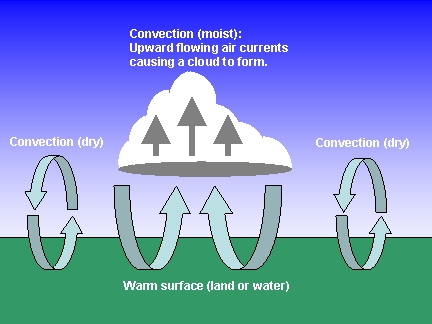
Natural convection: Driven by buoyancy forces due to density differences (e.g., warm air rises, cool air sinks).
Forced convection: Occurs when a fluid is moved by an external device (e.g., a fan, pump, or the heart in the circulatory system).
Examples: Atmospheric circulation, ocean currents, hot-air heating systems, engine cooling, blood flow.
Visualization and Applications
Convection is a key process in weather systems, oceanic circulation, and many engineering applications. The movement of air or water due to temperature differences leads to the formation of convection cells, which can be observed in the atmosphere as cloud formation and wind patterns.
Radiation
Definition and Physical Basis
Radiation is the transfer of heat by electromagnetic waves, primarily in the infrared region, but also visible light at higher temperatures. Unlike conduction and convection, radiation does not require a medium and can occur through a vacuum.
All objects emit thermal radiation depending on their temperature and surface properties.
At low temperatures: Emission is mainly in the infrared region (felt as heat).
At high temperatures: Objects emit visible light (e.g., the Sun, incandescent bulbs).
Good absorbers are also good emitters; black surfaces emit and absorb more efficiently than white or reflective surfaces.
Quantitative Description: Stefan-Boltzmann Law
The rate at which an object emits thermal radiation is given by the Stefan-Boltzmann law:
H: Heat current (W)
A: Surface area of the emitting object (m2)
e: Emissivity of the surface (dimensionless, 0 ≤ e ≤ 1)
\sigma: Stefan-Boltzmann constant ( W/m2·K4)
T: Absolute temperature of the surface (K)

Examples and Applications
The Sun emits most of its energy in the visible spectrum due to its high surface temperature (~5800 K).
The Earth emits primarily in the infrared, corresponding to its much lower average surface temperature (~14°C).
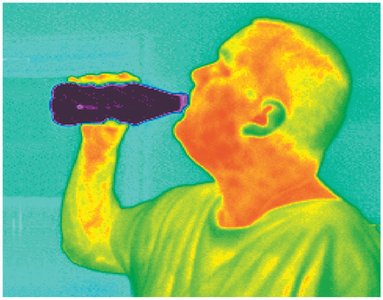
Thermal imaging cameras detect infrared radiation to visualize temperature differences.
