 Back
BackMolecular Bonds and Bonding in Solids
Study Guide - Smart Notes
 Tailored notes based on your materials, expanded with key definitions, examples, and context.
Molecules to Solids: Types of Molecular Bonds
Introduction to Molecular Bonds
Atoms combine to form molecules and solids through various types of bonds, each with distinct physical origins and energy scales. Understanding these bonds is essential for explaining the structure and properties of matter at the molecular and macroscopic levels.
Types of Molecular Bonds
Ionic Bonds
Ionic bonds are formed by the electrostatic attraction between oppositely charged ions, typically resulting from the transfer of one or more electrons from a metal to a nonmetal. This process creates cations and anions, which are held together by strong Coulomb forces.
Example: Sodium (Na) donates an electron to chlorine (Cl), forming Na+ and Cl– ions, which combine to form NaCl.
Ionization energy (Na): 5.138 eV (energy to remove the 3s electron).
Electron affinity (Cl): 3.613 eV (energy released when Cl gains an electron).
Net energy to create separated ions:
Binding energy of NaCl molecule: (energy released when ions come together to equilibrium separation).
Equilibrium separation: 240 pm (0.24 nm).
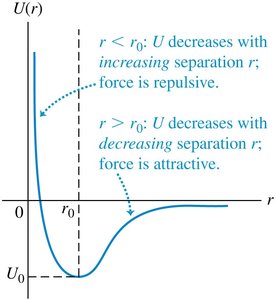
The equilibrium separation is determined by the balance between the attractive Coulomb force and the repulsive force due to the Pauli exclusion principle, which prevents extensive overlap of electron clouds.
Covalent Bonds
Covalent bonds involve the sharing of electron pairs between atoms. These bonds are highly directional and are responsible for the structure of many molecules, including organic compounds.
Example: The hydrogen molecule (H2) forms when two hydrogen atoms share their electrons, resulting in a bond energy of –4.48 eV.
Pauli exclusion principle: Only electrons with opposite spins can occupy the same spatial region, limiting covalent bonds to pairs of electrons.
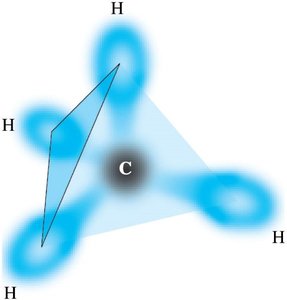
Multiple bonds: Atoms with several valence electrons (e.g., carbon) can form multiple covalent bonds, as in methane (CH4).
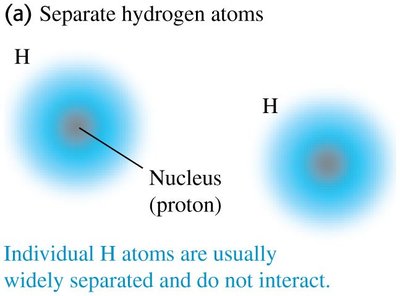
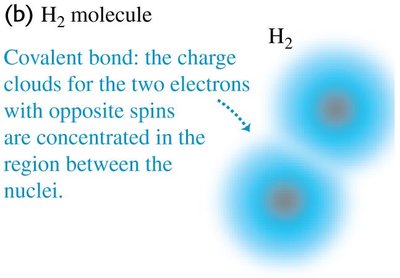
In methane, carbon forms four covalent bonds with hydrogen atoms, resulting in a tetrahedral geometry. The valence electrons occupy hybridized orbitals that point toward the corners of a tetrahedron, minimizing electron pair repulsion.
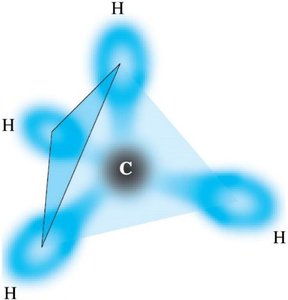
Note: Covalent and ionic bonds represent two extremes; many bonds have partial ionic and covalent character, leading to polar molecules with electric dipole moments (e.g., water).
Polar Molecules and Dipole Moments
When there is an unequal sharing of electrons, molecules develop a dipole moment, with one end being more positive and the other more negative. These polar molecules interact via dipole-dipole forces, contributing to properties such as the high dielectric constant of water.
Weak Bonds: van der Waals and Hydrogen Bonds
In addition to strong ionic and covalent bonds (1–5 eV), there are weaker interactions (<1 eV) that play crucial roles in the structure and behavior of matter.
van der Waals Bonds
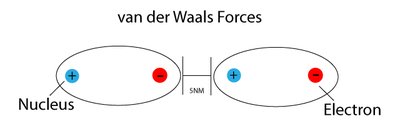
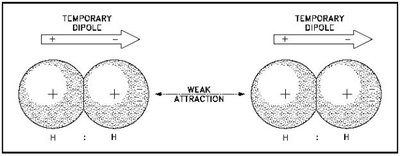
van der Waals bonds arise from interactions between electric dipole moments of atoms or molecules. These can be permanent or induced dipoles, and the interaction energy typically falls off rapidly with distance ().
Energy scale: ~0.1 eV or less.
Origin: Fluctuating charge distributions induce temporary dipoles, leading to weak attractions.
Applications: Responsible for the liquefaction and solidification of inert gases and nonpolar molecules (e.g., H2, O2, N2).
Hydrogen Bonds
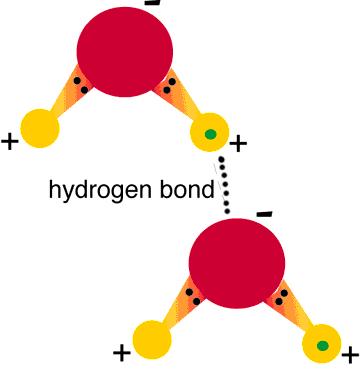
Hydrogen bonds occur when a hydrogen atom (proton) is shared between two electronegative atoms, creating an attractive interaction via induced dipoles. This bond is unique to hydrogen due to its small size and lack of inner electron cloud.
Energy scale: Less than 0.5 eV (weak bond).
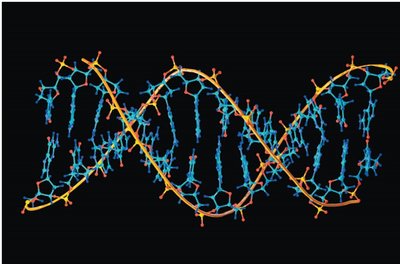
Importance: Critical in the structure of ice and in biological molecules (e.g., DNA, proteins), where they often provide cross-linking between chains.
Bonding in Solids
All the types of bonds discussed above can hold atoms together in solids as well as in molecules. In addition, metallic bonding is a key feature in metals, where electrons are delocalized over a lattice of positive ions. This will be discussed in detail in subsequent sections.
Summary Table: Types of Molecular Bonds
Bond Type | Mechanism | Typical Energy (eV) | Examples |
|---|---|---|---|
Ionic | Electron transfer, electrostatic attraction | 1–5 | NaCl, MgCl2 |
Covalent | Electron sharing | 1–5 | H2, CH4 |
van der Waals | Induced dipole-dipole | < 0.1 | Inert gases, H2, O2 |
Hydrogen | Proton shared between electronegative atoms | < 0.5 | H2O, DNA |
