 Back
Momentum and Its Conservation: Physics with Calculus Study Notes
Study Guide - Smart Notes
 Tailored notes based on your materials, expanded with key definitions, examples, and context.
Momentum
Definition and Properties
Momentum is a fundamental property of moving objects, often described as "inertia in motion." It is defined as the product of an object's mass and its velocity. The greater the mass or velocity, the greater the momentum.
Formula:
Units: kilogram meter per second (kg·m/s)
Key Points:
A stationary object has zero momentum.
Momentum is a vector quantity; it has both magnitude and direction.
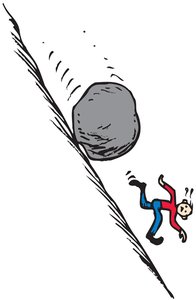
Example: A moving boulder has more momentum than a stone rolling at the same speed due to its greater mass. If the boulder moves faster, its momentum increases proportionally.
Impulse
Definition and Calculation
Impulse is the product of the force applied to an object and the time interval over which it acts. Impulse changes an object's momentum.
Formula:
Units: Newton-second (N·s), which is equivalent to kg·m/s
Key Points:
A larger force or a longer time interval results in a greater impulse.
Impulse is equal to the change in momentum:
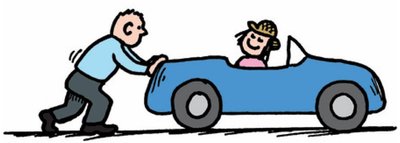
Example: Pushing a stalled car for a longer time imparts a greater impulse, resulting in a larger change in the car's momentum.
Impulse-Momentum Theorem
Relationship Between Impulse and Momentum Change
The impulse-momentum theorem states that the impulse on an object is equal to its change in momentum.
Formula:
Key Points:
Increasing the time over which a force acts increases the change in momentum.
Force can vary during the contact period; the total impulse is the area under the force vs. time graph.
Example: A golfer follows through with a swing to increase the time of contact, maximizing the impulse and thus the ball's momentum.

Increasing and Decreasing Momentum
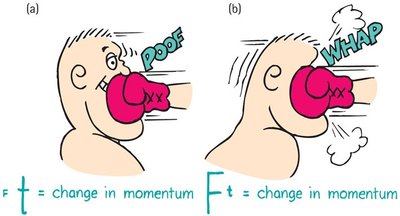
Increasing Momentum: Extending the time of contact (e.g., following through in sports) increases the change in momentum.
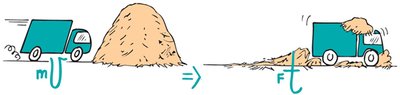
Decreasing Momentum Over a Long Time: Extending the time over which momentum is reduced (e.g., landing on a soft surface) decreases the average force experienced.
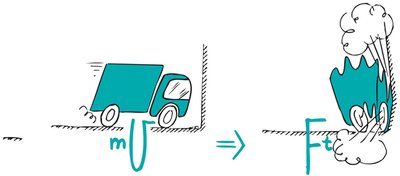
Decreasing Momentum Over a Short Time: A short stopping time results in a large force (e.g., karate chop breaking bricks).

Bouncing
Impulse in Bouncing Objects
When objects bounce, the impulse delivered is generally greater than when they simply come to rest. This is because the object must be stopped and then started in the opposite direction, requiring a "double impulse."
Example: Catching and then throwing a flowerpot upward requires more impulse than just stopping it.
Conservation of Momentum
Law of Conservation of Momentum
The law of conservation of momentum states that in the absence of an external force, the total momentum of a system remains constant.
Formula:
Key Points:
Momentum is conserved in all interactions where no external force acts.
Internal forces within a system do not change the system's total momentum.
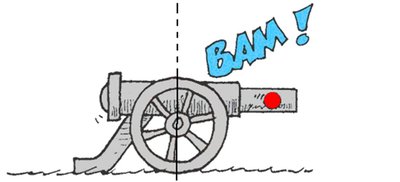
Example: When a cannon fires a cannonball, the cannon recoils with equal and opposite momentum to the cannonball.
Collisions
Types of Collisions
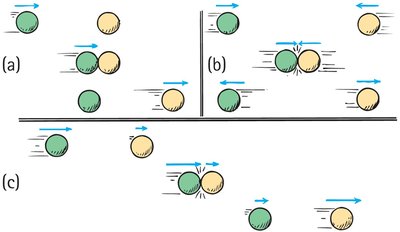
Elastic Collision: Objects rebound without lasting deformation or heat generation. Both momentum and kinetic energy are conserved.
Example: Billiard balls colliding.
Inelastic Collision: Objects deform and/or generate heat. Momentum is conserved, but kinetic energy is not.
Example: Cars crumpling in a crash.

Conservation of Momentum in Collisions
Formula:
Example: If a moving car of mass at 10 m/s collides with a stationary car of the same mass, after an elastic collision, both move at 5 m/s (assuming no external forces).
More Complicated Collisions
Collisions in Two Dimensions
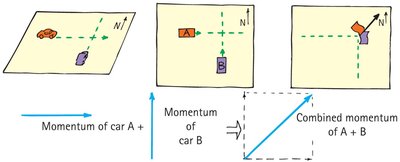
When objects collide at angles, their momenta are combined using vector addition. The total momentum is found by constructing a parallelogram of the individual momentum vectors.
Example: Two cars colliding at a corner; the combined momentum is the vector sum of their individual momenta.
Explosions
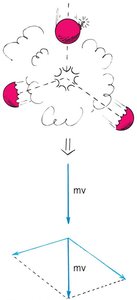
In an explosion, the vector sum of the momenta of all fragments equals the original momentum of the object before the explosion.
Example: A firecracker at rest explodes; the momenta of the pieces add up to zero if the firecracker was initially at rest.
Summary Table: Key Concepts in Momentum
Concept | Definition | Formula | Key Points |
|---|---|---|---|
Momentum | Inertia in motion | Vector quantity; conserved in isolated systems | |
Impulse | Change in momentum | Equal to change in momentum | |
Elastic Collision | No deformation or heat | Momentum and kinetic energy conserved | Billiard balls, air molecules |
Inelastic Collision | Deformation and/or heat | Momentum conserved, kinetic energy not | Car crashes, clay balls sticking together |
Conservation of Momentum | Total momentum constant if no external force | Applies to all collisions and explosions |
