 Back
BackMomentum, Impulse, and Collisions: Multi-Dimensional Analysis and Examples
Study Guide - Smart Notes
 Tailored notes based on your materials, expanded with key definitions, examples, and context.
Momentum, Impulse, and Collisions
Collisions in Two and Three Dimensions
Collisions in physics are events where two or more bodies interact, exchanging momentum and possibly energy. In two and three dimensions, the analysis of collisions requires vector treatment of momentum and consideration of multiple dynamic parameters.
Momentum Conservation Law: In 2D and 3D, momentum conservation is a vector equation, requiring separate consideration for each spatial direction.
Degrees of Freedom: 3D collisions involve six unknowns (three for each particle's velocity components after collision).
Collision and Scattering Planes: The collision plane is defined by the initial velocity vectors, while the scattering plane is defined by the final velocity vectors. These planes may not coincide.
Dynamic Parameters: Three dynamic parameters are needed to fully describe a 3D collision, typically related to angles and the nature of the interaction force.
Symmetry: If the scattering process is symmetric, certain angles may be randomly selected during the collision.
Center of Mass Reference Frame
The center of mass (CM) reference frame simplifies collision analysis by reducing the number of variables and equations. Key parameters include:
Total Mass:
Reduced Mass:
CM Velocity:
CM Momentum:
Comparison of 1D, 2D, and 3D Collisions
The complexity of collision analysis increases with dimensionality. The following table summarizes the equations and unknowns for each case:
Dimension | Momentum Conservation Equations | Energy Conservation | Total Equations | Target Variables | Dynamic Parameters Needed |
|---|---|---|---|---|---|
1D | 1 | 1 | 2 | 3 | 1 |
2D | 2 | 1 | 3 | 5 | 2 |
3D | 3 | 1 | 4 | 7 | 3 |
Types of Collisions
Collisions are classified based on energy conservation:
Elastic Collision: Both momentum and kinetic energy are conserved.
Inelastic Collision: Momentum is conserved, but kinetic energy is not.
Completely Inelastic Collision: The colliding bodies stick together after the collision, maximizing internal energy release.
Energy Conservation in Collisions
Energy conservation law in collisions is expressed as:
Kinetic Energy Before:
Kinetic Energy After:
Internal Energy Release: (for inelastic collisions)
Solving Collision Problems
To solve collision problems, follow these steps:
Identify known quantities (masses, initial velocities, angles).
Apply conservation of momentum in each direction.
Apply conservation of energy if the collision is elastic.
Use the center of mass frame to simplify calculations.
Determine unknowns using the appropriate number of equations and dynamic parameters.
Example: Elastic Collision in Two Dimensions
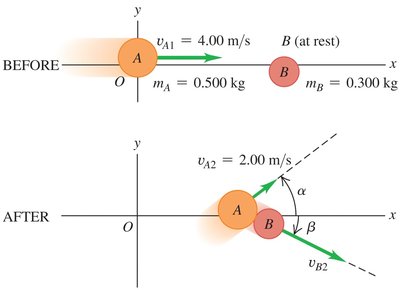
This example illustrates an elastic collision between two masses, where one is initially at rest. The analysis involves both the laboratory and center of mass reference frames.
Given: , , , ,
Unknowns: Final velocities and angles and
Strategy: Use conservation laws and vector components to solve for unknowns.
Step-by-Step Solution Using Center of Mass Frame
Calculate Total Mass:
Calculate Center of Mass Velocity:
Transform velocities to CM frame: ,
Apply conservation laws in CM frame, then transform back to lab frame.
Component Equations for 2D Collisions
For 2D collisions, the following component equations are used:
x-direction:
y-direction:
Energy: (elastic)
Summary Table: Collision Parameters
Reference Frame | Parameters | Equations |
|---|---|---|
Laboratory | Velocities, angles, masses | Momentum (x, y), Energy |
Center of Mass | Relative velocities, total mass | Momentum, Energy |
Maximal Dissipated Energy in Inelastic Collisions
For a given scattering angle, the maximal dissipated energy is the energy transferred to internal energy, compatible with conservation laws. This is found by maximizing subject to the constraints of momentum and energy conservation.
Internal Energy:
Scattering Angle: Determines the direction of final velocities and affects the energy distribution.
General Strategy for Collision Analysis
Use known quantities to find all center of mass parameters.
Use center of mass parameters to compute all other quantities.
Apply component equations for each spatial direction.
Check energy conservation for elastic collisions.
Additional info: The notes provide a step-by-step approach for both reference frame dependent and independent calculations, emphasizing the importance of vector analysis and the center of mass frame in simplifying collision problems.
