 Back
BackMomentum, Impulse, and Collisions: Principles and Applications
Study Guide - Smart Notes
 Tailored notes based on your materials, expanded with key definitions, examples, and context.
Momentum and Impulse
Definitions and Fundamental Principles
Momentum and impulse are foundational concepts in mechanics, describing how objects move and interact under forces. Momentum is a vector quantity defined as the product of an object's mass and velocity. Impulse is the effect of a force acting over a time interval, resulting in a change in momentum.
Momentum (\(\vec{p}\)): \(\vec{p} = m\vec{v}\)
Newton's Second Law (General Form): \(\sum \vec{F} = \frac{d\vec{p}}{dt}\)
Impulse (\(\vec{J}\)) for Constant Force: \(\vec{J} = \sum \vec{F} \Delta t\)
Impulse (General Case): \(\vec{J} = \int_{t_1}^{t_2} \sum \vec{F}(t) dt\)
Impulse-Momentum Theorem: \(\vec{J} = \Delta \vec{p}\)
Example: Landing with bent legs increases the time over which momentum changes, reducing the average force on the body.
Connection Between Momentum and Kinetic Energy
Momentum and kinetic energy are related but distinct quantities. Two objects can have the same momentum but different kinetic energies, affecting how difficult they are to stop or catch.
Kinetic Energy (\(K\)): \(K = \frac{1}{2}mv^2\)
For equal momentum, a more massive, slower object has less kinetic energy than a lighter, faster object.
Example: A 10 kg ball at 10 m/s and a 20 kg ball at 5 m/s both have \(-100\) kg·m/s momentum, but their kinetic energies are \(-500\) J and \(-250\) J, respectively.
Impulse in Real-World Scenarios
Impulse calculations are crucial in sports and collisions. For example, the average force on a golf ball or the impulse delivered to a baseball can be determined using the impulse-momentum theorem.
Average Force: \(F_{ave} = \frac{\Delta p}{\Delta t} = \frac{m \Delta v}{\Delta t}\)
Conservation of Momentum
Internal and External Forces
Momentum is conserved in a system if the net external force is zero. Internal forces (forces particles exert on each other) do not affect the total momentum of the system.
Total Momentum: \(\vec{P} = \sum \vec{p}_i\)
If \(\sum \vec{F}_{ext} = 0\), then \(\frac{d\vec{P}}{dt} = 0\) and \(\vec{P}\) is constant.
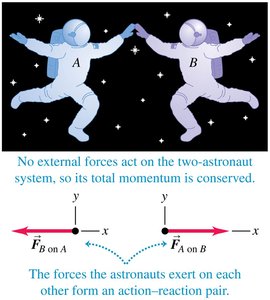
Example: Two astronauts pushing off each other in space experience equal and opposite forces, conserving the system's total momentum.
Action-Reaction Pairs and Momentum Conservation
Newton's Third Law ensures that forces between two objects are equal in magnitude and opposite in direction, forming action-reaction pairs. If external forces sum to zero, the system's momentum is conserved.
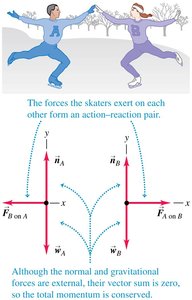
Example: Ice skaters pushing off each other experience equal and opposite forces, and the total momentum remains constant if external forces cancel out.
Types of Collisions
Classification of Collisions
Collisions are categorized based on the conservation of kinetic energy and momentum:
Elastic Collisions: Both momentum and kinetic energy are conserved (e.g., billiard balls).
Inelastic Collisions: Momentum is conserved, but kinetic energy is not (most real-world collisions).
Completely Inelastic Collisions: Objects stick together after collision, moving as one mass.
Elastic Collisions in Two Dimensions
In two-dimensional elastic collisions, both momentum and kinetic energy are conserved. The final velocities and angles can be determined using conservation laws.
Kinetic Energy Conservation: \(\frac{1}{2}m_1v_{1,i}^2 = \frac{1}{2}m_1v_{1,f}^2 + \frac{1}{2}m_2v_{2,f}^2\)
Momentum Conservation (x and y):
\(m_1v_{1,i} = m_1v_{1,f}\cos \phi + m_2v_{2,f}\cos \theta\)
\(0 = m_1v_{1,f}\sin \phi - m_2v_{2,f}\sin \theta\)
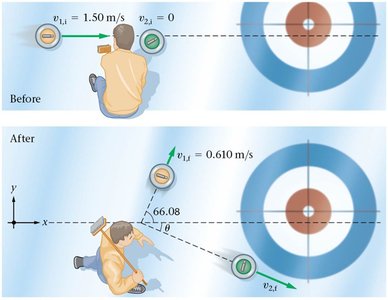
Example: Two curling stones collide; using the above equations, the final speeds and angles can be calculated.
Center of Mass
Definition and Calculation
The center of mass is the weighted average position of all the mass in a system. It is crucial for analyzing motion, especially in extended bodies and systems of particles.
Discrete System: \(x_{CM} = \frac{\sum m_ix_i}{\sum m_i}\), \(y_{CM} = \frac{\sum m_iy_i}{\sum m_i}\)
Continuous Distribution: \(\vec{r}_{CM} = \frac{\int \vec{r} dm}{\int dm}\)

Example: The Fosbury flop in high jump allows the athlete's center of mass to pass below the bar, even as their body clears it.
Center of Mass in Common Shapes
For objects with geometric symmetry, the center of mass is at the geometric center. For objects with an axis of symmetry, the center of mass lies along that axis, but may not be within the object itself.
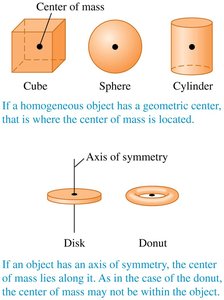
Example: The center of mass of a donut lies along its axis of symmetry, outside the material of the donut.
Motion of the Center of Mass
The velocity and acceleration of the center of mass are determined by the mass-weighted averages of the velocities and accelerations of the system's components. The total momentum of a system equals the total mass times the velocity of the center of mass.
Velocity: \(\vec{v}_{CM} = \frac{\sum m_i \vec{v}_i}{\sum m_i}\)
Acceleration: \(\vec{a}_{CM} = \frac{\sum m_i \vec{a}_i}{\sum m_i}\)
Total Momentum: \(\vec{P} = M \vec{v}_{CM}\)
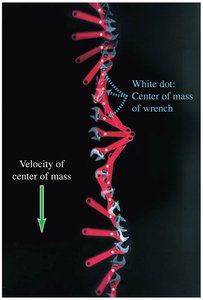
Example: The center of mass of a rotating wrench follows a smooth parabolic path, even as the wrench itself rotates.
Center of Mass in Explosions and Orbits
After an explosion, the center of mass of the fragments continues along the original trajectory. In celestial mechanics, planets and stars orbit their common center of mass (barycenter).
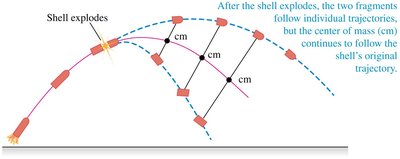
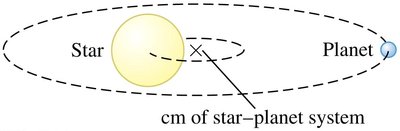
Example: The solar system's barycenter is the point about which both the Sun and planets orbit.
Rocket Propulsion and Systems with Varying Mass
Rocket Equation and Conservation of Momentum
Rockets accelerate by expelling mass (fuel) at high velocity. The conservation of momentum leads to the rocket equation, which describes how the rocket's velocity changes as it loses mass.
Rocket Equation: \(m dv = -v_{ex} dm\)
Integrating gives: \(v - v_0 = -v_{ex} \ln \left( \frac{m}{m_0} \right)\)
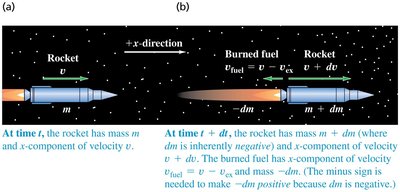
Example: As a rocket burns fuel, its mass decreases and its velocity increases according to the logarithmic relationship above.
Rocket Motion with Gravity
When a rocket is launched vertically, gravity must be considered. The effective change in velocity is reduced by the gravitational acceleration over time.
With Gravity: \(v - v_0 = -v_{ex} \ln \left( \frac{m}{m_0} \right) - gt\)
Additional info: For long flights, gravity decreases with altitude, making the analysis more complex.
