 Back
BackMomentum, Impulse, and Collisions: Step-by-Step Physics Guidance
Study Guide - Smart Notes
 Tailored notes based on your materials, expanded with key definitions, examples, and context.
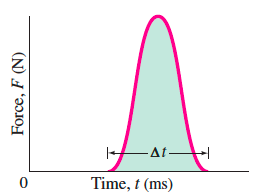
Q1. A 0.145-kg baseball pitched at 31.0 m/s is hit on a horizontal line drive straight back at the pitcher at 46.0 m/s. If the contact time between bat and ball is 5.00 × 10⁻³ s, calculate the force (assumed to be constant) between the ball and bat.
Background
Topic: Impulse and Momentum
This question tests your understanding of impulse, momentum change, and how force relates to these concepts during a collision. It involves applying the impulse-momentum theorem to a real-world scenario.
Key Terms and Formulas
Impulse (): The product of force and the time interval over which it acts, or the change in momentum.
Momentum ():
Impulse-Momentum Theorem:
Change in momentum:
Force:
Step-by-Step Guidance
Identify the known values: kg, m/s (initial velocity toward the pitcher), m/s$\,$ (final velocity, straight back toward the pitcher), s.
Calculate the change in velocity: . Be careful with the sign; since the ball is hit straight back, the direction reverses.
Find the change in momentum: .
Set up the impulse-momentum theorem: .
Try solving on your own before revealing the answer!
Final Answer: 2230 N
kg·m/s (negative sign indicates direction).
N (magnitude is 2230 N).
The force is large because the change in momentum happens over a very short time interval.
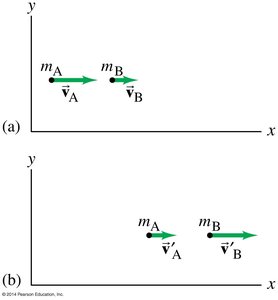
Q2. A 110-kg tackler moving at 2.5 m/s meets head-on (and holds on to) an 82-kg halfback moving at 5.0 m/s. What will be their mutual speed immediately after the collision?
Background
Topic: Conservation of Momentum (Inelastic Collision)
This question tests your ability to apply the principle of conservation of momentum to a completely inelastic collision, where two objects stick together after colliding.
Key Terms and Formulas
Momentum ():
Conservation of Momentum:
Inelastic collision: Objects stick together, so final velocity is shared.
Step-by-Step Guidance
Assign directions: Choose a positive direction (e.g., tackler's direction as positive).
Write the momentum conservation equation: .
Plug in the values: kg, m/s; kg, m/s (since they move head-on).
Solve for by rearranging the equation: .
Try solving on your own before revealing the answer!
Final Answer: -0.36 m/s
The negative sign indicates the direction of the combined mass after collision (toward the halfback's original direction).
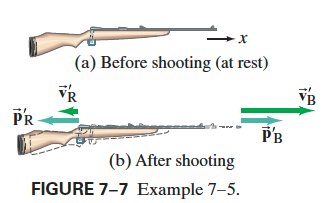
Q3. An atomic nucleus at rest decays radioactively into an alpha particle and a different nucleus. What will be the speed of this recoiling nucleus if the speed of the alpha particle is 2.8 × 10⁵ m/s? Assume the recoiling nucleus has a mass 57 times greater than that of the alpha particle.
Background
Topic: Conservation of Momentum (Radioactive Decay)
This question tests your understanding of momentum conservation in a two-body decay, where the initial momentum is zero and the products move in opposite directions.
Key Terms and Formulas
Momentum ():
Conservation of Momentum: (since initial momentum is zero)
Relationship:
Step-by-Step Guidance
Let be the mass of the alpha particle, and .
Write the conservation of momentum equation: .
Rearrange to solve for : .
Plug in the values: m/s, .
Try solving on your own before revealing the answer!
Final Answer: 4.9 × 10³ m/s
The recoiling nucleus moves much slower than the alpha particle due to its much greater mass.
