 Back
BackMomentum, Impulse, and Collisions: Structured Study Notes
Study Guide - Smart Notes
 Tailored notes based on your materials, expanded with key definitions, examples, and context.
Momentum, Impulse, and Collisions
Introduction to Momentum and Collisions
Momentum and impulse are fundamental concepts in physics, especially when analyzing collisions and interactions where forces are complex or unknown. The principle of conservation of momentum provides a powerful tool for solving problems involving collisions, ranging from sports to car accidents.
Momentum is the product of an object's mass and velocity, and is a vector quantity.
Impulse is the change in momentum resulting from a force applied over a time interval.
Collisions can be elastic or inelastic, depending on whether kinetic energy is conserved.




Momentum: Definition and Properties
Momentum, denoted by \( \vec{p} \), is defined as:
Formula:
Units: kg·m/s
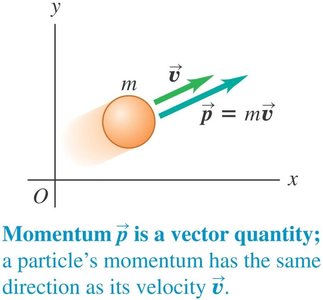
Momentum is a vector quantity, meaning it has both magnitude and direction.
Momentum is conserved in isolated systems (no external forces).
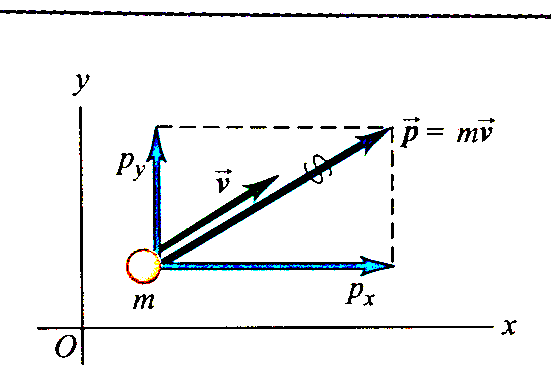
Component Form of Momentum
Momentum can be expressed in terms of its components:
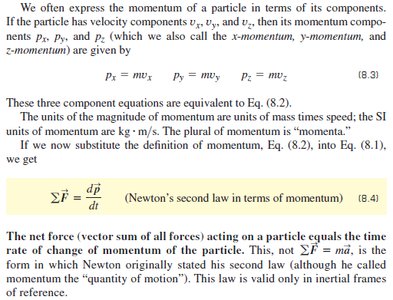
Newton's Second Law in Terms of Momentum
Newton's second law can be written as:
This expresses that the net force equals the rate of change of momentum.
Impulse: Definition and Calculation
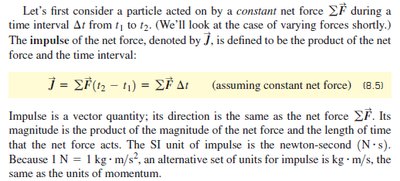
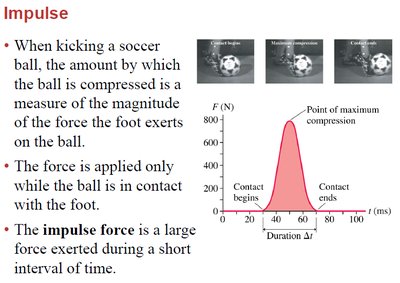
Impulse is the product of the net force and the time interval over which it acts:
Formula: (for constant force)
Impulse is a vector quantity, with the same direction as the net force.
Units: N·s (newton-second), equivalent to kg·m/s
Impulse-Momentum Theorem
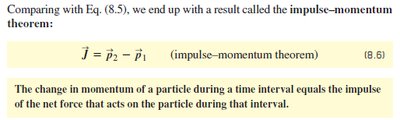
The impulse-momentum theorem states:
The change in momentum equals the impulse delivered by the net force.
Impulse for Varying Forces
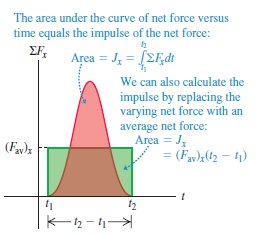
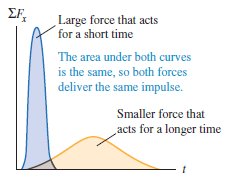
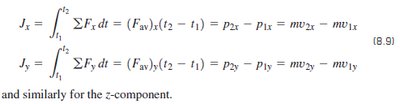
When the force is not constant, impulse is calculated by integrating the force over time:
The area under the force vs. time curve represents the impulse.
Impulse in Component Form
Worked Example: Impulse and Average Force
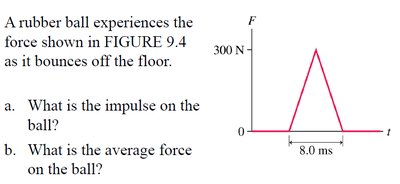
Consider a rubber ball experiencing a force as it bounces off the floor:
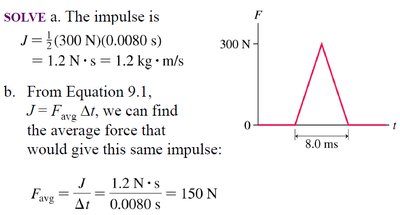
Impulse:
Average Force:
Momentum and Kinetic Energy Compared
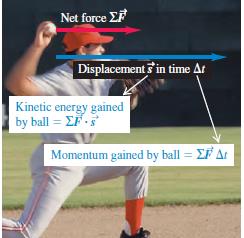
Momentum and kinetic energy are related but distinct concepts:
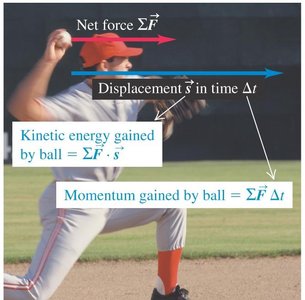
Momentum: Depends on mass and velocity; changes depend on the time over which a force acts.
Kinetic Energy: Depends on mass and velocity squared; changes depend on the distance over which a force acts.
Example: In pitching a baseball, the kinetic energy gained equals the work done (force × distance), while the momentum gained equals the impulse (force × time).
Conceptual Example: Momentum vs. Kinetic Energy
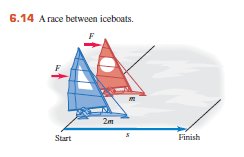
Consider two iceboats of mass m and 2m accelerated by the same force over the same distance:
Both boats have the same kinetic energy at the finish line.
The boat with greater mass (2m) has greater momentum, because it takes longer to reach the finish line, resulting in a larger impulse.
Sample Problem: Impulse and Force Calculation
You throw a ball of mass 0.40 kg against a wall. It hits at 30 m/s and rebounds at 20 m/s. Find:
Impulse:
Average Force: (if contact time is given)
Summary Table: Momentum vs. Kinetic Energy
Property | Momentum | Kinetic Energy |
|---|---|---|
Definition | ||
Units | kg·m/s | Joule (J) |
Depends on | Time force acts | Distance force acts |
Conservation | Conserved in isolated systems | Conserved only in elastic collisions |
Additional info:
All equations are vector equations unless specified otherwise.
Impulse and momentum are often easiest to use in component form for multi-dimensional problems.
