 Back
BackMomentum, Impulse, and Collisions – Study Notes
Study Guide - Smart Notes
 Tailored notes based on your materials, expanded with key definitions, examples, and context.
Momentum, Impulse, and Collisions
Introduction to Momentum
Momentum is a fundamental concept in physics that quantifies the motion of an object. It is defined for any object with mass m moving with velocity v:
Definition: Momentum (p) is the product of an object's mass and its velocity.
Formula:
Units: [kg·m/s]
Vector Quantity: Momentum has both magnitude and direction, always pointing in the same direction as velocity.
Sign Convention: If velocity is negative, momentum is also negative.
Example: A 4,000 kg truck moves to the right at 10 m/s, and an 800 kg racecar moves to the left at 50 m/s. Their momenta are:
Truck: kg·m/s (right)
Racecar: kg·m/s (left)
Impulse and Change in Momentum
Impulse is the effect of a force acting over a time interval, resulting in a change in momentum. It is closely related to Newton's Second Law:
Definition: Impulse (J) is the product of force and the time interval over which it acts.
Formula:
Units: [N·s] or [kg·m/s]
Impulse-Momentum Theorem: The impulse delivered to an object equals its change in momentum.
Example: A 50 kg crate at rest is pushed with a constant 100 N force for 8 seconds. The impulse is N·s, and the final speed is m/s.
Impulse from Force vs. Time Graphs
Impulse can also be determined as the area under a force vs. time graph:
Area under F vs. t graph: Represents impulse delivered to the object.
Positive area: Positive impulse; Negative area: Negative impulse.
Example: If a force acts over a time interval with a triangular profile, calculate the area (impulse) using for triangles or for rectangles.
Total Momentum of a System
The total momentum of a system is the vector sum of the momenta of all objects in the system:
Formula:
Momentum is conserved for the system if no external forces act.
Example: Two objects, A (4 kg, 12 m/s right) and B (5 kg, 9 m/s left): kg·m/s (right).
Conservation of Momentum
When objects interact (collide or push apart), the total momentum of the system is conserved if the system is isolated (no external forces):
Conservation Law:
Applies to both collisions and "push-away" problems (e.g., recoil, explosions).
Example: A 4-kg rifle fires a 5-g bullet at 600 m/s. The recoil speed of the rifle is found using conservation of momentum.
Types of Collisions
Collisions are classified based on whether kinetic energy is conserved:
Type | Momentum Conserved? | Kinetic Energy Conserved? | Objects Stick Together? |
|---|---|---|---|
Elastic | Yes | Yes | No |
Inelastic | Yes | No | No |
Completely Inelastic | Yes | No | Yes |
Example: Two blocks stick together after collision: completely inelastic. If both momentum and kinetic energy are conserved: elastic.
Identifying Collision Types
To determine the type of collision, follow these checks:
Check #1: Is momentum conserved?
Check #2: Do objects stick together? ( or described as "stuck", "embedded")
Check #3: Is ? (Elastic collision condition)
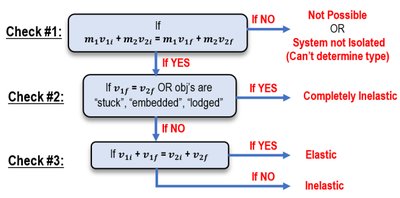
Example: Two carts collide and their final velocities are analyzed to determine if the collision is elastic, inelastic, or completely inelastic.
Center of Mass
The center of mass (C.O.M.) of a system is the weighted average position of all the mass in the system:
Formula (1D):
Formula (2D):
The center of mass is closer to the more massive objects.
Example: Two objects (10 kg each) at x = 0 and x = 4 m: m.
Collisions with Energy Considerations
Some problems require using both conservation of momentum and conservation of energy, especially when motion after collision involves changes in height, springs, or friction:
Momentum Conservation (during collision):
Energy Conservation (after collision):
Example: A crate sticks to another and moves up an incline; use momentum conservation for the collision, then energy conservation for the motion up the incline.
Elastic Collisions
In elastic collisions, both momentum and kinetic energy are conserved. For two objects:
Momentum:
Kinetic Energy:
Relative Velocity: (for 1D elastic collisions)
Example: Two blocks of equal mass exchange velocities in a head-on elastic collision.
Summary Table: Types of Collisions
Type | Momentum Conserved? | Kinetic Energy Conserved? | Objects Stick Together? |
|---|---|---|---|
Elastic | Yes | Yes | No |
Inelastic | Yes | No | No |
Completely Inelastic | Yes | No | Yes |
Additional info: In all collision problems, always start by drawing diagrams for before and after, write the appropriate conservation equations, and solve for the unknowns. For 2D collisions, apply conservation of momentum separately in the x and y directions.
