Back
BackMomentum, Impulse, and Collisions – Study Notes
Study Guide - Smart Notes
 Tailored notes based on your materials, expanded with key definitions, examples, and context.
Momentum, Impulse, and Collisions
Introduction to Momentum and Impulse
Momentum and impulse are essential concepts for analyzing interactions where forces are complex or unknown, such as collisions. These principles allow us to solve problems that cannot be addressed using Newton's second law alone.

Momentum of a Particle
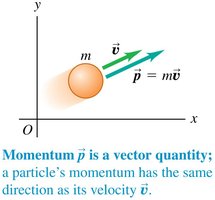
Momentum (\( \vec{p} \)) is defined as the product of a particle's mass and its velocity. It is a vector quantity, meaning it has both magnitude and direction, and always points in the direction of the velocity.
Definition: \( \vec{p} = m \vec{v} \)
Units: kg·m/s
Direction: Same as the velocity vector \( \vec{v} \)
Newton’s Second Law in Terms of Momentum
Newton’s second law can be expressed in terms of momentum, stating that the net force acting on a particle equals the rate of change of its momentum:
\( \sum \vec{F} = \frac{d\vec{p}}{dt} \)

Impulse
Impulse (\( \vec{J} \)) is the product of the net force and the time interval over which it acts. It quantifies the effect of a force acting over time and is also a vector quantity.
Constant Net Force: \( \vec{J} = \sum \vec{F} \Delta t \)
General Net Force: \( \vec{J} = \int_{t_1}^{t_2} \sum \vec{F} dt \)


Impulse from Force-Time Graphs
The impulse delivered by a force is equal to the area under the force versus time curve. For varying forces, the impulse can be calculated by integrating the force over the time interval.
Area under curve: \( J_x = \int_{t_1}^{t_2} \sum F_x dt \)
Average force: \( J_x = (F_{av})_x (t_2 - t_1) \)
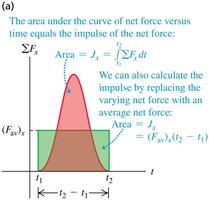
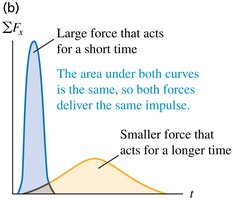
Both a large force acting for a short time and a smaller force acting for a longer time can deliver the same impulse if the area under their force-time curves is equal.
Impulse–Momentum Theorem
The impulse–momentum theorem states that the impulse of the net force acting on a particle during a time interval equals the change in the particle’s momentum during that interval:
\( \vec{J} = \Delta \vec{p} = \vec{p}_2 - \vec{p}_1 \)

Applications of Impulse and Momentum
When landing from a jump, bending your knees increases the time over which you stop, reducing the force on your legs and lowering the risk of injury. This is a practical application of the impulse–momentum theorem.

Momentum vs. Kinetic Energy
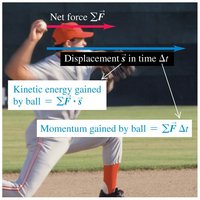
Kinetic energy is related to the work done on an object (force times displacement), while momentum is related to the impulse imparted (force times time). Both are important but describe different aspects of motion.
Kinetic Energy: \( KE = \frac{1}{2}mv^2 \)
Momentum: \( p = mv \)
Conservation of Momentum
Isolated Systems
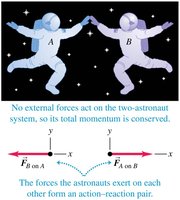
An isolated system is one in which no external forces act. In such systems, the total momentum is conserved. For example, two astronauts pushing off each other in space experience no external forces, so their total momentum remains constant.
Conservation of Momentum Principle
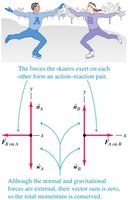
If the vector sum of external forces on a system is zero, the total momentum of the system remains constant. This principle applies even if individual momenta change due to internal forces.
Momentum as a Vector Quantity
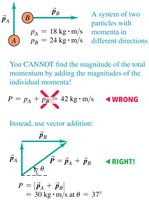
Momentum is a vector, so when adding momenta of multiple particles, use vector addition rather than simply adding magnitudes.
Collisions
Elastic Collisions
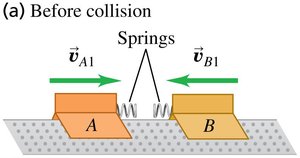
In an elastic collision, both momentum and kinetic energy are conserved. The total kinetic energy of the system is the same before and after the collision.
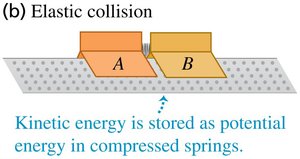
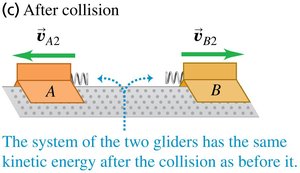
Completely Inelastic Collisions
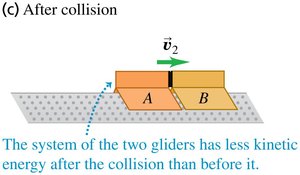
In a completely inelastic collision, the colliding bodies stick together after the collision. Momentum is conserved, but kinetic energy is not; some is transformed into other forms such as heat or deformation.
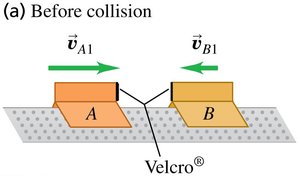
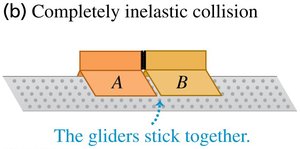
Summary Table: Elastic vs. Inelastic Collisions
Type of Collision | Momentum Conserved? | Kinetic Energy Conserved? | Example |
|---|---|---|---|
Elastic | Yes | Yes | Billiard balls |
Inelastic | Yes | No | Car crash |
Completely Inelastic | Yes | No | Objects stick together |
Inelastic Collision Example
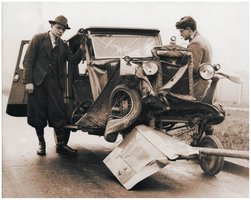
Cars are designed to undergo inelastic collisions, absorbing energy through deformation to protect passengers. The energy absorbed cannot be recovered and is dissipated as heat and structural damage.
Elastic Collision Example
Billiard balls are an example of nearly perfectly elastic collisions, where the balls deform very little and kinetic energy is almost entirely conserved.

Elastic Collisions in One Dimension
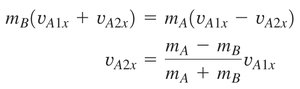
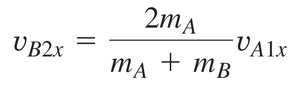
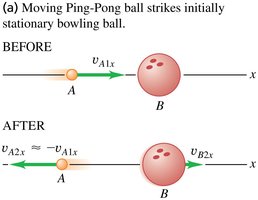
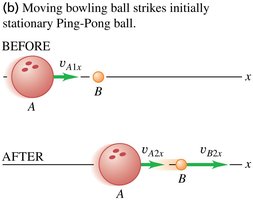
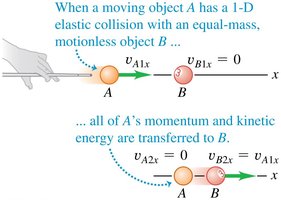
For a one-dimensional elastic collision between two bodies (A and B), where B is initially at rest, the final velocities can be determined using conservation of momentum and kinetic energy:
\( v_{A2x} = \frac{m_A - m_B}{m_A + m_B} v_{A1x} \)
\( v_{B2x} = \frac{2m_A}{m_A + m_B} v_{A1x} \)
Special Cases
B much more massive than A: A reverses direction, B barely moves.
B much less massive than A: A slows slightly, B moves with nearly twice A's original velocity.
Equal masses: A stops, B moves with A's original velocity.
Center of Mass
Definition and Calculation
The center of mass of a system is the point where the system's mass can be considered to be concentrated for the purpose of analyzing translational motion. For particles with masses \( m_1, m_2, \ldots \), the position vector of the center of mass is:
\( \vec{r}_{cm} = \frac{\sum m_i \vec{r}_i}{\sum m_i} \)

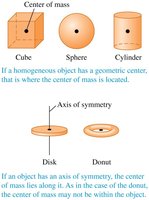
Center of Mass of Symmetrical Objects
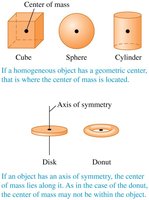
For homogeneous objects with geometric symmetry, the center of mass is located at the geometric center or along the axis of symmetry. For example, a sphere's center of mass is at its center, while a donut's center of mass lies along its axis of symmetry but not within the material itself.
Motion of the Center of Mass
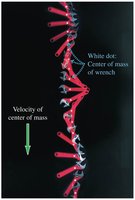
The total momentum of a system equals the total mass times the velocity of the center of mass. The center of mass moves as if all the mass were concentrated at that point and acted upon by the net external force.
\( M \vec{v}_{cm} = \sum m_i \vec{v}_i = \vec{P} \)

External Forces and Center-of-Mass Motion
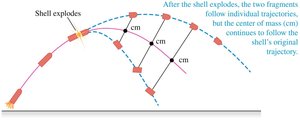
When external forces act on a system, the center of mass moves as though all the mass were concentrated at that point and the net external force acts on it.
Rocket Propulsion and Changing Mass
Rocket Propulsion
In systems where mass changes, such as rockets burning fuel, the principles of momentum conservation still apply. As a rocket expels fuel at high speed, its mass decreases, but the momentum of the system (rocket plus expelled fuel) is conserved.