 Back
BackMomentum, Impulse, and Collisions – Study Notes
Study Guide - Smart Notes
 Tailored notes based on your materials, expanded with key definitions, examples, and context.
Momentum, Impulse, and Collisions
Introduction to Momentum and Impulse
In many physical situations, such as hailstones shattering a roof, the forces involved are complex and difficult to analyze directly using Newton's second law. Instead, the concepts of momentum and impulse provide powerful tools for solving these problems, especially when considering the conservation of momentum in isolated systems.

Momentum and Newton's Second Law
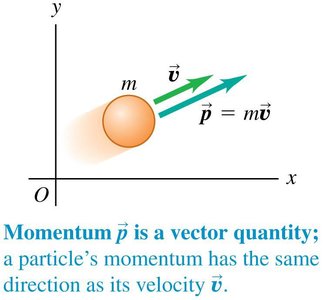
Momentum (\( \vec{p} \)) is a vector quantity defined as the product of a particle's mass and its velocity:
Definition: \( \vec{p} = m \vec{v} \)
Momentum has the same direction as velocity.
Newton's second law can be expressed in terms of momentum:
\( \sum \vec{F} = \frac{d\vec{p}}{dt} \)
This form shows that the net external force equals the rate of change of momentum.

Impulse
Impulse is the product of the net external force and the time interval over which it acts. It is also a vector quantity and is given by:
For a constant force: \( \vec{J} = \sum \vec{F} \Delta t \)
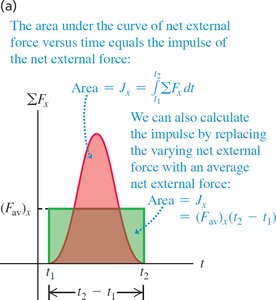
For a varying force: \( \vec{J} = \int_{t_1}^{t_2} \sum \vec{F} dt \)


The impulse is equal to the area under the force vs. time curve:
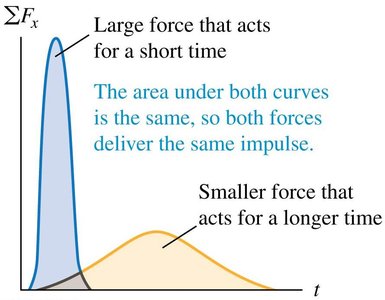
Different force-time profiles can deliver the same impulse if the area under the curve is the same:
Impulse-Momentum Theorem
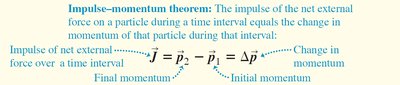
The impulse-momentum theorem states that the impulse of the net external force on a particle during a time interval equals the change in momentum of that particle:
\( \vec{J} = \Delta \vec{p} = \vec{p}_2 - \vec{p}_1 \)
Example: Ball Rebounding from a Wall
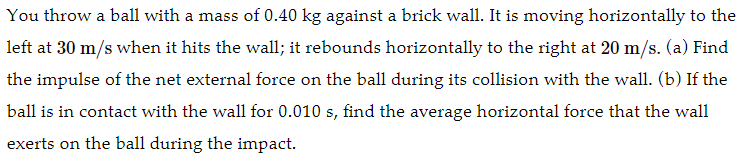
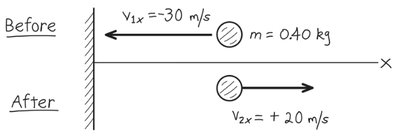
A ball of mass 0.40 kg is thrown against a wall, rebounding with a change in velocity. The impulse and average force can be calculated using the impulse-momentum theorem.
Impulse and Momentum in Two Dimensions
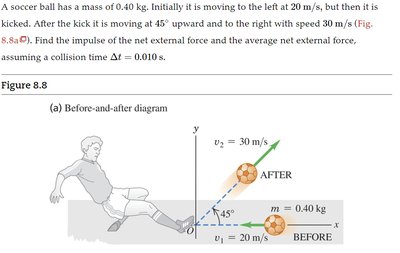
When analyzing impulse and momentum in two dimensions, vector addition is required to determine the resultant impulse and change in momentum.
Impulse and Momentum in Everyday Life
When landing from a jump, bending your knees increases the time over which your momentum changes, reducing the force on your legs and lowering the risk of injury.

Comparing Momentum and Kinetic Energy
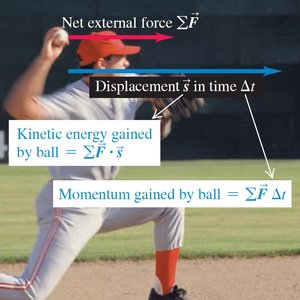
Momentum and kinetic energy are both related to motion but differ in their dependence on velocity and their physical interpretation:
Kinetic energy: Related to the work done to accelerate an object (\( KE = \frac{1}{2}mv^2 \)).
Momentum: Related to the impulse imparted to an object (\( \vec{p} = m\vec{v} \)).
Conservation of Momentum
Isolated Systems
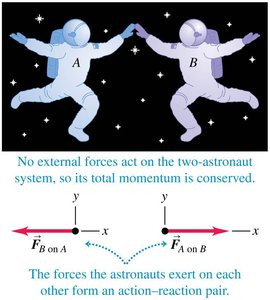
An isolated system is one in which no external forces act on the system. In such systems, the total momentum is conserved.
Conservation of Momentum Principle
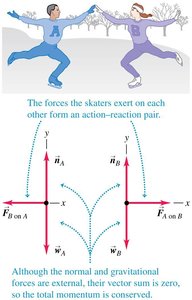
If the vector sum of the external forces on a system is zero, the total momentum of the system remains constant:
\( \sum \vec{F}_{ext} = 0 \implies \vec{p}_{total} = \text{constant} \)
Momentum as a Vector Quantity
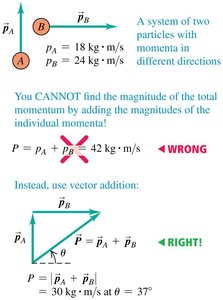
Momentum is a vector, so when applying conservation of momentum, vector addition must be used. The total momentum is not simply the sum of the magnitudes of individual momenta.
Example: Rifle and Bullet Recoil
When a rifle is fired, the bullet and rifle recoil in opposite directions. Conservation of momentum allows calculation of the recoil velocity and final kinetic energies.

Example: Two Robots Colliding
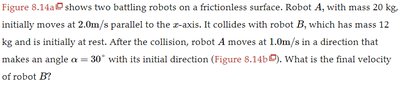
Two robots collide on a frictionless surface. Conservation of momentum in two dimensions is used to find the final velocities after the collision.
Collisions
Elastic Collisions
In an elastic collision, both momentum and kinetic energy are conserved. The total kinetic energy after the collision is the same as before.
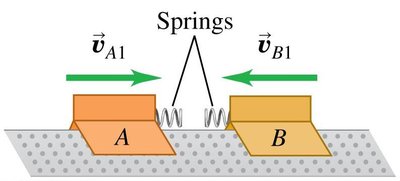
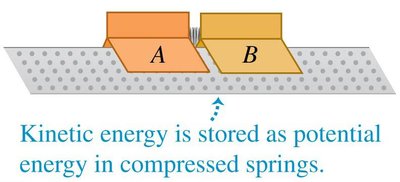
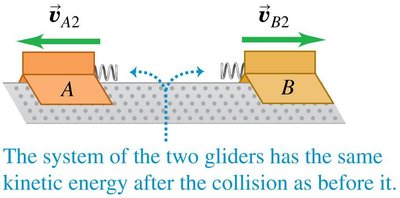
Inelastic and Completely Inelastic Collisions
In an inelastic collision, kinetic energy is not conserved, though momentum is. In a completely inelastic collision, the colliding objects stick together after the collision.
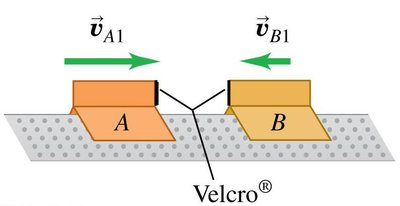
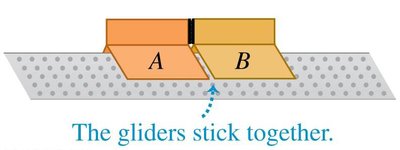
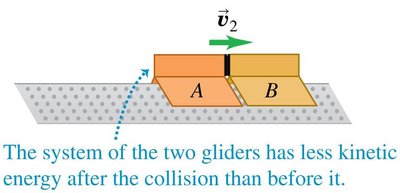
In any collision where external forces can be neglected, total momentum is conserved.
In elastic collisions, total kinetic energy is also conserved.
Application: Car Collisions
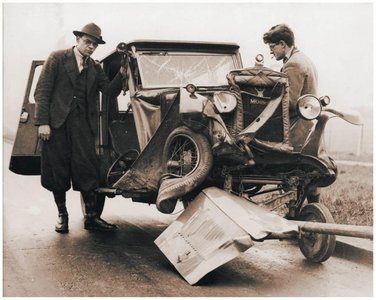
Modern cars are designed to undergo inelastic collisions, absorbing energy through deformation to protect occupants.
Example: Bullet and Block
A bullet embeds itself in a block, and the combined system slides to a stop due to friction. Conservation of momentum and energy principles are used to analyze the motion.

Inelastic Collisions in Two Dimensions
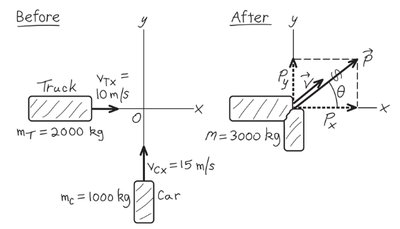
When two objects collide and stick together, their combined velocity after the collision can be found using vector addition of their initial momenta.

Elastic Collision Example: Billiard Balls
Billiard balls are an example of nearly perfectly elastic collisions, where kinetic energy and momentum are both conserved.

Elastic Collisions in One Dimension
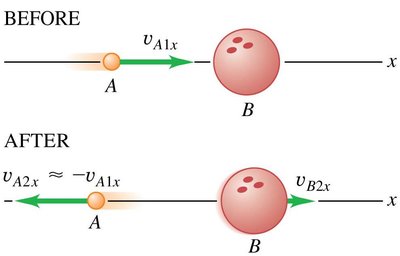
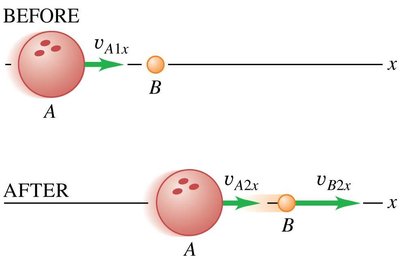
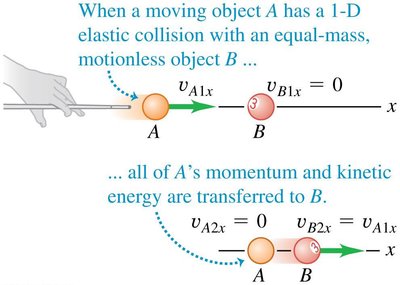
For a one-dimensional elastic collision between two objects A and B (with B initially at rest), the final velocities are given by:
\( v_{A2} = \frac{m_A - m_B}{m_A + m_B} v_{A1} \)
\( v_{B2} = \frac{2m_A}{m_A + m_B} v_{A1} \)
Special cases:
If B is much more massive than A, A reverses direction, B barely moves.
If B is much less massive than A, A slows slightly, B moves with nearly twice A's original speed.
If A and B have equal masses, A stops and B moves with A's original speed.
Relative Velocities in Elastic Collisions
In 1D elastic collisions, the relative velocity of approach before the collision equals the relative velocity of separation after the collision, but in the opposite direction:
\( v_{B2x} - v_{A2x} = - (v_{B1x} - v_{A1x}) \)
Center of Mass
Definition and Calculation
The center of mass of a system of particles is the point where the system's mass can be considered to be concentrated for the purpose of analyzing translational motion. For particles with masses \( m_1, m_2, \ldots \), the position is:
\( \vec{r}_{cm} = \frac{1}{M} \sum_i m_i \vec{r}_i \), where \( M = \sum_i m_i \)
Motion of the Center of Mass
The total momentum of a system equals the total mass times the velocity of the center of mass. The center of mass moves as if all the mass were concentrated at that point and acted on by the net external force.
External Forces and Center-of-Mass Motion
The acceleration of the center of mass is determined by the net external force acting on the system:
\( M \vec{a}_{cm} = \sum \vec{F}_{ext} \)
Additional info: These notes cover the core concepts of Chapter 8: Momentum, Impulse, and Collisions, including definitions, principles, and key examples. For further practice, refer to the worked examples and end-of-chapter problems in your textbook.
