 Back
Momentum, Impulse, and Conservation Laws: Physics with Calculus Study Guide
Study Guide - Smart Notes
 Tailored notes based on your materials, expanded with key definitions, examples, and context.
Momentum and Impulse
Impulse: Definition and Physical Meaning
Impulse is a fundamental concept in physics describing the effect of a force acting over a short time interval, typically during collisions or rapid interactions. It quantifies the change in momentum resulting from the force.
Impulse (J): The product of the average force and the time interval over which it acts. It is a vector quantity.
Formula:
Units: Newton-seconds (N·s), equivalent to kg·m/s.
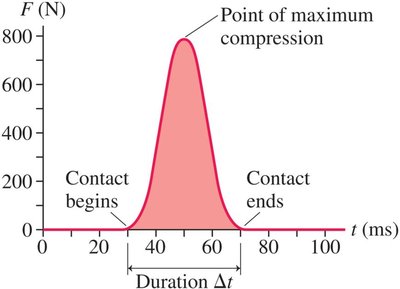
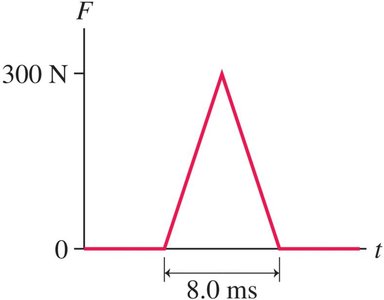
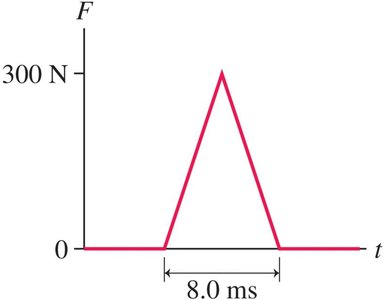
Physical Example: Kicking a soccer ball, where the force rises quickly to a maximum and then falls back to zero as contact ends.
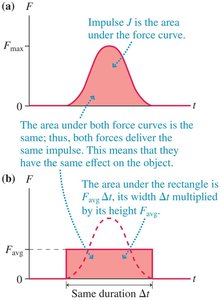
Impulse is proportional to the area under the force vs. time curve.


Impulse and Force Curves
The effect of an impulsive force is determined by the area under the force-time curve. A harder kick (higher force) or longer contact time increases the impulse and the resulting speed of the object.
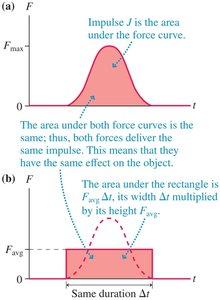
Average Force (Favg): Defined as the constant force that would produce the same impulse over the same time interval.
Formula:
Example: Impulse on a Bouncing Ball
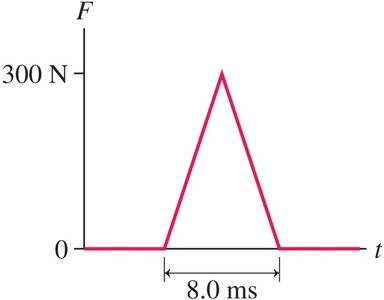
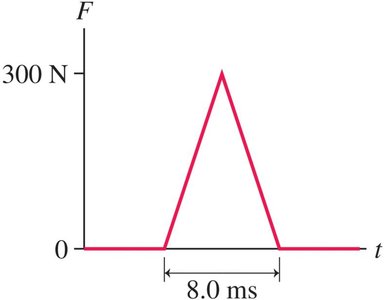
For a triangular force curve, the impulse is calculated as the area of the triangle:
Area of triangle:
Impulse:
Average force:
Momentum and the Impulse-Momentum Theorem
Momentum: Definition and Properties
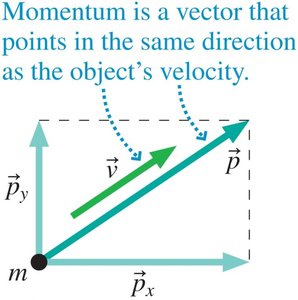
Momentum is the product of an object's mass and velocity, and is a vector quantity pointing in the direction of motion.
Formula:
Units: kg·m/s
Momentum is a vector: ,
Impulse-Momentum Theorem
The impulse-momentum theorem states that the impulse delivered to an object equals the change in its momentum:
Formula:
Component form: ,
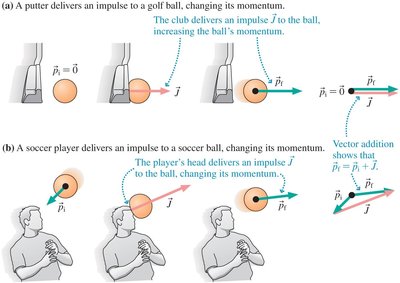
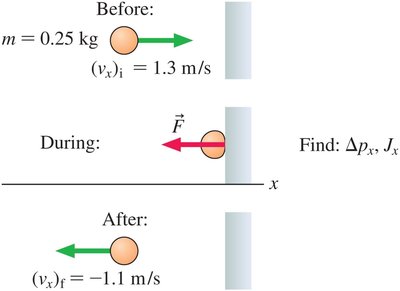
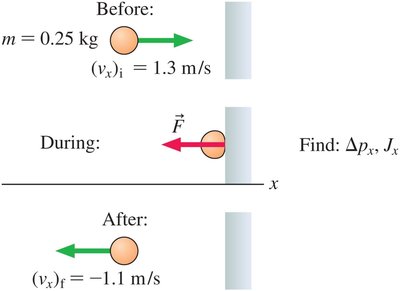
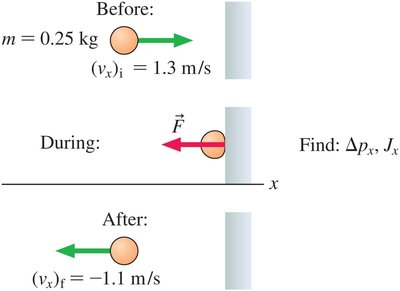
Example: Change in Momentum (Ball Rebounding)
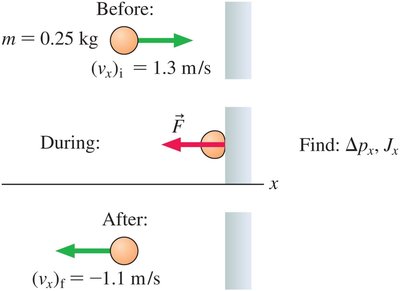
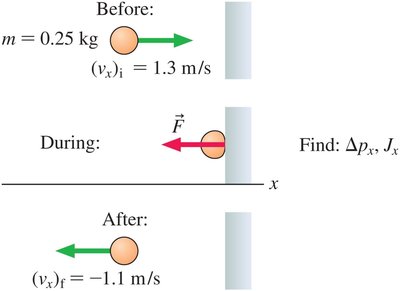
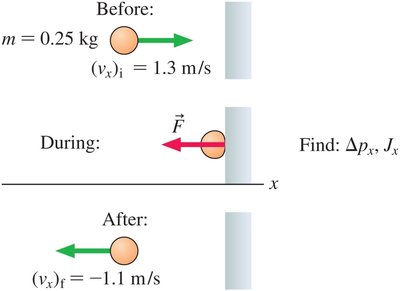
When a ball rebounds from a wall, its momentum changes direction. The impulse delivered by the wall equals this change.
Initial momentum:
Final momentum:
Change in momentum:
Impulse: (negative indicates direction)
Conservation of Momentum
Law of Conservation of Momentum
In an isolated system (no net external force), the total momentum before an interaction equals the total momentum after.
Formula:
System: Defined by a boundary; internal forces do not change total momentum, only external forces do.
Isolated system: Net external force is zero.
Example: Ice Skaters Pushing Off
Two skaters push off from each other on frictionless ice. The system is isolated, so momentum is conserved.
Initial momentum: Both at rest,
Final momentum:
Solving:
Example values:
Collisions and Explosions
Inelastic Collisions
In a perfectly inelastic collision, objects stick together and move with a common final velocity. Momentum is conserved, but kinetic energy is not.
Formula:
Applications: Clay hitting the floor, bullet embedding in wood.
Explosions
In an explosion, particles move apart after a brief, intense interaction. If the system is isolated, total momentum is conserved.
Formula: (if initially at rest)
Momentum in Two Dimensions
Solving Two-Dimensional Collision Problems
When collisions occur in two dimensions, conservation of momentum must be applied to each component:
Component equations:
Example: Falcon and pigeon collision, where both x and y components are calculated and combined to find final speed and direction.
Angular Momentum
Definition and Conservation
Angular momentum is the rotational analog of linear momentum, defined for rotating objects.
Formula:
Conservation: If no net external torque acts, angular momentum is conserved:
Moment of inertia (I): Depends on mass distribution; changing I (e.g., by moving mass outward) changes angular velocity to conserve L.
Example: Merry-Go-Round Period Change
When a person moves outward on a rotating platform, the moment of inertia increases, causing angular velocity to decrease to conserve angular momentum.
Formula:
Period:
Summary Table: Rotational vs. Linear Dynamics
Rotational Dynamics | Linear Dynamics |
|---|---|
Torque | Force |
Moment of inertia | Mass |
Angular velocity | Velocity |
Angular momentum | Linear momentum |
Key Concepts and Problem-Solving Strategies
Impulse-momentum theorem:
Conservation of momentum: Total momentum is constant in isolated systems.
Conservation of angular momentum: Total angular momentum is constant if no net external torque acts.
Before-and-after visual overview: Draw diagrams showing the system before and after interaction, define knowns and unknowns.
