 Back
BackMomentum, Impulse, and Conservation of Momentum – Study Notes
Study Guide - Smart Notes
 Tailored notes based on your materials, expanded with key definitions, examples, and context.
Momentum & Impulse
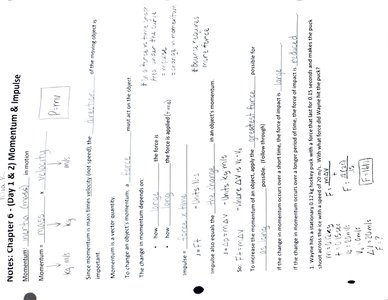
Definition of Momentum
Momentum is a vector quantity that describes the motion of an object and is the product of its mass and velocity. It is a fundamental concept in physics, especially in analyzing collisions and motion.
Formula:
Units: kg·m/s
Vector Quantity: Direction matters (same as velocity)
Example: A 2 kg object moving at 3 m/s has a momentum of kg·m/s.
Impulse and Change in Momentum
Impulse is the product of force and the time interval over which the force acts. It is equal to the change in momentum of an object.
Formula:
Units: N·s (Newton-seconds), which is equivalent to kg·m/s
Impulse-Momentum Theorem: The impulse on an object is equal to its change in momentum.
Example: If a 1 kg ball increases its velocity from 2 m/s to 6 m/s, the change in momentum is kg·m/s.
Conservation of Momentum
Law of Conservation of Momentum
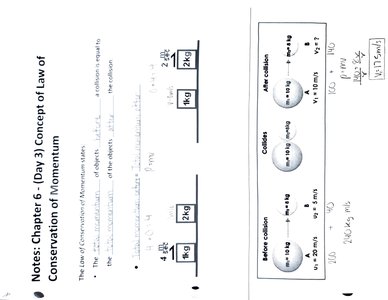
The law of conservation of momentum states that in a closed, isolated system (no external forces), the total momentum before an event (such as a collision) is equal to the total momentum after the event.
Mathematical Statement:
Applies to all types of collisions (elastic and inelastic)
Example: Two carts, one with mass 2 kg moving at 4 m/s and another with mass 1 kg at rest, collide and stick together. The total momentum before is kg·m/s. After collision, the combined mass is 3 kg, so m/s.
Types of Collisions
Elastic Collision: Both momentum and kinetic energy are conserved.
Inelastic Collision: Momentum is conserved, but kinetic energy is not. In a perfectly inelastic collision, objects stick together after the collision.
Example: Two balls collide and move together after the collision. The combined velocity can be found using conservation of momentum.
Mathematical Notes on Conservation of Momentum
System Analysis and Equations
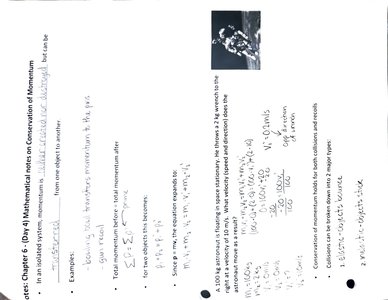
In an isolated system, momentum can be transferred from one object to another, but the total remains constant.
General Equation:
For perfectly inelastic collisions:
Example: An astronaut throws a wrench in space; the astronaut moves in the opposite direction to conserve momentum.
Worked Problems
Solving conservation of momentum problems involves:
Identifying the system and objects involved
Writing the momentum conservation equation
Solving for the unknown (usually a final velocity)
Example Problem: A 1000 kg car moving at 20 m/s collides with a 2000 kg truck at rest. After collision, they stick together. Find the final velocity:
Total initial momentum: kg·m/s
Total mass after collision: kg
Final velocity: m/s
Summary Table: Types of Collisions
Type of Collision | Momentum Conserved? | Kinetic Energy Conserved? | Objects Stick Together? |
|---|---|---|---|
Elastic | Yes | Yes | No |
Inelastic | Yes | No | Sometimes |
Perfectly Inelastic | Yes | No | Yes |
Practice Problems and Solutions
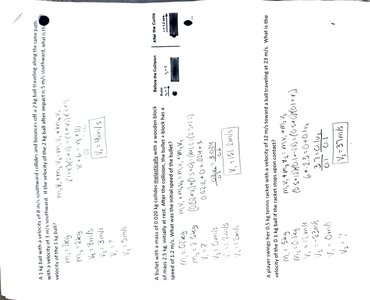
Several worked examples are provided in the notes, including step-by-step solutions for finding final velocities after collisions using the conservation of momentum principle.
Additional info: These notes cover the core concepts of momentum, impulse, and the conservation of momentum, including both qualitative explanations and quantitative problem-solving strategies. The examples and equations provided are foundational for understanding collisions and motion in physics.
