 Back
Momentum, Impulse, Energy, and Efficiency: Study Guide for Physics with Calculus
Study Guide - Smart Notes
 Tailored notes based on your materials, expanded with key definitions, examples, and context.
Momentum and Impulse
Definition and Properties of Momentum
Momentum is a fundamental concept in physics describing the quantity of motion an object possesses. It is defined as the product of an object's mass and velocity.
Momentum (p):
Units: kilogram meter per second (kg·m/s)
Example: If a freight train triples its mass but maintains the same speed, its momentum triples. If it doubles its speed with the same mass, its momentum doubles.
Impulse and Its Relationship to Momentum
Impulse is the change in momentum resulting from a force applied over a period of time.
Impulse (J):
Impulse-Momentum Theorem:
Example: Padded dashboards increase the time of impact, reducing the force experienced by occupants during collisions.

Impulse in Collisions
The force experienced during a collision depends on the time of impact and whether the object bounces.
Key Factors: Height of fall, speed before impact, time of impact, surface hardness, and bouncing behavior.
Example: A dish falling from a cabinet experiences different impact forces depending on whether it lands on a soft or hard surface and whether it bounces.

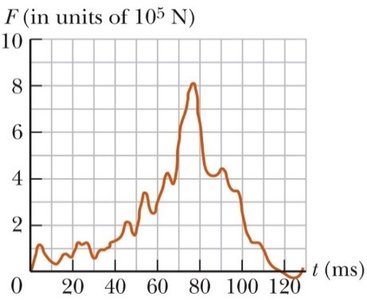
Force-Time Graphs in Impulse
The area under a force-time graph represents the impulse delivered to an object.
Graph Interpretation: The total impulse is the integral of force over time.
Example: A ball hitting a wall experiences a force over a short time interval, as shown in a force-time graph.
Conservation of Momentum
Law of Conservation of Momentum
In the absence of external forces, the total momentum of a system remains constant.
Equation:
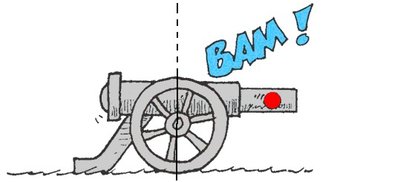
Application: When a cannon fires a ball, the momentum of the cannon and ball after firing must sum to zero if initially at rest.
Collisions: Elastic and Inelastic
Collisions are classified based on whether kinetic energy is conserved.
Elastic Collision: Both momentum and kinetic energy are conserved.
Inelastic Collision: Momentum is conserved, but kinetic energy is not.
Completely Inelastic Collision: Objects stick together after collision.
Example: Two carts with equal mass colliding and exchanging velocities.
Work and Energy
Work
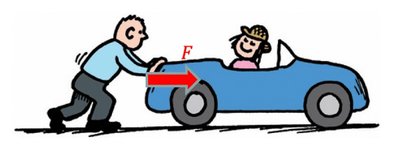
Work is done when a force causes displacement.
Work (W):
Units: Joules (J)
Example: Pushing a cart twice as far with the same force doubles the work done.
Note: If no displacement occurs (e.g., pushing against a wall), no work is done.

Gravitational Potential Energy
Potential energy is stored due to an object's position in a gravitational field.
Potential Energy (PE):
Units: Joules (J)
Example: Ranking the potential energy of bags lifted to different heights.



Kinetic Energy
Kinetic energy is the energy of motion.
Kinetic Energy (KE):
Units: Joules (J)
Example: A car moving twice as fast as another identical car has four times the kinetic energy.
Work-Energy Theorem
The work done on an object is equal to the change in its kinetic energy.
Work-Energy Theorem:
Example: Pushing a crate across a floor: the work done minus energy lost to friction equals the kinetic energy gained.
Conservation of Energy
Law of Conservation of Energy
Energy cannot be created or destroyed; it can only be transformed from one form to another.
Key Principle: Total energy in a closed system remains constant.
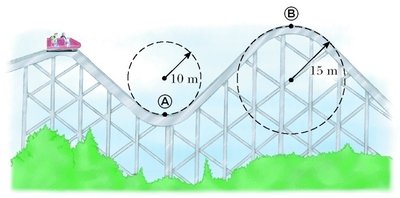
Example: Potential energy converts to kinetic energy as a roller coaster descends.
Efficiency
Definition and Calculation of Efficiency
Efficiency measures how much input energy is converted into useful output.
Efficiency:
Example: A machine with 30% efficiency converts 30% of input energy to useful work; the rest is lost as heat or other forms.
Summary Table: Key Formulas
Concept | Formula | Units |
|---|---|---|
Momentum | kg·m/s | |
Impulse | kg·m/s | |
Work | J | |
Potential Energy | J | |
Kinetic Energy | J | |
Efficiency | % |
Additional info:
All equations are provided in LaTeX format for clarity and academic rigor.
Images included are directly relevant to the explanation of momentum, impulse, work, energy, and efficiency.
Examples and applications are drawn from the provided materials and expanded for academic completeness.
