 Back
BackMomentum, Impulse, Work, Energy, and Power: Core Concepts in Physics
Study Guide - Smart Notes
 Tailored notes based on your materials, expanded with key definitions, examples, and context.
Momentum
Definition and Properties
Momentum is a fundamental property of moving objects, representing inertia in motion. It is defined as the product of an object's mass and its velocity:
Formula:
Units: kilogram meter per second (kg·m/s)
Momentum is a vector quantity, meaning it has both magnitude and direction.
An object at rest has zero momentum.
Example: A moving boulder has more momentum than a stone rolling at the same speed due to its greater mass. A faster boulder has more momentum than a slower one of the same mass.

Impulse and Momentum Change
Impulse
Impulse is the product of the force applied to an object and the time interval over which it acts. It quantifies the change in momentum:
Formula:
Impulse-Momentum Theorem:
Impulse causes a change in velocity, and thus a change in momentum.
Example: A force applied over a longer time produces a greater change in momentum. For instance, following through with a golf club or baseball bat increases the time of contact, resulting in a greater impulse and higher speed of the ball.


Impulse in Real-World Scenarios
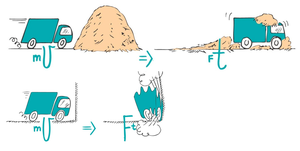
Increasing momentum: Apply the greatest force for as long as possible (e.g., swinging through in golf or baseball).
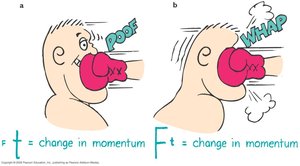
Decreasing momentum over a long time: Extending the time of impact reduces the force (e.g., airbags in cars, bending knees when landing from a jump).
Decreasing momentum over a short time: Shorter contact time results in a larger force (e.g., karate chop breaking bricks).

Conservation of Momentum
Law of Conservation of Momentum
The law of conservation of momentum states that in the absence of an external force, the total momentum of a system remains unchanged:
Formula:
Applies to all types of collisions and interactions within a closed system.
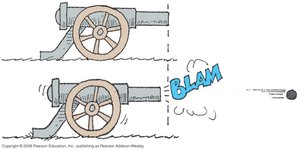
Example: When a cannon is fired, the cannonball moves forward and the cannon recoils backward with equal and opposite momentum.

Collisions
Types of Collisions
Elastic Collision: Objects rebound without lasting deformation or heat generation. Both momentum and kinetic energy are conserved.
Inelastic Collision: Objects deform and/or generate heat. Momentum is conserved, but kinetic energy is not.
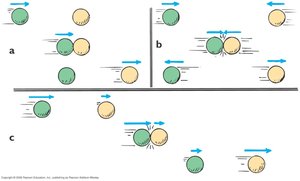
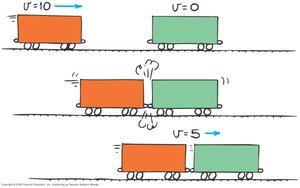
Example: Two freight cars of equal mass, one moving and one at rest, couple together after collision. The final speed is half the initial speed of the moving car, as the total momentum is shared.

Work and Energy
Work
Work is done when a force acts on an object and moves it through a distance:
Formula:
Units: Joule (J), where 1 J = 1 N·m
Work requires both force and movement in the direction of the force.
Example: Lifting a barbell from the floor involves doing work against gravity.



Potential Energy
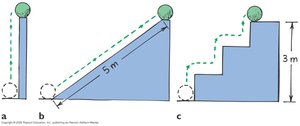
Potential energy (PE) is stored energy due to position or configuration. Gravitational potential energy is energy due to elevation above a reference point:
Formula:
Depends on mass (m), gravitational acceleration (g), and height (h).
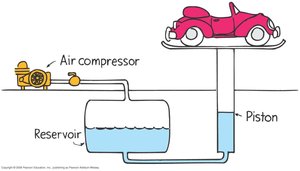
Example: Water in an elevated reservoir or a car hoisted for repairs has increased potential energy relative to the ground.
Kinetic Energy
Kinetic energy (KE) is the energy of motion:
Formula:
Any object with momentum also has kinetic energy.
Work-Energy Theorem
The work-energy theorem states that the net work done on an object equals its change in kinetic energy:
Formula:
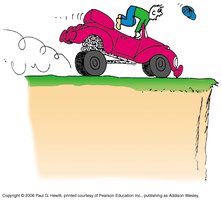
Doubling the speed of an object requires four times the work.
Conservation of Energy
Law of Conservation of Energy
Energy cannot be created or destroyed; it can only be transformed from one form to another. The total energy in a closed system remains constant.
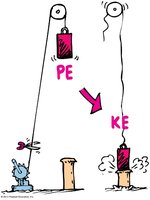
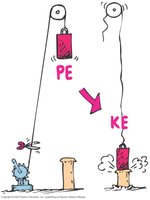
Example: In a pile driver, potential energy is converted to kinetic energy as the weight falls, and then to work as it strikes the pile.
Energy Transformations
When a bow is drawn, work is done and stored as potential energy. Upon release, most of this energy becomes the kinetic energy of the arrow, with some lost as heat.

Kinetic Energy and Momentum Compared
Both are properties of moving objects and depend on mass and velocity.
Momentum is a vector (directional), while kinetic energy is a scalar (non-directional).
Momentum: ; Kinetic Energy:
Doubling velocity doubles momentum but quadruples kinetic energy.
Power
Definition and Units
Power measures how quickly work is done or energy is transferred:
Formula:
Units: Watt (W), where 1 W = 1 J/s

Example: Running up stairs quickly requires more power than walking up slowly, even if the work done (change in height) is the same.
