 Back
BackMotion Along a Straight Line: Displacement, Velocity, and Acceleration
Study Guide - Smart Notes
 Tailored notes based on your materials, expanded with key definitions, examples, and context.
Motion Along a Straight Line
Introduction to Kinematics
Kinematics is the branch of physics that describes the motion of objects without considering the causes of motion. In straight-line (one-dimensional) motion, we use a coordinate system (usually the x-axis) to specify the position of an object, treating it as a particle for simplicity.
Displacement, Time, and Average Velocity
Displacement is a vector quantity that represents the change in position of an object along a straight line. It is defined as the difference between the final and initial positions:
Displacement:
Time Interval:
Average Velocity:
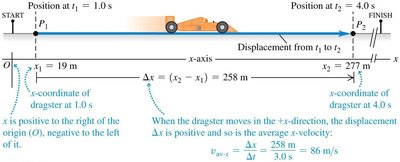
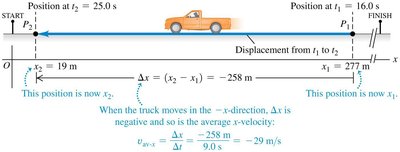
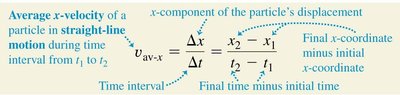
Example: If a dragster moves from to in , the average velocity is .
Position-Time Graphs and Velocity
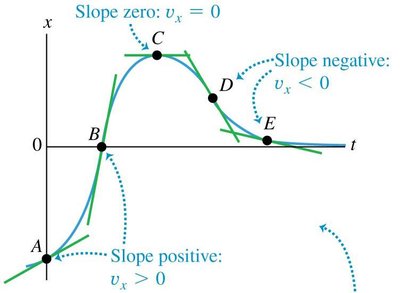
Position-time ( vs. ) graphs visually represent how an object's position changes over time. The slope of the line connecting two points gives the average velocity, while the slope of the tangent at a point gives the instantaneous velocity.
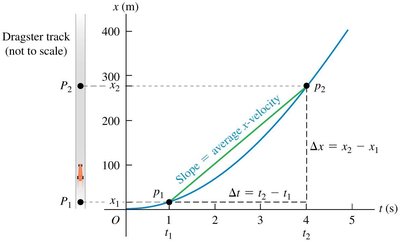
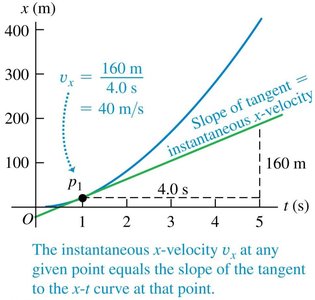
Key Points:
Positive slope: Positive velocity (moving in +x direction)
Negative slope: Negative velocity (moving in -x direction)
Zero slope: Zero velocity (object at rest)
Rules for the Sign of Velocity
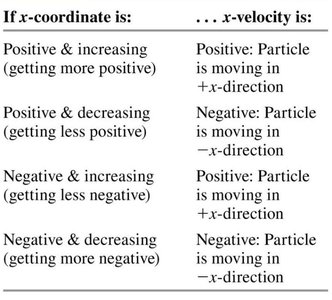
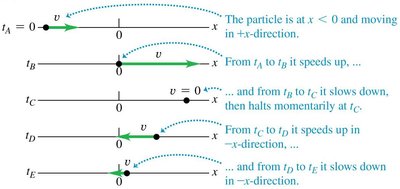
The sign of velocity depends on the direction of motion and the chosen coordinate system. The following table summarizes the relationship between the x-coordinate and the sign of velocity:
If x-coordinate is: | ... x-velocity is: |
|---|---|
Positive & increasing | Positive: Particle is moving in +x-direction |
Positive & decreasing | Negative: Particle is moving in -x-direction |
Negative & increasing | Positive: Particle is moving in +x-direction |
Negative & decreasing | Negative: Particle is moving in -x-direction |
Typical Velocity Magnitudes
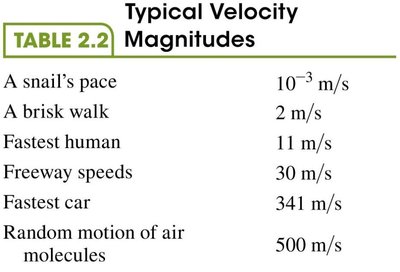
Velocities in nature span a wide range. The following table provides typical values for various objects and phenomena:
Object/Phenomenon | Velocity (m/s) |
|---|---|
A snail’s pace | |
A brisk walk | 2 |
Fastest human | 11 |
Freeway speeds | 30 |
Fastest car | 341 |
Random motion of air molecules | 500 |
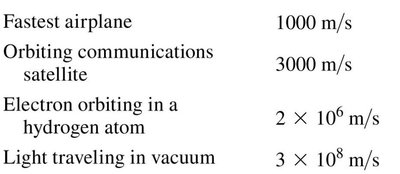
Fastest airplane | 1000 |
Orbiting communications satellite | 3000 |
Electron in hydrogen atom | |
Light in vacuum |
Instantaneous Velocity
Instantaneous velocity is the velocity of an object at a specific instant in time. It is found as the slope of the tangent to the position-time curve at that point:
Instantaneous velocity:
Interpreting Position-Time and Velocity-Time Graphs
Graphs are essential tools for visualizing motion. The slope of a position-time graph gives velocity, while the slope of a velocity-time graph gives acceleration. Key features include:
Positive slope: Positive velocity or acceleration
Negative slope: Negative velocity or acceleration
Zero slope: Zero velocity or acceleration
Average and Instantaneous Acceleration
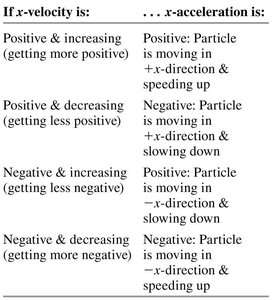
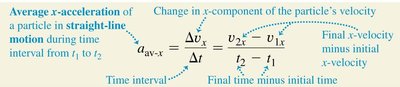
Acceleration is the rate of change of velocity with respect to time. It can be average (over a time interval) or instantaneous (at a specific instant):
Average acceleration:
Instantaneous acceleration:
Constant Acceleration and Kinematic Equations
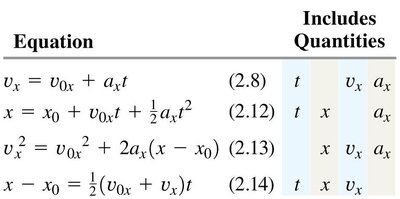
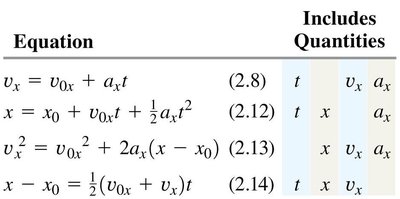
When acceleration is constant, the following kinematic equations describe the motion:
Worked Example: Constant-Acceleration Calculations
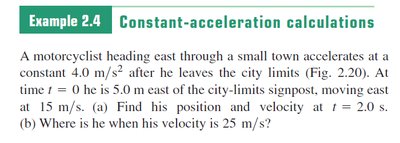
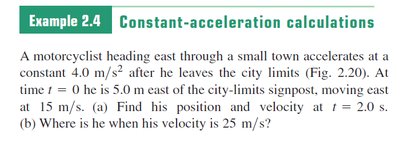
Example: A motorcyclist accelerates at from an initial velocity of and position east of a signpost. Find the position and velocity at .
Position:
Velocity:
Summary Table: Kinematic Equations for Constant Acceleration
Equation | Includes Quantities |
|---|---|
t, , | |
t, x, | |
x, , | |
t, x, |
Key Concepts and Applications
Displacement is a vector; distance is a scalar.
Velocity can be positive or negative depending on direction.
Acceleration describes how velocity changes; it can also be positive or negative.
Use kinematic equations for problems involving constant acceleration.
Interpret graphs carefully: slopes and areas under curves have physical meaning.
