 Back
BackMotion Along a Straight Line: Displacement, Velocity, and Acceleration
Study Guide - Smart Notes
 Tailored notes based on your materials, expanded with key definitions, examples, and context.
Motion Along a Straight Line
Displacement, Time, and Average Velocity
Motion along a straight line is a fundamental topic in kinematics, focusing on how objects move in one dimension. The displacement, time interval, and average velocity are key quantities used to describe such motion.
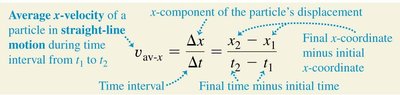
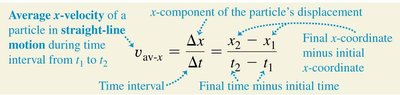
Displacement (Δx): The change in position of a particle along the x-axis, defined as Δx = x2 - x1.
Time Interval (Δt): The difference between the final and initial times, Δt = t2 - t1.
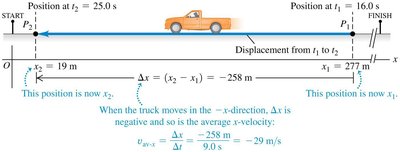
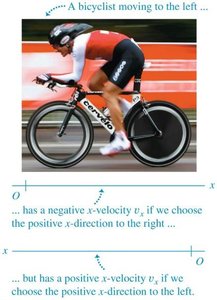
Average Velocity (vav-x): The rate of change of displacement over time, given by: The sign of velocity indicates direction: positive for motion in the +x direction, negative for motion in the -x direction.
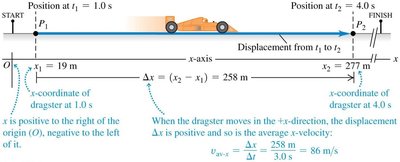
Example: A dragster moves from x1 = 19 m at t1 = 1.0 s to x2 = 277 m at t2 = 4.0 s. The displacement is Δx = 258 m and the average velocity is 86 m/s.
Position-Time Graphs and Velocity
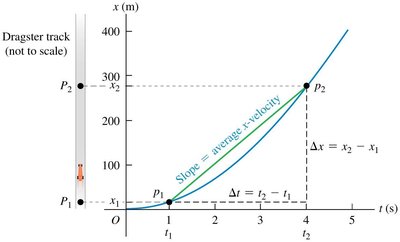
Position-time (x-t) graphs are used to visualize motion. The slope of the graph represents the average velocity over a time interval.
Slope Interpretation: The slope between two points (x1, t1) and (x2, t2) gives the average velocity.
Direction: Positive slope indicates motion in the +x direction; negative slope indicates motion in the -x direction.
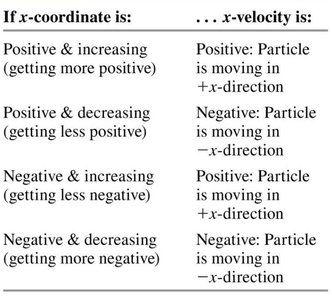
Rules for the Sign of x-Velocity
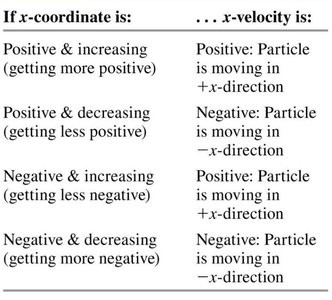
The sign of the x-velocity depends on the direction and change of the x-coordinate.
Positive & Increasing: Moving in +x direction.
Positive & Decreasing: Moving in -x direction.
Negative & Increasing: Moving in +x direction.
Negative & Decreasing: Moving in -x direction.
If x-coordinate is: | x-velocity is: |
|---|---|
Positive & increasing | Positive: Particle is moving in +x-direction |
Positive & decreasing | Negative: Particle is moving in -x-direction |
Negative & increasing | Positive: Particle is moving in +x-direction |
Negative & decreasing | Negative: Particle is moving in -x-direction |
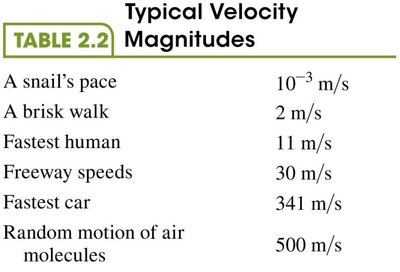
Typical Velocity Magnitudes
Velocity magnitudes vary widely depending on the context, from slow-moving objects to fast-moving particles.
Object | Velocity (m/s) |
|---|---|
A snail's pace | |
A brisk walk | 2 |
Fastest human | 11 |
Freeway speeds | 30 |
Fastest car | 341 |
Random motion of air molecules | 500 |
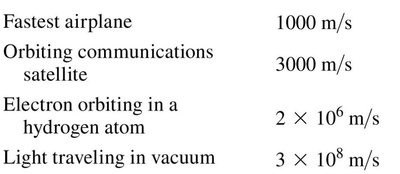
Fastest airplane | 1000 |
Orbiting communications satellite | 3000 |
Electron orbiting in a hydrogen atom | |
Light traveling in vacuum |
Instantaneous Velocity
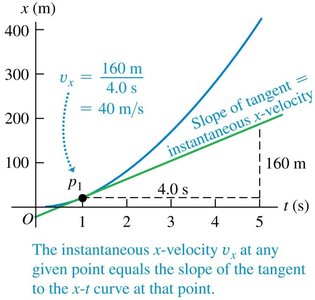
Instantaneous velocity is the velocity at a specific instant, defined as the slope of the tangent to the x-t curve at that point.
Mathematical Definition:
Graphical Interpretation: The slope of the tangent line at a point on the x-t graph gives the instantaneous velocity.
Velocity-Time Graphs
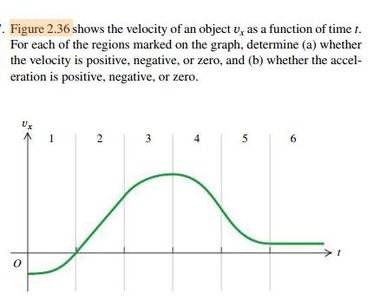
Velocity-time (vx-t) graphs provide information about the velocity at each instant and can be used to determine acceleration.
Positive Slope: Indicates increasing velocity (speeding up).
Negative Slope: Indicates decreasing velocity (slowing down).
Zero Slope: Indicates constant velocity.
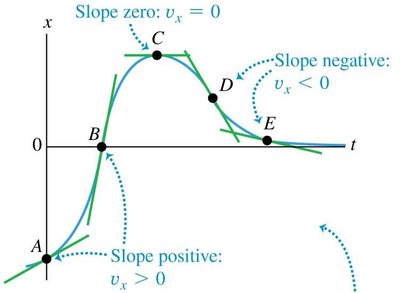
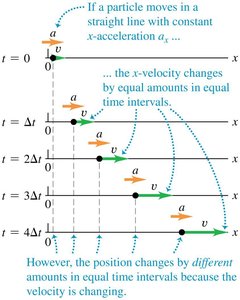
Motion Diagrams and x-t Graphs
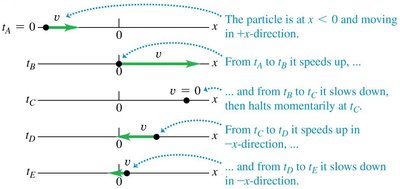
Motion diagrams visually represent the position and velocity of a particle at different times, helping to understand the direction and magnitude of motion.
Arrows: Indicate direction and speed of motion.
Position Markers: Show the location of the particle at each time interval.
Average and Instantaneous Acceleration
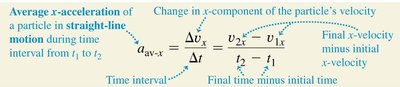
Acceleration describes the rate of change of velocity with time. Average acceleration is calculated over a time interval, while instantaneous acceleration is the value at a specific instant.
Average Acceleration (aav-x):
Instantaneous Acceleration: The slope of the tangent to the vx-t curve at a point.
Rules for the Sign of x-Acceleration
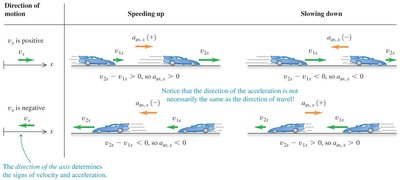
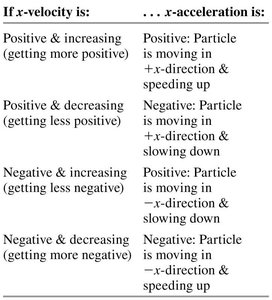
The sign of acceleration depends on the direction of velocity and whether the object is speeding up or slowing down.
If x-velocity is: | x-acceleration is: |
|---|---|
Positive & increasing | Positive: Particle is moving in +x-direction & speeding up |
Positive & decreasing | Negative: Particle is moving in +x-direction & slowing down |
Negative & increasing | Positive: Particle is moving in -x-direction & slowing down |
Negative & decreasing | Negative: Particle is moving in -x-direction & speeding up |
Constant Acceleration and Kinematic Equations
When acceleration is constant, the motion can be described using kinematic equations. These equations relate displacement, velocity, acceleration, and time.
Kinematic Equations:
Application: These equations are used to solve problems involving motion with constant acceleration, such as a car accelerating along a highway or a motorcycle speeding up after leaving city limits.
Graphical Representation of Constant Acceleration
Graphs of position, velocity, and acceleration versus time illustrate the effects of constant acceleration.
x vs t: Parabolic curve for constant acceleration.
vx vs t: Linear graph; slope equals acceleration.
ax vs t: Horizontal line; area under curve gives change in velocity.
Summary Table: Kinematic Equations and Quantities
The following table summarizes the kinematic equations and the quantities they include:
Equation | Includes Quantities |
|---|---|
t, v_x, a_x | |
t, x, a_x | |
x, v_x, a_x | |
t, v_x |
Example Problems
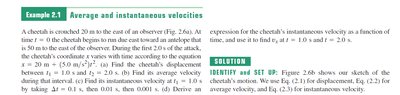
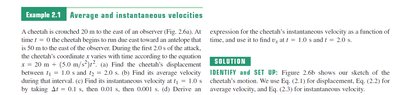
Worked examples illustrate the application of kinematic equations to real-world scenarios, such as calculating the position and velocity of a motorcycle or car under constant acceleration.
Example: A motorcyclist accelerates at 4.0 m/s2 from an initial velocity of 15 m/s. After 2.0 s, the position and velocity can be found using:
Summary
Motion along a straight line is characterized by displacement, velocity, and acceleration. Position-time and velocity-time graphs, along with kinematic equations, provide powerful tools for analyzing and predicting the motion of objects in one dimension.
Additional info: The notes include expanded explanations, definitions, and examples to ensure completeness and academic quality for exam preparation.
