 Back
Motion Along a Straight Line: Displacement, Velocity, and Acceleration
Study Guide - Smart Notes
 Tailored notes based on your materials, expanded with key definitions, examples, and context.
Motion Along a Straight Line
Displacement
Displacement is a vector quantity that describes the change in position of an object. It is defined as the difference between the final and initial position vectors.
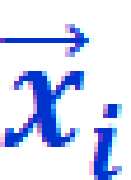
Initial Position Vector: \( \vec{x}_i \)
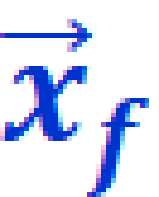
Final Position Vector: \( \vec{x}_f \)
Displacement Formula: \( \Delta \vec{x} = \vec{x}_f - \vec{x}_i \)

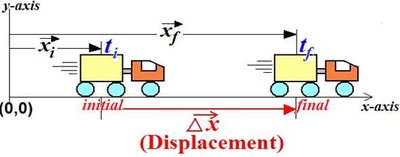
Displacement Example: The diagram below shows a truck moving from an initial position \( \vec{x}_i \) at time \( t_i \) to a final position \( \vec{x}_f \) at time \( t_f \). The displacement \( \Delta \vec{x} \) is indicated.
Distance vs. Displacement
Distance is a scalar quantity representing the total length of the path traveled, while displacement is a vector representing the straight-line change in position.
Distance: Total path length traveled, regardless of direction.
Displacement: Straight-line vector from initial to final position.
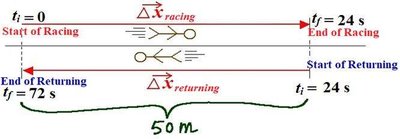
Example: In a race and return scenario, the displacement may be zero if the object returns to its starting point, but the distance is the sum of the path lengths.
Average Velocity and Speed
Average velocity is a vector quantity defined as displacement divided by the time interval. Average speed is a scalar quantity defined as total distance divided by the time interval.
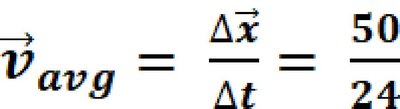
Average Velocity Formula: \( \vec{v}_{avg} = \frac{\Delta \vec{x}}{\Delta t} \)
Average Speed Formula: \( \text{Average Speed} = \frac{\text{Distance}}{\Delta t} \)
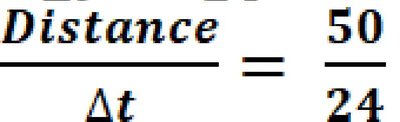
Example: If an object travels 50 m in 24 s, \( \vec{v}_{avg} = \frac{50}{24} \) m/s.
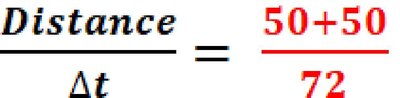
Return Trip Example: For a round trip, displacement may be zero, so \( \vec{v}_{avg} = 0 \), but average speed is nonzero.

Position-Time Graphs
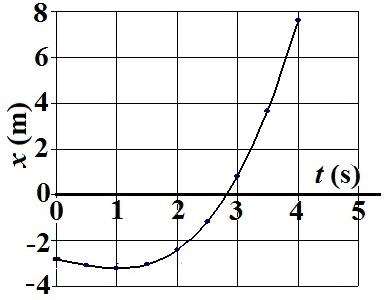
Position-time graphs show how an object's position changes over time. The slope of the graph represents velocity.
Graph Example: The graph below shows position \( x \) versus time \( t \) for an object.
Motion Representation: The diagram below shows the object's position at different times along a straight line.

Velocity-Time Graphs
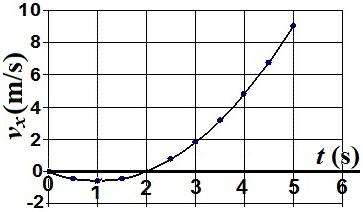
Velocity-time graphs show how an object's velocity changes over time. The slope of the velocity-time graph represents acceleration.
Graph Example: The graph below shows velocity \( v_x \) versus time \( t \) for an object.
Acceleration
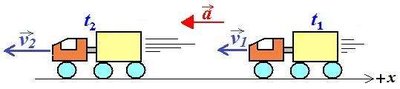
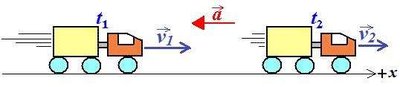
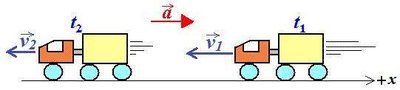
Acceleration is the rate of change of velocity with respect to time. It is a vector quantity.
Acceleration Direction: The direction of acceleration can be opposite or the same as the velocity, depending on whether the object is speeding up or slowing down.
Equations of Motion
For constant acceleration, the position and velocity of an object can be described by the following equations:
Position Equation: \( x = x_0 + v_{0x} t + \frac{1}{2} a_x t^2 \)
Velocity Equation: \( v_x = v_{0x} + a_x t \)
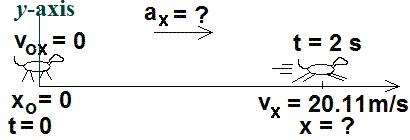
Example: The diagram below shows a cat accelerating from rest, with initial position and velocity zero, and final velocity after 2 seconds.
Multiple Objects and Relative Motion
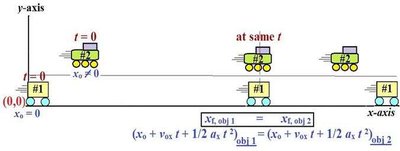
When analyzing the motion of multiple objects, their positions and velocities can be compared at the same time using the equations of motion.
Example: The diagram below shows two objects moving along the x-axis, and their positions are compared at the same time.
Piecewise Motion
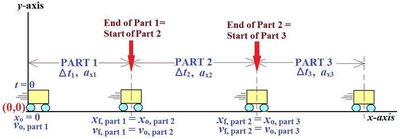
Sometimes, motion is divided into segments, each with its own acceleration and time interval. The end of one segment is the start of the next.
Example: The diagram below shows motion divided into three parts, each with different acceleration and time intervals.
Vertical Motion Under Gravity
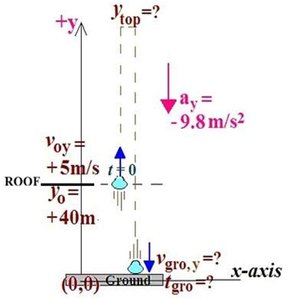
Objects moving vertically under gravity experience a constant acceleration of \( -9.8 \) m/s2. The equations of motion apply, with the y-axis as the direction of motion.
Example: The diagram below shows an object thrown upward from a roof, with initial velocity, position, and acceleration due to gravity.
Additional info: All equations are written in LaTeX format for clarity and academic rigor. The notes cover the fundamental concepts of motion along a straight line, including displacement, velocity, acceleration, and their graphical representations, as well as examples of piecewise and vertical motion.
