 Back
BackMotion Along a Straight Line: Kinematics in One Dimension
Study Guide - Smart Notes
 Tailored notes based on your materials, expanded with key definitions, examples, and context.
Motion Along a Straight Line (Kinematics in One Dimension)
Introduction to Kinematics
Kinematics is the branch of mechanics that describes the motion of objects without considering the causes of motion (forces). In this chapter, we focus on the motion of objects along a straight line, analyzing their position, velocity, and acceleration as functions of time.
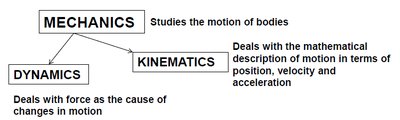
Mechanics: Studies the motion of bodies.
Kinematics: Describes motion in terms of position, velocity, and acceleration.
Dynamics: Examines the forces causing changes in motion.
We will treat moving objects as particles (point masses) and restrict our analysis to straight-line (one-dimensional) motion.
Key Parameters in Kinematics
Displacement
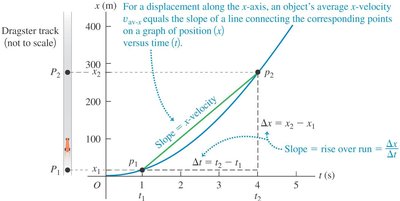
Average velocity
Average speed
Instantaneous velocity
Average and instantaneous acceleration
For constant acceleration, we will derive equations for velocity and position at any time, with special attention to motion under gravity near Earth's surface.
Describing Motion in One Dimension
Position and Displacement
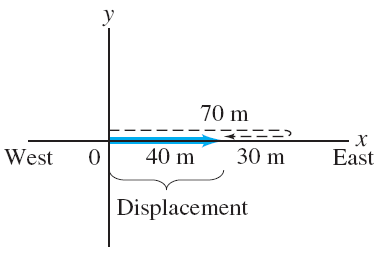
The position of an object along a straight line (the x-axis) is given by its coordinate x(t). Displacement is the change in position:
Displacement (Δx): The straight-line distance from the initial to the final position, including direction. It is a vector quantity.
Distance: The total length of the path traveled, regardless of direction. It is a scalar quantity.
Mathematically,
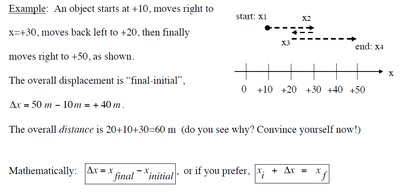
Example: An object moves from m to m, back to m, and finally to m. The displacement is m m$.
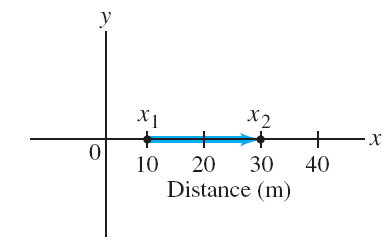
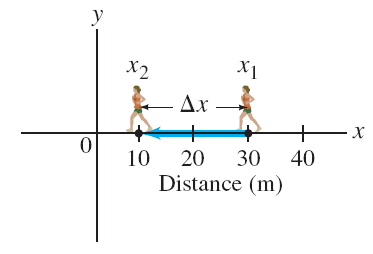
Note: The sign of displacement indicates direction. Positive displacement is in the positive x-direction; negative displacement is in the negative x-direction.
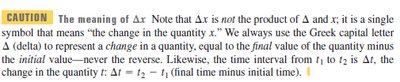
Caution: means "change in x" and is always final minus initial value. Similarly, .
Speed and Velocity
Speed: Scalar quantity; total distance traveled divided by time elapsed.
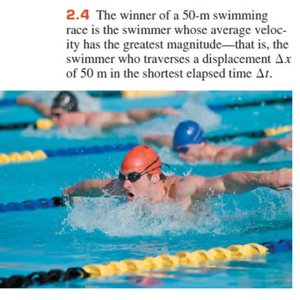
Velocity: Vector quantity; displacement divided by time elapsed. Includes direction.
Formulas:


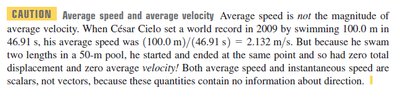
Example: If you run from to m and back to in 60 s, your average velocity is zero (displacement is zero), but your average speed is m/s.
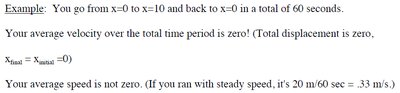
Important: Average speed is not the magnitude of average velocity. Both average and instantaneous speed are scalars and do not include direction.
Instantaneous Velocity
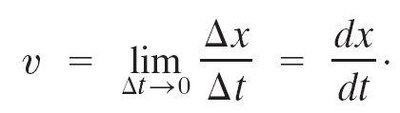
The instantaneous velocity is the velocity at a specific instant, defined as the derivative of position with respect to time:
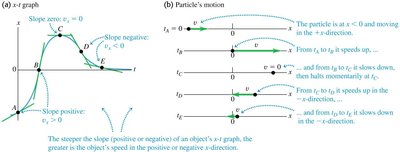
On a position-time (x-t) graph, the instantaneous velocity is the slope of the tangent to the curve at a given point.
Graphical Interpretation
The slope of an x-t graph at any point gives the instantaneous velocity.
The slope of a v-t graph gives the acceleration.
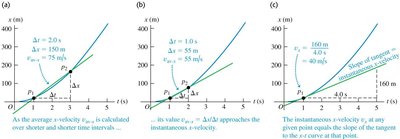
As the time interval becomes smaller, the average velocity approaches the instantaneous velocity.
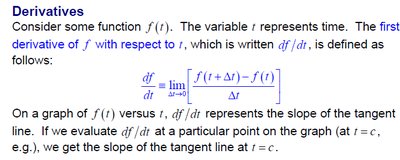
Derivatives and Integrals in Kinematics
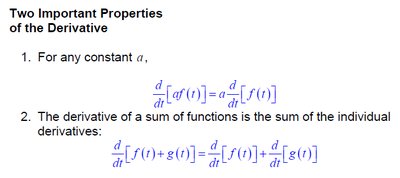
Derivatives are used to find instantaneous velocity and acceleration from position and velocity functions, respectively. For a function :
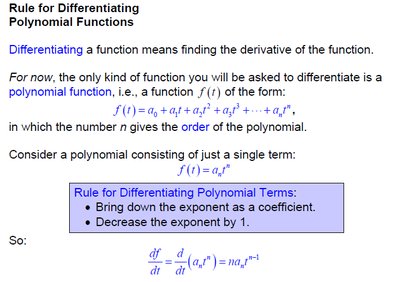
For polynomial functions, the derivative is found by bringing down the exponent and reducing it by one:
Integrals are used to find position from velocity or velocity from acceleration:
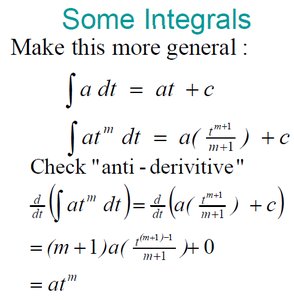
Motion Diagrams and Graphs
Motion Diagrams
A motion diagram shows the position of a particle at various instants, with arrows representing velocity at each instant. These diagrams help visualize changes in velocity and acceleration.
Interpreting Graphs
Position-time and velocity-time graphs are essential tools for analyzing motion. The area under a velocity-time graph gives displacement, while the area under an acceleration-time graph gives the change in velocity.
Freely Falling Bodies
Free Fall and Acceleration Due to Gravity
Free fall is the motion of an object under the influence of gravity alone. All objects, regardless of mass, fall with the same constant acceleration (in the absence of air resistance):
Acceleration due to gravity (g): m/s2 near Earth's surface.

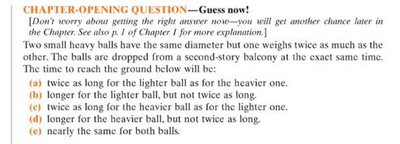
Example: Dropping two balls of different masses from the same height, they reach the ground at the same time (neglecting air resistance).
Summary Table: Key Kinematic Quantities
Quantity | Symbol | Definition | Vector/Scalar |
|---|---|---|---|
Displacement | Vector | ||
Distance | - | Total path length | Scalar |
Average velocity | Vector | ||
Average speed | - | Scalar | |
Instantaneous velocity | Vector | ||
Instantaneous acceleration | Vector |
Practice and Conceptual Questions
Which quantity is always positive: distance or displacement?
Can an object have zero velocity and nonzero acceleration? (Yes, at turning points.)
Does a heavier object fall faster than a lighter one in the absence of air resistance? (No, both fall with the same acceleration.)
Summary
Kinematics describes motion using position, velocity, and acceleration.
Displacement is a vector; distance is a scalar.
Velocity and acceleration are vectors; speed is a scalar.
Instantaneous quantities are found using derivatives; total changes can be found using integrals.
All objects in free fall (neglecting air resistance) accelerate downward at m/s2.
