 Back
Motion and Acceleration: Speed, Velocity, and Reference Frames
Study Guide - Smart Notes
 Tailored notes based on your materials, expanded with key definitions, examples, and context.
Motion and Acceleration
Speed
Speed is a measure of how fast an object is moving, defined as the distance covered per unit of time. It is a scalar quantity, meaning it has magnitude but no direction. The SI unit for speed is meters per second (m/s).
Formula: , where is speed, is distance, and is time.
Example: If an object moves 62.7 cm in 1.4 minutes, convert units as needed and apply the formula to find speed.
Velocity
Velocity describes how fast and in what direction an object is moving. It is a vector quantity, meaning it has both magnitude and direction. The SI unit is also meters per second (m/s).
Formula: , where is velocity, is displacement, and is time.
Example: A bird flying 775 m east at 23 km/h: convert units and solve for time using the velocity formula.
Comparing Speed and Velocity
Speed is only concerned with how much ground an object covers, while velocity also considers direction. Both can change over time as an object moves.
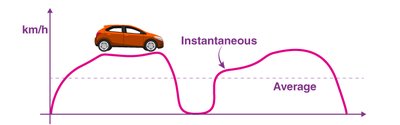
Instantaneous Velocity: The velocity at a specific instant in time.
Average Velocity: Calculated using total displacement and total time; does not reflect changes at specific moments.
Acceleration
Acceleration is the rate of change of velocity per unit of time. It is a vector quantity, with SI units of meters per second squared (m/s2).
Formula: , where and are initial and final velocities, and is time.
Example: A car accelerates from rest to 32.6 m/s east in 12 seconds: .
Instantaneous Acceleration: The acceleration at a particular instant in time. Average Acceleration: Calculated using total change in velocity over total time.
Frames of Reference
A frame of reference is a coordinate system used to describe the position and motion of objects. The choice of frame affects how motion is described.
Inertial Reference Frame: A frame that is not accelerating; the laws of physics are the same in all inertial frames.
Calculations of speed and velocity are typically done in a stationary (Earth-based) inertial frame.
Relative Motion
Motion can be described relative to different frames of reference. The velocity of an object relative to one frame can be found using vector addition:
Formula: , where is the velocity of object X relative to frame B, is velocity relative to frame A, and is velocity of frame A relative to B.
For two objects relative to Earth: .
Example: On a moving walkway (+1.1 m/s), a person walks at +0.6 m/s relative to the walkway. Their velocity relative to the ground is m/s.
Summary Table: Key Quantities in Linear Motion
Quantity | Type | SI Unit | Formula |
|---|---|---|---|
Speed | Scalar | m/s | |
Velocity | Vector | m/s | |
Acceleration | Vector | m/s2 |
Additional info:
Instantaneous values (velocity, acceleration) are found using calculus in more advanced courses, but here are introduced conceptually as values at a single moment.
Relative motion is foundational for understanding more complex systems, such as those involving multiple moving objects or non-inertial frames.
