 Back
BackMotion in a Plane and Newton's Laws: Study Notes for College Physics I
Study Guide - Smart Notes
 Tailored notes based on your materials, expanded with key definitions, examples, and context.
Motion in a Plane
Velocity and Acceleration in a Plane
Motion in a plane involves both magnitude and direction, requiring vector analysis. Velocity and acceleration are vector quantities, meaning they have both direction and magnitude. The direction of acceleration relative to velocity determines how an object's motion changes.
Velocity (\vec{v}): The rate of change of position with respect to time, directed tangentially to the path.
Acceleration (\vec{a}): The rate of change of velocity with respect to time. It can be decomposed into components parallel and perpendicular to velocity.
Parallel Component: Changes the object's speed.
Perpendicular Component: Changes the object's direction.
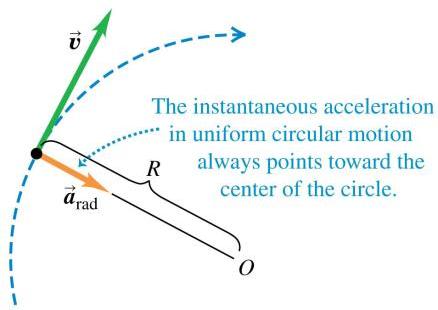
Uniform Circular Motion: Acceleration is always perpendicular to velocity, pointing toward the center of the circle.
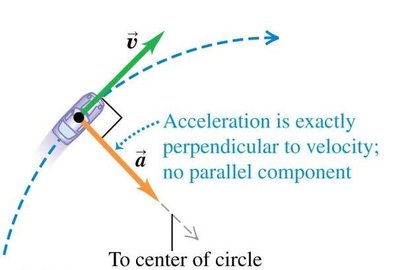
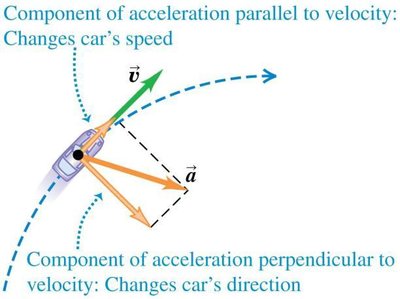
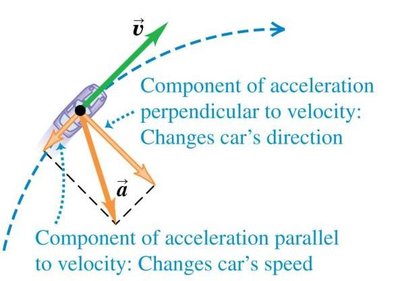
Uniform Circular Motion
Uniform circular motion occurs when an object moves at constant speed along a circular path. The acceleration, called centripetal acceleration, always points toward the center of the circle and is responsible for changing the direction of velocity.
Centripetal Acceleration (a_{rad}): The magnitude is given by , where v is speed and R is radius.
Period (T): The time for one complete revolution.
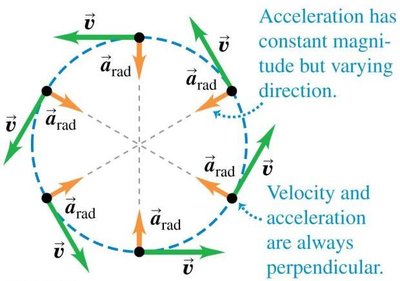
Velocity and acceleration are always perpendicular in uniform circular motion.
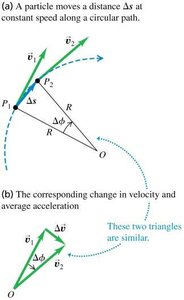

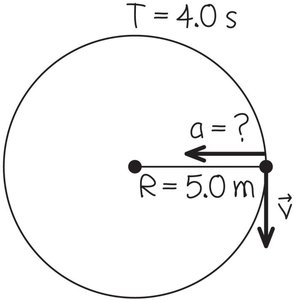
Example: Acceleration in a Vertical Circle
Consider passengers in a carnival ride moving in a circle of radius 5.0 m, completing one revolution in 4.0 s. The acceleration is calculated using the formulas for velocity and centripetal acceleration.
or
Properties of Uniform Circular Motion
In uniform circular motion, the magnitude of acceleration remains constant, but its direction continuously changes, always pointing toward the center. Velocity and acceleration vectors are always perpendicular.
Constant speed, changing direction.
Acceleration is centripetal, directed radially inward.
Projectile Motion
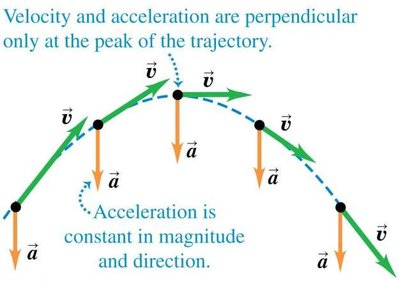
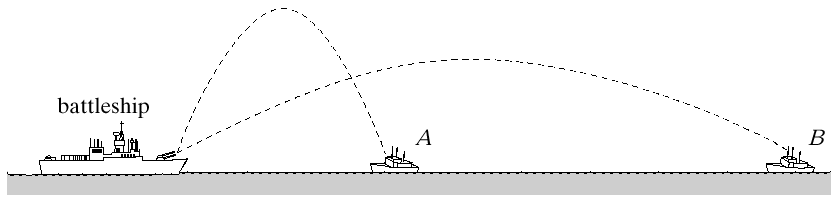
Projectile motion describes the path of an object launched into the air, subject only to gravity. The trajectory is parabolic, and velocity and acceleration vectors change throughout the motion.
Velocity and acceleration are perpendicular only at the peak of the trajectory.
Acceleration due to gravity is constant in magnitude and direction.
Newton's Laws of Motion
Force and Interactions
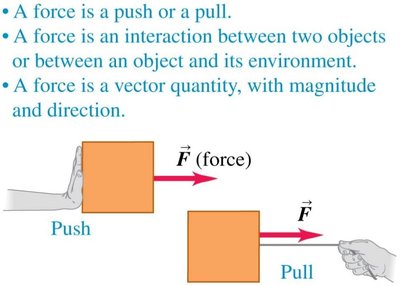
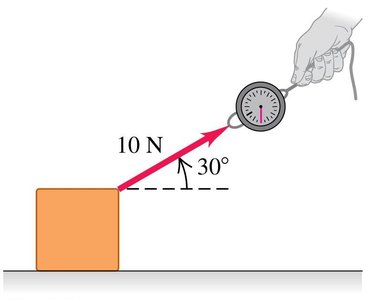
Force is a fundamental concept in physics, describing the interaction between objects or between an object and its environment. Forces can be contact or long-range, and are vector quantities with both magnitude and direction.
Contact Forces: Arise from physical contact (e.g., normal force, friction, tension).
Long-Range Forces: Act over a distance (e.g., gravitational, magnetic).
SI Unit: Newton (N), where .
Types of Forces
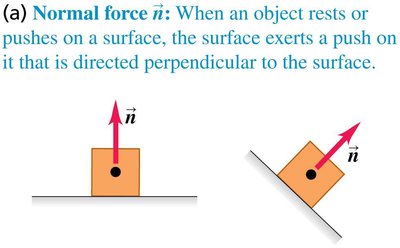
Normal Force (\vec{n}): Exerted by a surface, acts perpendicular to the surface.
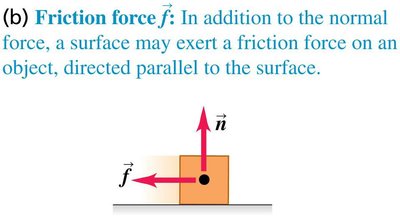
Friction Force (\vec{f}): Acts parallel to the surface, opposes motion.
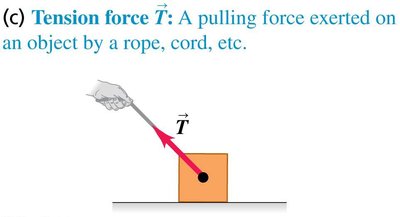
Tension Force (\vec{T}): Pulling force exerted by a rope or cord.
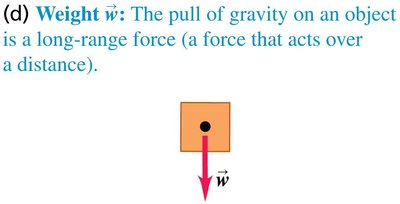
Weight (\vec{w}): Gravitational force exerted by the Earth, acts downward.
Magnitude of Forces
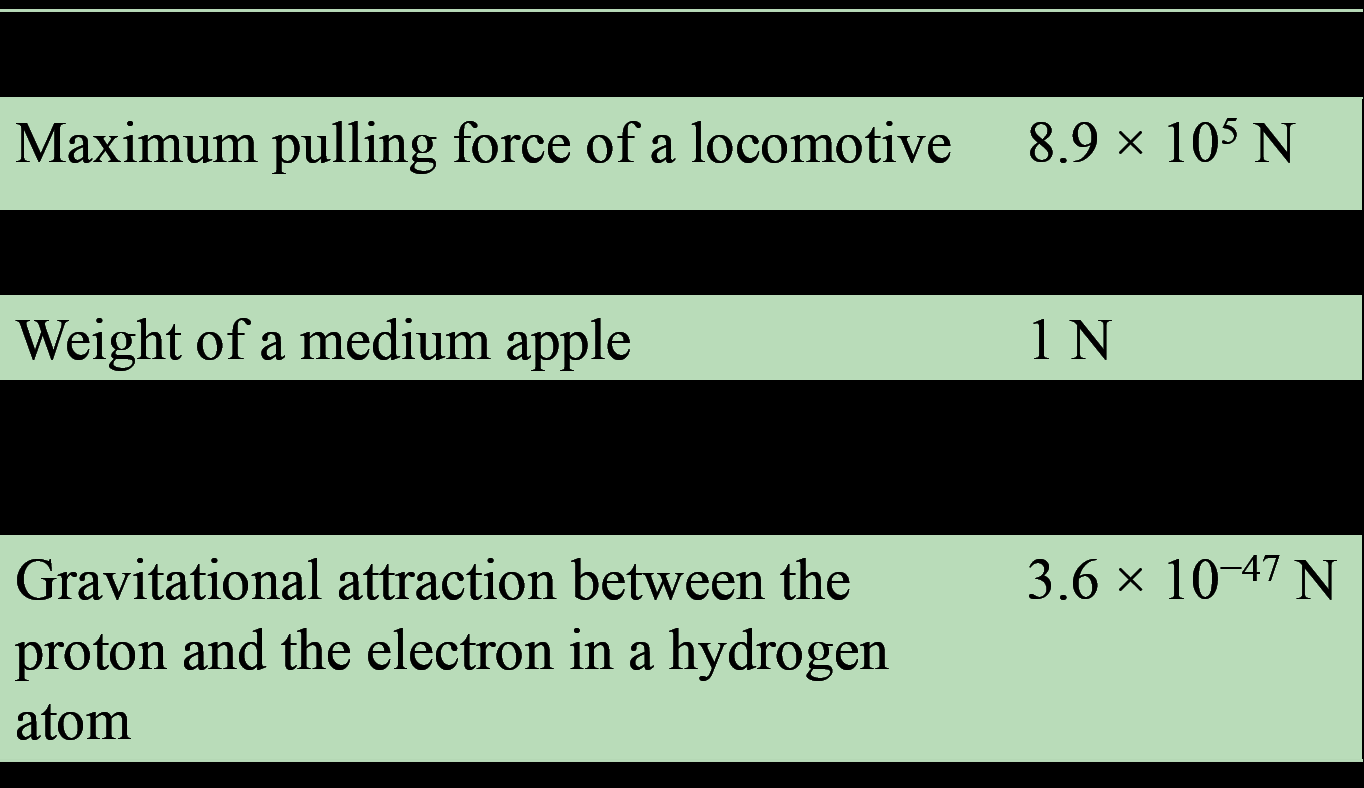
Forces can vary greatly in magnitude, from everyday objects to atomic interactions. The table below compares typical force magnitudes.
Situation | Force (N) |
|---|---|
Maximum pulling force of a locomotive | |
Weight of a medium apple | 1 |
Gravitational attraction between proton and electron in hydrogen atom |
Superposition of Forces
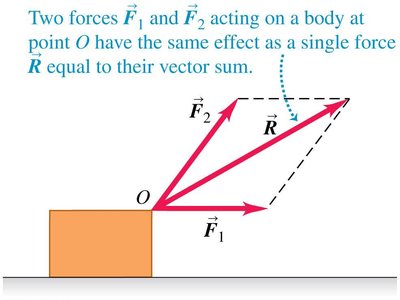
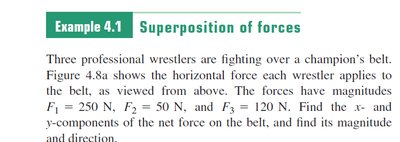
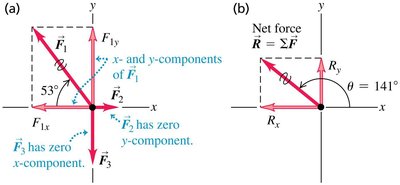
When multiple forces act on an object, their combined effect is equivalent to the vector sum of all individual forces, called the resultant or net force.
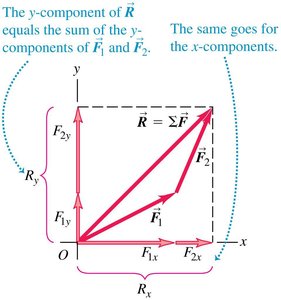
Resultant Force (\vec{R}): The vector sum of all forces acting on an object.
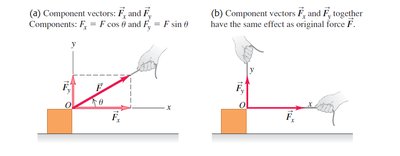
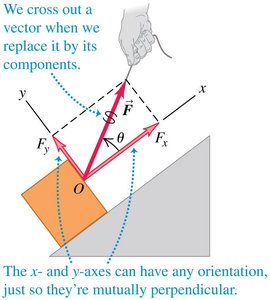
Forces can be decomposed into components along perpendicular axes (x and y).
Use trigonometry to find force components: , .
Newton's Three Laws of Motion
Newton's laws form the foundation of classical mechanics, describing the relationship between forces and motion.
First Law (Law of Inertia): An object remains at rest or in uniform motion unless acted upon by a net external force.
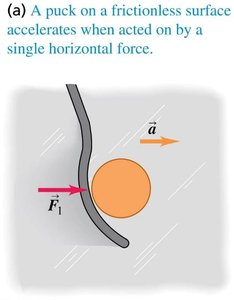
Second Law: The acceleration of an object is proportional to the net force and inversely proportional to its mass.
Third Law: For every action, there is an equal and opposite reaction.


Newton's First Law: Inertia and Equilibrium
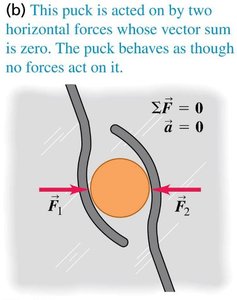
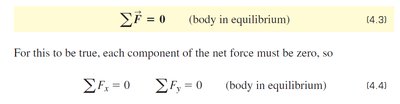
Inertia is the tendency of an object to resist changes in its state of motion. A body is in equilibrium when the net force acting on it is zero.
Equilibrium:
Each component must be zero: ,


Newton's Second Law: Mass and Acceleration
When a net force acts on a body, it accelerates in the direction of the net force. Mass is a quantitative measure of inertia, and the unit of mass is kilogram (kg).
Inertial mass: Ratio of net force to acceleration.
Formula:
Mass and Weight
The weight of an object is the gravitational force exerted by the Earth. The value of gravitational acceleration (g) depends on altitude and location.
Weight:
On other planets, g differs from Earth's value.
Non-Zero Net Force and Acceleration
When the net force on an object is not zero, the object accelerates in the direction of the net force. The magnitude and direction of acceleration are determined by the net force and the object's mass.
Formula:
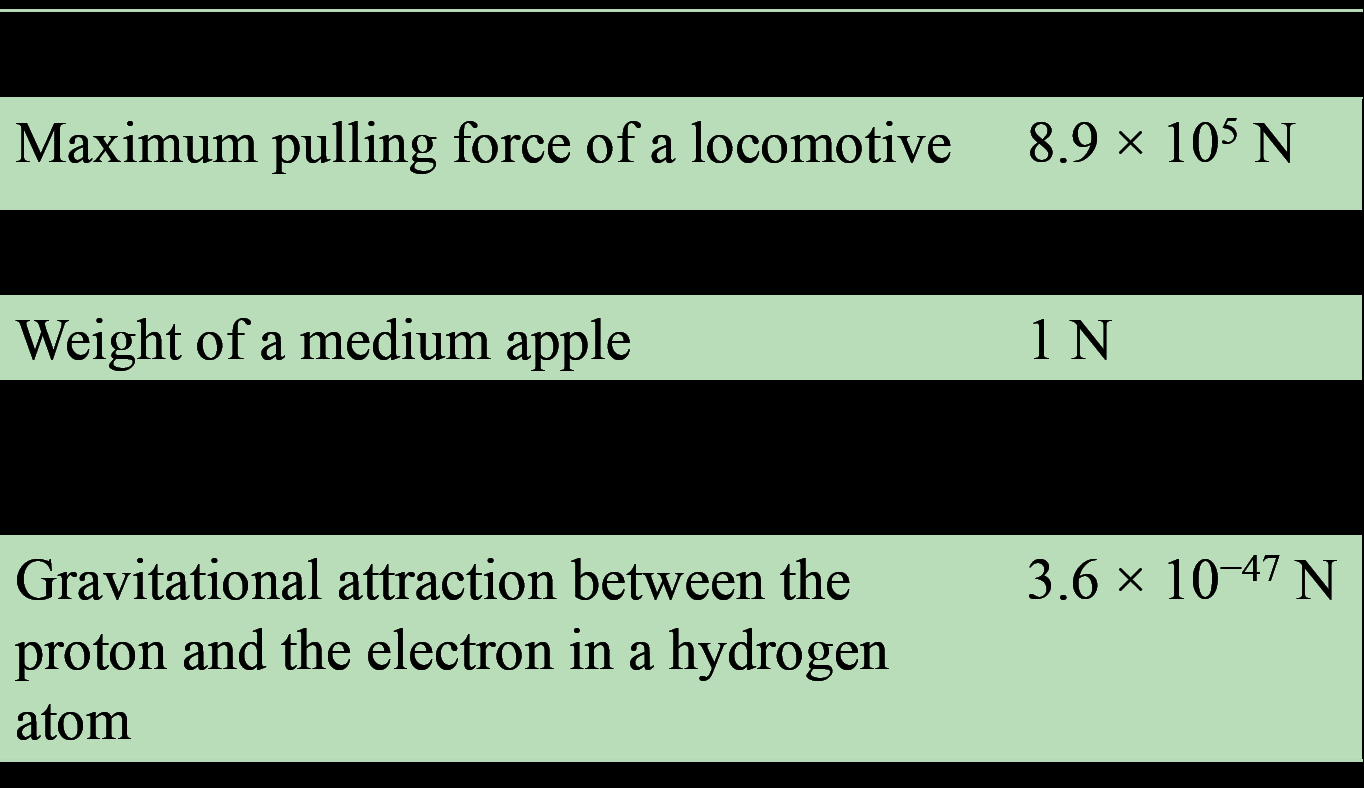
Summary Table: Typical Force Magnitudes
Situation | Force (N) |
|---|---|
Maximum pulling force of a locomotive | |
Weight of a medium apple | 1 |
Gravitational attraction between proton and electron in hydrogen atom |
Additional info: Academic context and expanded explanations have been added to ensure completeness and clarity for exam preparation.
