 Back
BackMotion in One Dimension: Concepts, Graphs, and Vectors
Study Guide - Smart Notes
 Tailored notes based on your materials, expanded with key definitions, examples, and context.
Motion in One Dimension
Overview
This chapter introduces the fundamental concepts of motion in one dimension, focusing on how to model, represent, and analyze the movement of objects along a straight line. Key topics include position, displacement, distance, speed, velocity, and the use of vectors and graphs to describe motion.
2.1 From Reality to Model
Physics often uses models to simplify and represent real-world phenomena. In the context of motion, a model helps us analyze how an object's position changes over time.
Model: A simplified representation of a real-world system.
To analyze motion, we track the object's position at different times.
If position does not change, the object is at rest; if it changes, the object is moving.
Reference Axes and Origin
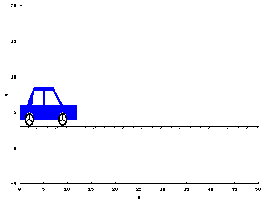
To measure position, we need a reference axis (an imaginary straight line) and an origin (a reference point from which measurements are made).
Position is measured from the origin to the center of the object.
Representing Position with Graphs
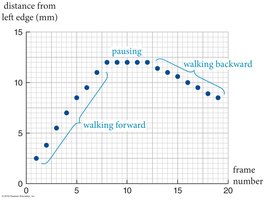
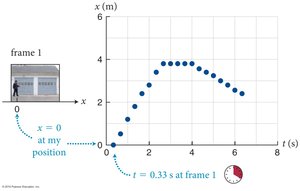
Position can be represented graphically, typically with position on the vertical axis and time on the horizontal axis. The graph provides a visual model of motion.
Increasing distance from the origin: object moves away.
Constant distance: object is at rest.
Decreasing distance: object moves toward the origin.
Calibration and Real-World Interpretation
To relate model measurements to real-world distances, calibration is necessary. This involves knowing the ratio between model units and actual distances.
Position as a Function of Time
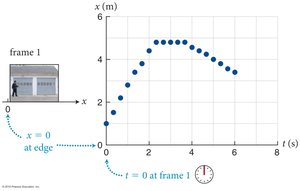
Position is often described as a function of time, x(t). The graph of x versus t allows us to determine the position at any instant and to analyze how position changes over time.
Two reference points: starting position and starting time.
Changing the origin or starting time does not affect the relative motion.
2.2 Distance vs. Displacement
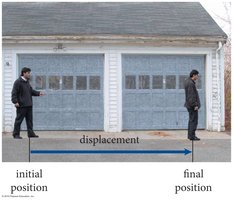
Displacement is a vector quantity representing the change in position from the initial to the final point. Distance is a scalar quantity representing the total path length traveled, regardless of direction.
Displacement (Δx): (can be positive, negative, or zero)
Distance: Always positive; sum of all path segments traveled.
Zero displacement does not mean zero distance traveled.
Practice Example
If you take 2 steps forward and 3 steps backward (1 step = 1 m):
Displacement:
Distance:
2.3 Representing Motion with Graphs
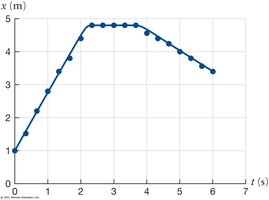
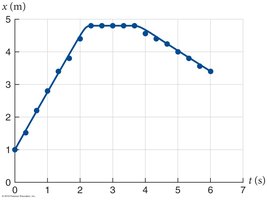
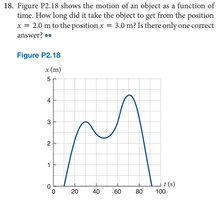
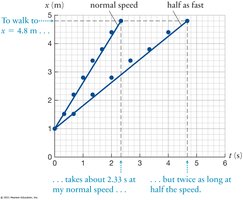
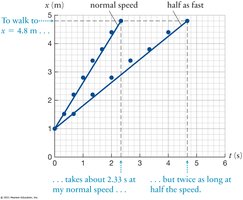
Motion can be represented by plotting position at various times and interpolating between points to form a continuous curve x(t). This curve allows us to predict position at any time and to extract information such as the time taken to move between two positions.
Extracting Information from Graphs
To find position at a given time: draw a vertical line at the desired time and read the corresponding position.
To find the time at which a position is reached: draw a horizontal line at the desired position and read the corresponding time.
2.4 Average Speed and Average Velocity
Average speed is the total distance traveled divided by the total time taken. Average velocity is the displacement divided by the time interval.
Average speed:
Average velocity:
Average velocity can be positive or negative, depending on direction.
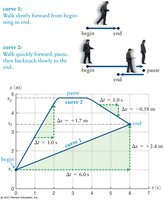
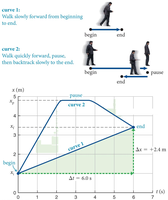
Example: Average Velocity Calculation
Displacement:
Time interval:
Average velocity:
2.5 Scalars and Vectors
Scalars are quantities described by magnitude and unit only (e.g., distance, temperature). Vectors have magnitude, unit, and direction (e.g., displacement, velocity).
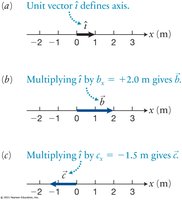
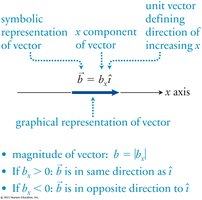
Vectors in one dimension are specified by an algebraic sign (positive or negative).
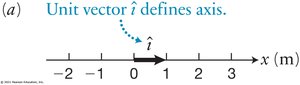
Unit vectors (e.g., ) are used to indicate direction along an axis.
2.6 Position and Displacement Vectors
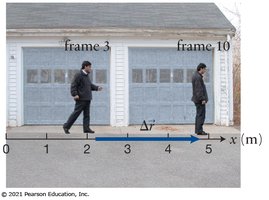
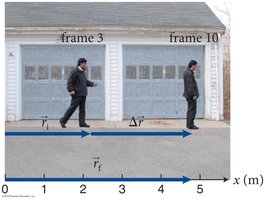
Displacement can be represented graphically as an arrow from the initial to the final position. The position vector points from the origin to the object's location.
Displacement:
Distance: (always positive)
Final position:
Vector Addition and Subtraction
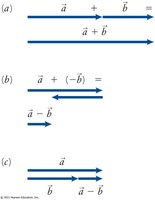
Vectors are added by placing the tail of one at the tip of the other. To subtract, reverse the direction of the vector being subtracted and add.
Summary Table: Scalars vs. Vectors
Quantity | Scalar | Vector |
|---|---|---|
Distance | Yes | No |
Displacement | No | Yes |
Speed | Yes | No |
Velocity | No | Yes |
Key Equations
Displacement:
Distance:
Average speed:
Average velocity:
Applications and Examples
Analyzing motion graphs to determine when an object is at rest, moving forward, or moving backward.
Using position-time graphs to extract displacement and velocity information.
Distinguishing between scalar and vector quantities in physical problems.
