 Back
BackMotion in One Dimension: Structured Study Notes
Study Guide - Smart Notes
 Tailored notes based on your materials, expanded with key definitions, examples, and context.
Motion in One Dimension
Representing Position
In one-dimensional motion, position is typically represented along a straight line, using either the x-axis for horizontal motion or the y-axis for vertical motion. The positive direction is conventionally to the right (x-axis) or upward (y-axis).
Position: The location of an object at a particular time, denoted as x (horizontal) or y (vertical).
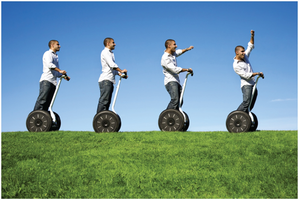
Motion Diagram: Each dot represents the object's position at a specific time.
Quantitative Representation: Tables and graphs (x vs. t) are used to analyze motion.
From Position to Velocity
The slope of a position-versus-time graph indicates the velocity of the object. Steeper slopes correspond to faster speeds.
Velocity: The rate of change of position with respect to time.
Graphical Interpretation: The slope at any point on the position-time graph gives the instantaneous velocity.
Direction: Positive slope = motion to the right/up; negative slope = motion to the left/down.
Interpreting Position-vs-Time Graphs
Position-versus-time graphs provide information about an object's motion, including position, velocity, and direction.
Position at time t: Read directly from the graph.
Velocity at time t: Find the slope at that point.
Direction: Determined by the sign of the slope.
From Position to Velocity: Velocity Graphs
Velocity-versus-time graphs can be deduced from position-versus-time graphs. They offer another way to represent motion.
Velocity Graph: Shows how velocity changes over time.
Relationship: The slope of the position graph at each point corresponds to the value on the velocity graph.
From Velocity to Position
Position-versus-time graphs can be constructed from velocity-versus-time graphs. The sign and magnitude of velocity determine the slope and steepness of the position graph.
Positive velocity: Positive slope.
Negative velocity: Negative slope.
Magnitude: Steeper slope for larger velocity.
Uniform Motion
Uniform motion refers to straight-line motion with constant velocity, where equal displacements occur during equal time intervals.
Uniform Motion: Position-versus-time graph is a straight line.
Equation:

Equations of Uniform Motion
The velocity in uniform motion tells us how much the position changes each second.
Position Equation:
Displacement:
From Velocity to Position: Area Under the Curve
The displacement of an object is equal to the area under the velocity-versus-time graph during a given time interval.
Displacement:
Instantaneous Velocity
Instantaneous velocity is the velocity of an object at a specific instant in time. It is found by calculating the slope of the tangent to the position-time curve at that point.
Definition: Velocity at a specific instant.
Graphical Method: Slope of the tangent line to the curve.
Calculation:
Displacement from Velocity Graphs
Even when speed varies, the area under the velocity-versus-time graph gives the displacement.
Displacement:
Acceleration
Acceleration describes how an object's velocity changes over time. It is defined as the rate of change of velocity.
Definition:
Units: meters per second squared (m/s2)

Representing Acceleration
Acceleration is represented as the slope of the velocity-versus-time graph. An acceleration graph can be constructed from a velocity graph.
Graphical Representation: Slope of velocity-time graph.
Acceleration Graph: Shows how acceleration changes over time.
The Sign of the Acceleration
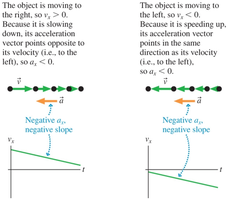
The sign of acceleration depends on both the direction of motion and whether the object is speeding up or slowing down.
Negative acceleration: Can mean slowing down or speeding up, depending on direction.
Positive acceleration: Can mean speeding up or slowing down, depending on direction.
Motion with Constant Acceleration
When acceleration is constant, the velocity-time graph is a straight line, and the displacement can be found as the area under the velocity-time graph.
Velocity Equation:
Displacement Equation:
Relative velocity and displacement:
Free Fall
Free fall occurs when an object moves under the influence of gravity only. All objects in free fall have the same acceleration, regardless of mass.
Definition: Motion under gravity alone.
Acceleration: (on Earth)
Direction: Always points downward.
Equations: Use constant acceleration kinematics with for downward motion.

Problem-Solving Approach
Solving physics problems involves four steps: strategize, prepare, solve, and assess.
Strategize: Identify the type of problem and general approach.
Prepare: Gather information, draw diagrams, and do preliminary calculations.
Solve: Perform mathematical calculations to find the answer.
Assess: Check if the answer makes sense, has correct units, and fits the context.
Summary Table: Kinematic Equations for Constant Acceleration
The following table summarizes the key equations for one-dimensional motion with constant acceleration:
Equation | Description |
|---|---|
Velocity as a function of time | |
Position as a function of time | |
Velocity-position relationship | |
Displacement |
Applications and Examples
Soccer ball kicked toward goal: Use uniform motion equations to determine time for defender to block.
Car braking to a stop: Use constant acceleration equations to find stopping distance.
Rocket launch: Use kinematic equations to find speed and distance after a given time.
Free fall experiments: Use to calculate time and velocity for falling objects.
Additional info:
All equations are valid for one-dimensional motion and can be adapted for vertical or horizontal cases.
For free fall, air resistance is neglected unless otherwise specified.
