 Back
Motion in One Dimension: Velocity, Acceleration, and Freely Falling Bodies
Study Guide - Smart Notes
 Tailored notes based on your materials, expanded with key definitions, examples, and context.
Motion in One Dimension
Velocity and Position by Integration
In kinematics, the relationship between acceleration, velocity, and position can be described using calculus. If the acceleration as a function of time, a(t), is known, the velocity and position functions can be determined by integration.
Velocity from Acceleration: The velocity at time t is found by integrating acceleration:
Position from Velocity: The position at time t is found by integrating velocity:
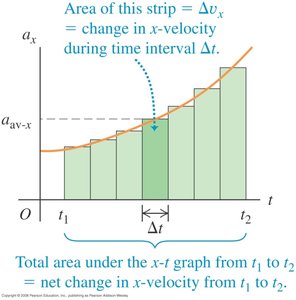
Additional info: The area under the acceleration-time graph between two times gives the change in velocity over that interval.
Motion with Constant Acceleration
When acceleration is constant, the equations of motion can be derived directly using calculus. These equations are fundamental for analyzing linear motion under uniform acceleration.
First Equation (Velocity-Time):
Second Equation (Position-Time):
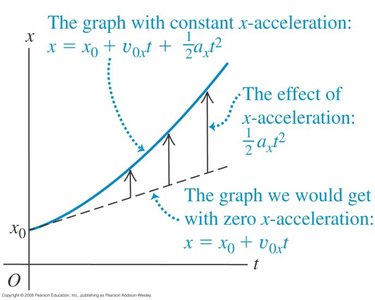
Third Equation (Velocity-Position, Time Eliminated):
Average Velocity (for constant acceleration): The average velocity is the arithmetic mean of the initial and final velocities:
Summary Table of Constant Acceleration Equations:
Equation | Excluded Variable | Included Variables |
|---|---|---|
x | v, v_0, a, t | |
v | x, x_0, v_0, a, t | |
t | v, v_0, a, x, x_0 |
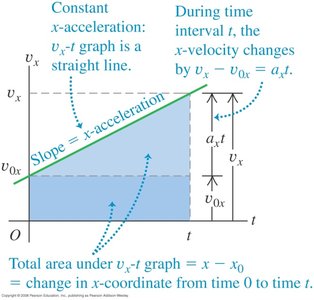
Additional info: The area under the velocity-time graph gives the displacement, and the slope of the velocity-time graph gives the acceleration.
Freely Falling Bodies
Objects in free fall experience constant acceleration due to gravity, denoted as g. On Earth, g = 9.80 \pm 0.02 \text{ m/s}^2. The equations of motion for free fall are the same as those for constant acceleration, with a = -g (downward direction).
Key Points:
All objects fall with the same acceleration in the absence of air resistance (Galileo's principle).
Common values: Earth (g = 9.80 \text{ m/s}^2), Moon (g = 1.60 \text{ m/s}^2), Sun (g = 270 \text{ m/s}^2).
Example 1: Dropping a Ball from a Height
Suppose a ball is dropped from a height of 16 m. To find the time it takes to hit the ground, use:
Given: m, ,
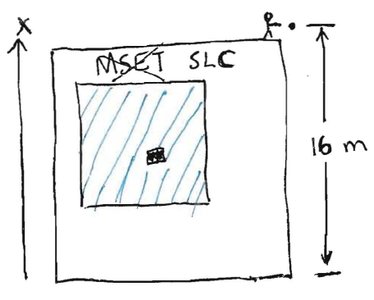
Example 2: Throwing a Ball Upward
If a ball is thrown upward at 10 m/s, the time to reach maximum height is found by setting final velocity to zero:
Set , solve for :
Example 3: Speed When Returning to Ground
To find the speed when the ball returns to the ground (after being thrown upward from 16 m):
Plug in m/s, m, , .
Example 4: Time to Hit the Ground (Thrown Upward)
To find the total time until the ball hits the ground after being thrown upward from a height, solve the quadratic equation:
This leads to a quadratic in :
Use the quadratic formula to solve for .
Summary
Integration connects acceleration, velocity, and position.
Constant acceleration leads to three key kinematic equations.
Freely falling bodies are a special case of constant acceleration motion.
Graphical analysis (area under curves, slopes) provides physical meaning to the equations.
